Also with James
C-Realm Radio 056 →
Public audio available

2021-12-14
KMO talks with James, a long-time listener to and supporter of the C-Realm Podcast about Doomerism, what makes it so attractive, and what got him out of it. Recorded in Eureka Springs, Arkansas.
Open the formatted reading edition →
Reading edition · Approved reading edition. Edited for punctuation, paragraphing, repeated words, fillers, and obvious transcription errors; more than half of the machine transcript of the conversation was unpunctuated and was repunctuated with an automated punctuation model, then checked by eye. Speaker attribution is based on conversational context, checked at key turn boundaries with a simple automated voice comparison; no full audio listen has been done, and short or ambiguous turns are marked as uncertain. Opinions and factual claims are the speakers’ own, as of December 2021. The conversation was recorded in person in Eureka Springs, Arkansas. James’s written addendum, read by KMO, follows the conversation. No Vault continuation is identified for this episode.
“If you speak the truth, have a foot in the stirrup.” — Opening quotation
KMOHello, and welcome to another installment of the C-Realm Podcast. I’m your host, KMO, and this is episode number 577, “The Thing at the Window,” with guest James. Prepared for release onto the World Wide Web on Monday, December 14th, 2021.1 And for those of you who are tuning into this podcast for the first time, and I don’t expect for there to be a lot of you, but for those in that position, I started this podcast back in October of 2006. At the time, I was living in Gravette, Arkansas, having moved there from Fayetteville, Arkansas, having moved there from where I am now, Berryville, Arkansas. But since I started the podcast in Gravette, it, and I have since lived in, well, one other place in Arkansas, and then Maryland, Tennessee, New York City, Vermont, and now here I am back in Arkansas. This time I’m at my mom’s place in Berryville, Arkansas.
So in that time, I’ve gone down a deep rabbit hole and come out again. When I started the podcast, I was against the drug war. Still am, but you know, it doesn’t occupy a lot of my thoughts like it used to. I was enthusiastic about the prospects for nanotechnology, artificial intelligence, genetic engineering, all the stuff that you might think of as being the ingredients for a techno-utopian mindset. I was also very captivated by the lyrical ravings, you might say, of Terence McKenna, which included his prediction that on December 21st, 2012, we would experience a maximal peak in novelty, you know, the historical novelty that he had developed the time wave zero to chart out, that that was going to come to such a head on the 21st of December, 2012, that it would basically be the singularity. Although that wasn’t the word he was using, he was using the word concrescence.
But then soon after I started the podcast, I discovered that I wasn’t really interested in talking much about the drug war. I wasn’t really interested in entertaining any arguments in favor of it, really. And I thought that if after a couple of conversations or episodes on the topic, if you still thought the drug war was a good idea, you probably weren’t going to be interested in the sorts of media that I would be producing. So that topic just sort of fell by the wayside. The people that I wanted to talk to about technological issues, they didn’t answer my email invitations. Who did answer my email invitations? Well, one, Dmitry Orlov, who set me on the path to peak oil and the peak oil obsession. This idea that the world was going to be reduced to a pre-industrial status in short order. Nobody, or almost nobody, was prepared for it.
And worst of all, the powers that be knew about it and were keeping it from us. You might argue, I mean, if you’re a petroleum geologist, you might say that peak oil is just a fact. It’s not a conspiracy theory, but there definitely was a conspiracy theory element to it in the way that I discovered it. Fast forward many years. The fast collapse of industrial civilization from a lack of fossil fuel energy has not occurred. If I could go back to 2006 and tell myself, hey, I’m from the year 2021. The lights are still on. Cars are still running. Gasoline is available everywhere you look. And yeah, it’s expensive, but it’s not in your top 10 list of worries. Focus on something else. If I could see the world of 2021 back in 2006, I would not have taken peak oil seriously. Maybe as a sort of abstract intellectual exercise, but certainly not as this looming thing that was going to disrupt everybody’s lives, whether or not they were willing to muster the courage to look it in the eye and face it as it came down on them, or whether they were just going to distract themselves with trivialities and shopping and status contests.
The person that you’re going to hear from in today’s episode of the podcast is somebody who, like me, was interested in psychedelics. He was also very caught up in the poetic ramblings of Terence McKenna. He was a regular listener to the Psychedelic Salon podcast. And thanks to Lorenzo, for years, there was a link, a prominent link to the C-Realm podcast on the Matrix Masters homepage. So if you discovered the Psychedelic Salon podcast, you were quite likely to have also discovered the C-Realm podcast in 2006, 2007, 2008. So somebody who came into the C-Realm on that vector, James, is about to tell his story. So I first heard from James back in 2011, and I know that because I just searched through my Gmail inbox for his email address, and the first message that I received from him 55 messages ago was from 2011, and it’s just an introduction.
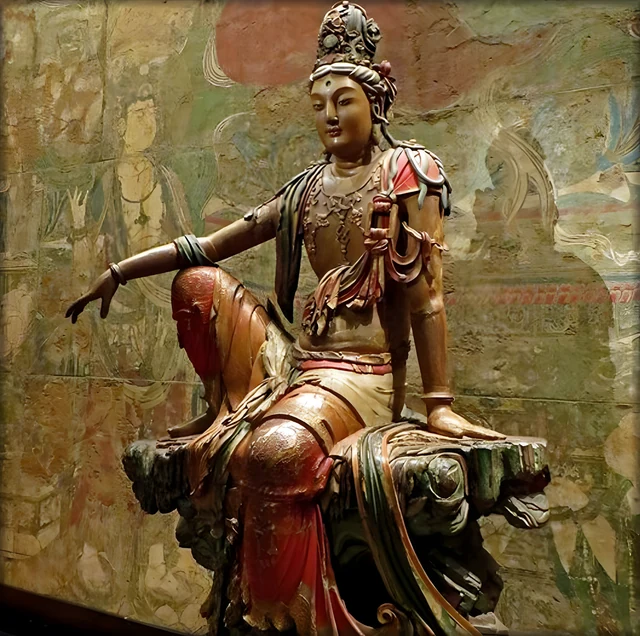
I haven’t reread it, actually, but I just spent quite a bit of time with James, so I don’t really need to, you know, ground myself in who he presented himself as. And, you know, I have a very fresh impression of the person from face-to-face, real-world interaction. But James and I have been to a lot of the same places, specifically Kansas City, Missouri, Columbia, Missouri, which is where the University of Missouri is, Mizzou. We both went to school there. And right near the Kansas City Art Institute, where I have spent some time, I spent some time there in my youth, right across the street from that is the William Rockhill Nelson Museum of Art,2 which has an amazing Asian art collection, including this fabulous wooden statue of the Bodhisattva Guan Yin. And it is Guan Yin and that particular representation of Guan Yin that is the cover art for this episode.
I have basked in front of that statue in a psychedelically enhanced state, as has James, I believe, although we didn’t know each other at the time. But at one point, I’m going to make a reference to across the street from the Art Institute at the Nelson. That is the William Rockhill Nelson Museum of Art. All right, here is my conversation with James.
Program identification: “You’re listening to the C-Realm Podcast. C stands for consciousness.”
KMOAll right. Well, I am in Eureka Springs with fellow Gen Xer, James. And it’s miniature doomsday in the crypto markets, has been for a few days. But in terms of the sorts of doom that I was talking about in the C-Realm Podcast for years, seems like we’re pretty far from it. What are your thoughts on doom?
JamesI was kind of raised on doom. You know like to me doom is like a personal psychology that goes about as deep as it gets in my mind.
KMOSo was it religious doom that you were raised on?
JamesYeah, that was the kind of overarching structure, was that it was contextualized in a religious framework, yes, but it was just very real to my family. As I got older, I realized that when other people said they were religious or they’re Christians or they go to church, that meant a certain thing to them and had a certain reality. But it didn’t mean that you were kind of like fever pitched, you know, into that and that everything about your life was defined by that kind of thinking.
KMOSo what was— when you talk about your family, are you talking about nuclear family or an extended family?
JamesNuclear family and then some of the family surrounding that. Like, my grandfather was the kind of patriarch figure for the religious community. There was an actual church, like an institutional church, that they were part of when I was very young, but then when I was nine they broke off from that. I started meeting in each other’s homes and it was like just like five families that were all together, but they were all my family, like aunts and uncles, cousins and whatnot.
KMODid you all live nearby?
JamesI was born in Fort Smith, Arkansas, but we I grew up in a small town in Oklahoma, southeastern Oklahoma. So yeah, in this region this looks like where I grew up exactly.
KMOAnd did those five families live in one place?
JamesThey all lived in the same town. My grandfather owned a business that many of them worked at and they were very close. And then when I was, let’s see, seven, my grandfather started getting these prophecies. They believed in modern day revelation that the spirit or Jesus or God or various you know figures could speak through people. So, but they started getting these specific messages to my grandfather that defined them as one of the lost tribes of Israel from the Bible that had this modern purpose, which was to prepare for the end of the world, the apocalypse. And so then from then when I was, you know, nine to 12 or so, that started evolving more. And by the time I was 15, they were told to everybody to sell their businesses and their houses and go and buy land and live together and form this community that would be the preparation for the end times.
KMOHow old were you at the time?
JamesWhen we finally moved and set up shop in that endeavor. They actually sort of tried it once before that, when I was like 13, and they bought a piece of land and built all these homes, but then, before they could even really move in, they were told to change course and go somewhere else. So then when I was 15, they went to where they ended up, which was in oh near Kansas City area.
KMOWould it be fair to call it a compound?
JamesYeah, yeah, they first built a community building that looks pretty identical to the pyramids in Central America. It’s built into the earth like that and just has like one entrance and no windows and a basement full of every kind of provision. They were preppers before that was a thing.
KMOSo that was a full-on doomsday.
JamesI don’t know the right terminology, but yeah, sounds right.
KMOIt sounds kind of like a bunker.
Speaker uncertainNo windows, no cupboards.
JamesYeah, they were expecting Mad Max-type scenarios. They were expecting Raiders, maybe a nuclear war, just whatever level of catastrophe, however far you take it, including, you know, divinely sanctioned. You know. So I mean, this isn’t any kind of random craziness. I mean this is the end, you know. So roll out the, you know, dark horses or whatever, you know, the apocalyptic imagery is for, you know, the worst-case scenario, and this was—
KMOWas prophecy given to your grandfather?
JamesYes.
KMOOr it came through him? Was there a time frame? Of when it was supposed to happen?
JamesYeah. Soon.
KMOSoon. So. And you were 15 by the time your family took up residence in the compound. So that’s nearly old enough to say, I’m out of here. How long did you stick with it?
JamesIt is. Except I mean it was an odd kind of situation because I mean everything I’m saying it probably sounds like some kind of David Koresh, like I don’t know what it sounds like, but the odd thing was is like to outward observer, you wouldn’t know any of this was really going on. I mean it’s amazing how people can compartmentalize, because I mean, my grandfather owned a bank. All these people had jobs and were successful and acted fairly normal. It’s just that they were having this, it’s like they were all trippin, you know, but on some kind of bad acid like that, it’s like they’re tripping, but they were letting themselves be susceptible to a lot of fear and just feeling very unpowered and afraid. I mean I was raised in such a culture of paranoia and fear.
I mean it’s unbelievable and even like really trippy. I guess when I went I said that word and I kind of thought of them that way, like that’s how it’s, like that was how my whole childhood, because they were like casting out spirits and, you know, saying that people were possessed and you know, like making this all so real that you know there’s demons all around you and yet like not giving us any tools to work with, like you’re completely helpless, bliss [wording unclear]. All you have is your faith that God or [wording unclear] will intervene, just a kind of hope and a prayer. Literally that’s all you have. But yet they would like go and have jobs and talk to people like normal and like you’d never know all this stuff. So it was a odd head trip. So I mean, yeah, I wanted to be away from it, but I mean I wasn’t like.
I was also like kind of crazy myself and like— like, I literally wasn’t sure what reality was. I mean, I wanted to find out. As a young person, I mean, we had a community college in the town I grew up in. And I remember, you know, going to that as a really young person and trying to find things where I could be like, what’s really happening? What is reality, I mean, and being having a interest, my mind would go towards the supernatural, because that was, I mean, that’s all I knew. And so I remember finding Robert monroe’s book Journeys Out of the Body, I think it’s called, from like the early ’70s, and that made a big impression on me and I’m like I want to have an out-of-body experience and like, prove what if this stuff is really real, you know or not, and like.
And then I got older and I got into psychedelics and I was like obsessed with, like opening the doors and trying to find out what’s real, and with spirits and all this stuff. And I mean I went down rabbit holes and it wasn’t necessarily healthy for me. So all that’s all in the midst of me, still living with my parents, you know, like I’m saying you know, so I was searching and flailing around and just being a crazy person and trying to be sane. I thought I wanted to be a philosopher, but I could. I had no idea how to be kind of disciplined and diligent and careful and all the things you need to do to be rational, right?
KMOSo how did you come into contact with psychedelics while you’re still living at home with the ultra religious?
JamesThat was when we moved up. That was when I was 15 and moved up. Of course, it wasn’t before then, because I would have never known any way to get access to anything like that when I was younger, but then when I got into, you know, I had 50 people in my class of, you know, high school before we moved. And then it went to like 500 or something, much bigger school, all these people I don’t know that are much more urbane than I was. And all these options, I mean, there weren’t even like skaters or anything when at my school, it wasn’t big enough. I mean, it was like you know, the subcultures were very limited so I found people where the energies to meet a pot [wording unclear], and then you know, sometime later down there about mushrooms and then about acid. Now, most of my psychedelic use was when I was older, in my 20s, so after I had left the house. So I mean I left as soon as I thought I could. You know when I graduated from high school. So you know.
KMOYou know, I was raised Southern Baptist, but I basically became an atheist in my teens. And then when I started doing psychedelics, I had read like Robert Heinlein’s Stranger in a Strange Land, which was, you know, it’s very mystical, but from a science fiction writer’s perspective. But it was also very hippie free love. It was kind of a, you know, a blueprint for the 1960s hippie movement, even though Heinlein himself is this really rigid military type dude. But from that I got into some like new age spirituality, like the Richard Bach.
JamesYes yeah.
KMOSo Jonathan Livingston Seagull, and The Adventures of a Reluctant Messiah— Illusions, that’s the title. Yeah, so I was. I was kind of on that vibe when I was getting into psychedelics. Which is to say, very mainstream, very light and fluffy, happy mysticism.
JamesI’m familiar. In fact, I really love all that material you just mentioned. I read all that and enjoyed it a lot. I don’t consider it fluffy. I certainly don’t consider Heinlein fluffy.
KMOStranger in a Strange Land, I think, is kind of fluffy. I mean, some of his others, I mean, he had a long writing career and he went through, I don’t know if he ever took psychedelics. It’s kind of hard to believe he wrote Stranger in a Strange Land without, you know, at least a couple acid trips.
JamesI guess it just has a fondness in my heart because when I read it, being a younger person, I mean, I greatly romanticized it and thought it was some, you know, truly was some great ideal.
KMOI think the darkest stuff I read in that period was like Philip K. Dick and H.P. Lovecraft.
JamesPhilip K. Dick could— one of those— well, both of those people, and Lovecraft, they can genuinely mess with my head, especially back when I was reading him when I was younger. I mean I don’t know what those guys were doing, wherever they were coming from. You know, psychically I mean I can still, I’m still pretty open to what is really going on. So, as far as I’m concerned, Philip K. Dick and H.P. Lovecraft are mad scientists, genius, mystic, you know shaman, that are genuinely casting some spells, that are doing some real shit. You know, because I’ll have strange, you know very interesting dreams, not just some, you know silly regurgitation, but genuinely weird. You know dreams that influence my life. You know if I get depth it really reading. You know Dick, or— or Lovecraft for a month or two.
KMOSo back to your childhood and your teenage years. This is the 80s, right?
JamesI was born in 72. So, yeah.
KMOSo we’re both Gen X. I think I’m early Gen X. You’re somewhat later Gen X. I graduated class of 86.
JamesI graduated class of 1990.
KMOSo we’re talking late 80s, early 90s then. Where did you go from there? I mean, you’re not living, how long did you live with your parents or how long did you live in that community?
JamesRight. Well, I left when I was 18 and moved out and went to college and what ended up going to MU, and I thought I wanted to be an English teacher. I thought I’d like — well, you know, it wasn’t that deep of a ambition but honestly — but I thought that that would work for me. I love reading and writing and I thought I would like that environment, especially college. But I was also extremely idealistic and when I started doing student teaching and getting into the phases of actually doing what I thought I was going to do, I mean I thought, my God, you know I can’t be a part of this system. You know I have a [wording unclear] of, politically, you know, judging it all for inculcating young minds and not truly opening them and not truly, you know, caring for their, the genuine welfare of their psyches.
And so I didn’t realize at the time, of course, that there’s tons of options. I could have worked at any number of alternative schools or tutored or all kind of things, right, but I just had this knee-jerk reaction that was probably based in my own just angers or insecurities and other bullshit, you know, but I was just like, fuck all this, I’m not doing this, you know. Yeah, yes, just being a young person. So then I’m like, oh well, I’m just gonna get a job doing whatever, I don’t care. And then there again some fanciful idea that I was gonna be a writer. So I need life experience and so it doesn’t really matter what it is. So just, you know, get jobs waiting tables and doing all kind of bullshit, shit working in factories a few times and shit jobs, and but I thought that was good for me and but then I started to kind of really actually enjoy cooking because I, in the course of these jobs, I got a job at a restaurant and then I talked to this chef and let me be her apprentice, and that kind of started in my early 20s.
Then I desired to be a chef and so then I did that for a number of years and then when I was 25 I was working at a place. I was working at several different. I was working at like two different places and at both places there was this girl, one of the places. I never saw her because she was a baker and she worked in the basement. I never saw her hardly, but at the other place I’d see her pretty often and kind of get to know her, and then I got a job at a new place. And well, what happened was she got a job in a new place and she talked him into hiring me. So then we’re working together side-by-side in this very intimate little kitchen. It was at Café Sebastienne [spelling unverified], which is on the campus of the Art Institute in Kansas City, and it was their little flagship, little fancy restaurant where the Kemper family that owned it could just throw unlimited money.
It was such a sweet gig — I mean for a restaurant job, it was pretty cool. We were only open for lunches and Friday night dinner, and money was no object. They would just do the most obscene menus, like, whatever they wanted to do. And the chef was cool, and the girl that got me the job was the sous chef, and then I was just some other guy there helping, like, prep cook or whatnot. Apprentice, I guess, still at that point. And so I’m working side-by-side with this girl, and I’m like, this girl’s really cool. She makes amazing food. So I don’t know if you want me to go and tell all that, like the story of me meeting my wife, but that’s what I’m starting to talk about there.
KMOAnd that was at what age?
James25.
KMO25.
JamesYep. Next year will be 25.
KMOI have been on that campus at the Kansas City Art Institute many times. I’ve tripped over at the Nelson many times. It’s a good place to trip.
JamesYeah, love the grounds to walk around. Even the inside too peaceful.
KMOAnd yeah, absolutely, you know, there’s a wooden statue of the bodhisattva Guan Yin inside there. She’s in he, she, he’s in a grotto. Do you know the one I’m talking about?
JamesYeah, I’ve spent quite a bit of time in the presence of that entity on large doses of LSD.
KMOYeah, oh, that’s wonderful. So young love is probably a good antidote to religious doomerism inculcated from a young age.
JamesYes.
KMOAnd that’s a good place to be. I mean, you know, in a pet project of a rich person on the campus of a art school.
JamesYeah, it was lucky — lucky for me, you know. So I know when we quit that, we so we started dating there and when we both finally quit that job and we and did other things in life, we looked back on that and thought what we could have milked that so hard. Oh my God, because the chef loved us. It was just such a tiny little crew of people. I mean, there was literally only one other cook that would sometimes be there, you know, and there was like two dishwashers off and on and the chef and hilarious characters, you know, the [wording unclear; heard “tomato d”] and some of these people. They were there and the chef, we’re like she loved us to death. We’d go hang out with her all the time in her house and like we were like her — I don’t know nieces or nephews or something.
She wasn’t that much older than us but she kind of treated us, you know, like her progeny and so, yeah, we’re like, oh my gosh, we could have run that place, but we thought we were there again just being young and dumb, like, what is this? This is nothing.
KMOSo were you still in touch with your family at that point?
JamesI was in touch with them. Yeah, you know I hadn’t. It’s not like they beat us. You know I didn’t have such a kind of you know grievance against them that I’m like I’m never gonna talk to you again or something like that. It was just I just don’t want to be around you. I don’t feel comfortable, I can’t relate to you. You know, it’s just completely alien. So so I would go out there for holidays or, you know, as little as I could. You know, really.
KMOHow about now?
JamesWell, now it is different, because in 2020 my dad died, and so my mom is living in this house by herself, and I feel beholden to her just as a human being, you know, just as a, as a, of course, hopefully, right, people get older, and they soften and get more compassion, and so that’s happened to me too, and I try, I have, you know, I can’t go the full distance, but I really try to be as kind and supportive as I can to her, even though I don’t really know what to do, because she won’t leave that place, because that’s where she’s supposed to be according to her religious views. You know, God told her to be there, so that’s it. So you know, I can’t. If I want to be with her, I have to go there, and then I don’t want to live there though.
So it’s hard to know what’s going to happen in the future, because I know she’s gonna need help, but I would dread the idea of living on that compound again. You know, to help my mother, but you know my kind of that, I don’t know. My wife too is even less inclined than I am.
KMORight and you have a child?
JamesYes, we have child, yes, was 12 [wording unclear], and she’s wonderful and kind. And she’s actually, because she doesn’t have all the baggage that I have, or even my wife, and is just disposed to be respectful towards people, she doesn’t have much of a problem being around them.
Program identification: “You’re listening to the C-Realm Podcast with your host, KMO.”
KMOFast forward, I guess, to how long have you been listening to the C-Realm podcast?
JamesI do not know the exact year because I’m not good with dates like that, but I believe I started with episode 19, so super early, pretty much from the beginning, like prioritization. I couldn’t tell you what the titles were from back then.
KMOAnd what led you there? What was your incoming vector?
JamesPsychedelic Salon.
KMOOkay, one of those.
JamesTerence McKenna.
KMOGotcha.
JamesYears and years ago, I had found Terence McKenna Talks on some kind of bulletin board, forum. I don’t know what the hell it was in retrospect. And I was, of course, enamored. And so then, whenever that was, I had just become a massage therapist and gotten my first job. And it was this real chill place where they, you know, just kind of stressed us to do whatever we thought we should do. So if I wasn’t busy I might sit around and surf the web for a little bit. So I was there one day and I was looking for more Terence McKenna talks and I found Psychedelic Salon and I listened to him like sweet, and this is what I wanted. And then, hey, what’s this little button? You know a little place. You can click up here for C-Realm podcast. Well, what is that?
KMOSo it’s really the very optimistic, “we’re approaching the 2012 concrescence,” you know, message of Terence McKenna that brings you to the C-Realm.
JamesAnd I was not into the peak oil thing at that time, you know. But the episode, no, that was before that. That was probably 2007, maybe, or eight, maybe it’s 2008, I don’t know, but it was before the housing crash.
KMOYeah that episode would have been— it was right before that. 2007. Okay, probably first quarter 2007. Okay. And so, yeah, I mean it was really my first conversation with Dmitry Orlov which set me down the peak oil path, and you know, Jim Kunstler came soon thereafter, so you were on board for the happy psychedelic stuff, and then the podcast takes this sort of doomer turn, but not hard, not a hard turn, you know, but definitely veering off into some.
JamesWell, I hope you won’t feel, you know, self-conscious about the fact that you definitely did influence me in my — yeah, I was a susceptible, you know person and there you are articulating the very thoughts that I was so intrigued with and afraid of. I’m being facetious. But it did kind of coincide, a little bit like that, where I mean like yeah, I didn’t know about peak oil and so then when I heard about it, I’m like holy shit, you know, and it actually, you know, kind of freaked me out, because it to me, in my state of mind, it had to bring about a revisitation of this whole paradigm that my parents had brought me up with. Because I’m like, you know, it’s not — I still, of course, don’t believe in their metaphysics and their ontology of the world, but like there’s maybe they’re onto something about this whole you know thing crumbling down, you know, even if it’s just a, you know, financial meltdown, and you know really hard times common, or with the peak oil, I mean that’s, you know, that’s a long-term situation you’re in, right?
I mean, you got people like you know Kunstler writing books you know about, you know The Long Emergency kind of yes, and well, the fiction books too. That came later. Well, yes, so that kind of world? I’m thinking, is that possible? Like I’m actually like, oh my God, like, were they right? This is exactly what they were saying. Like this is the world we’re going to inherit pretty soon. And so I’m like, and they’re already like, super prepared. I mean, they’re going through, like let’s see, do we have this size surgical needle? I mean, they are, oh, I mean, you wouldn’t believe how, it’s an arcana, you know, of preparations that, you know, like I said, my grandfather owned a bank, like they’re very organized builder type people. So if they set their mind to do it, I mean, by God, they got pioneer stoves and stuff and know how to use it.
I mean, they’re ready as far as I can tell, as far as, you know, reasonably somebody might be ready. But anyway. So, yeah, I’m thinking, is this really gonna happen? And yeah, so I kind of went down that road with you so, but you know, when you found your way out of it, I followed along and it really helped me. Like, okay, here’s some resources, here’s some ways of thinking, here’s some different people saying different things and maybe — yeah, you know this is a little rash, maybe this is a bit too much, too soon, maybe it’s more like so-and-so says, and look at this example from history or whatnot, and you get the John Michael Greer’s and certain figures, the cool head, apparently cool in the mind and that can talk some of us down and help us look at things you know and ways that that aren’t so dramatic.
KMOThe first book I read by John Michael Greer was Apocalypse Not3, basically saying, look, this peak oil thing, you know, fossil fuels, petroleum is finite, and it is, you know, we are really dependent on it, but civilizations don’t collapse overnight. They take hundreds of years to unwind. And that was in, like, 2008 that I read that, so that was fairly early. I mean, I was still on the peak oil train for years after I read that. And the thing with John Michael Greer is he appears at the same places where you know the hardcore fast collapse doomer folks speak, and he really, really enjoys those live events, like particularly afterwards when he gets to just hang out and kind of hold court and people sit around and listen to him talk and they’re drinking beer and whatever you know, not when he’s on the mic, on the stage, but afterwards he just he lives for that.
And so it occurs to me now, like many years after the fact, that, yeah, he, there were so many times when he could have contradicted the people who were on stage with him and he just doesn’t. You know he’s happy to let those rough edges between his views and theirs just not ever make contact, just not worry about it. I’m here to enjoy myself and I’m not going to make a stink and I hadn’t even planned to talk about that. I mean, that’s just a realization that comes to me right now is that I think he’s sort of been playing along. You know, he could have been more of a contrarian in that community, like he could acknowledge the parts of the peak oil story that are supportable and make sense and then sort of draw a hard line. And he just never draws that hard line.
JamesI don’t know him, I’ve never met him, but there are people that I have met that are mature enough, people where they would play it like that because they have the wisdom to see that barking at people and pushing on them and calling them out — and no matter how factual your evidence is or convincing your arguments, is not necessarily the best thing. So which is a wonderful, impressive, you know, example to be around in my mind.
KMOSo, given the trajectory that you’d sketched out in this conversation, how did COVID hit you?
JamesYou want to jump ahead to COVID?
KMOSure. What— yeah, what have the last two years been like?
JamesWell, of course, by the time COVID happened, I was in a very different place. I had, I guess by that time, a 10-year-old daughter who was the most life-changing event that we had had. I don’t think that we were at all mature in any sense until we had the kiddo. And so when COVID happened, by that time we had a business that we ran from our property and we homeschooled our daughter. So you know — I mean just speaking personally to my own personal story — I kind of loved COVID, I mean, effects on my life, because by that time I was not all that social of a person and we had a little place out in the country that I was more than happy to spend all my time at. I couldn’t get enough time to just walk out and sit at the creek all day.
I mean to do yoga and meditate, to take walks, to write in my journal, to listen to podcasts, to read books, to hang out with my daughter. I mean that’s what life’s for in my mind, my life. I was getting to do everything I always wanted to do, but it was too busy to do or had all these obligations that was calling on me. I mean it was wonderful, even with family, like that first year, like you know, no Thanksgiving, no Christmas, like — and a lot of our family is very liberal and very afraid of it all, and so it’s just like you know, forget about it, you’re completely off the hook. You can do whatever you want, you know, and you have all your time like that was wonderful. So and here, and I wasn’t scared about getting it. Personally I was not at all, except right at first when I didn’t know what it was.
But over time I felt like it was greatly exaggerated and I was not personally worried whatsoever. My wife was more so, but she’s just a little bit of a hyper contract [wording unclear] just as a person. That’s just part of her structure and so— but we— that’s not— it wasn’t a problem between us. You know, if she wants to be more cautious, that’s fine. She’s not very social either. So we just, you know, didn’t go out much, but for whatever, if we had different reasons, it all came together in the end. So we enjoy each other’s company, fortunately, you know, we met working together. We’ve always worked together. We like working together, we like spending time together, you know. But we also understand, you know, personal time is good too. So so you know all the little relationships, some people — I heard about stories of people getting stuck at home and it was really stressful and upsetting or depressing or whatever, because it was hard to be with whoever they happen to live with. But in my— I was fortunate that, I mean, it’s really a joy to spend time with my wife and child at the time.
KMOSo, but what did you think of responses you were seeing from other people online?
JamesWell, I mean at first, like a lot of people, I was just trying to understand what was going on. It took me a little while to become incredulous, but you know, and I really limit my media intake pretty severely. I don’t watch TV at all. I don’t, I’m not on Twitter. I’m not, I don’t do any of that stuff.
KMOYou missed a lot of the craziness of just not being on Twitter.
JamesSo I just have very select channels. I mean, that’s, you’re one of them. And there’s, you know, a handful of others that I don’t, that I check in with what is like Sam Harris at the time. Yeah, was I thought, being he’s actually more liberal politically than I am, but he at least had a calm, rational perspective, or it seemed like early on at the time. Oh, who else, you know, I don’t even know offhand, like I say, I mean it was probably not more than three or four sources. I mean, yeah, I checked in with NPR, but I was already a little bit incredulous with them, so anyway. But once I passed through all of that I just kind of stopped paying attention. I mean I that’s not one of my causes or I don’t, it’s not like a domain where I find like a really motivating symbolism to kind of work with. Like I mean it’s doesn’t really resonate to me. It.
KMOSo, all right, lucky you. Really. Yeah. So I’m sure— I mean, you’ve kind of brought it up in passing, but I haven’t asked you anything at all about your politics.
JamesI’m not all that political so I don’t really have very sophisticated politics. I like listening to people talk about it, sometimes different points of view and perspectives, and but you know I also like Victorian romances or you know what got the core [wording unclear], or science fiction or all kinds of things. I like stories and so a lot of times for me the political stories are they’re too cerebral, like they’re I can’t like get into them like emotionally enough. This is just me, I mean. But you know, there again, probably my upbringing, like I was just raised like steeped in mythology and a palpable, you know visual sense of the symbolism that’s being kind of lived through, and like the language of politics is just so dry and boring and like fake and manipulative and I mean you know I’d rather watch like a film noir or a con man or something like you know, in a movie or something a lot of times than listen to a politician.
So I understand that it has significance and I appreciate people— I’m not trying to denigrate it. I can only just speak for my own, in my own mind. I it’s also just the fact that like I don’t have a mind for it, like I’m not good at that thinking that way, kind of strategic, and you know like that, some way of being like that, where it’s like, okay, how can we get stuff done? We have this bureaucracy we got to work with all right. You know I’ve had friends that are like that. Like you know, different kind of people, like had a friend that was a social worker and we were all drunks and fuck-ups, you know, but she was good, she could cut through the bureaucracy. She’s like, you need benefits, we’ll get benefits. We’re gonna figure this out like here’s this form, here’s that form, here’s what you need to say, here’s this angle here.
Talk to this person. I can’t do any of that, you know so and that’s part that’s. I guess that’s some of my associations with politics. Like I mean, how you got this like really complex bureaucratic system and how can you work with them to make things happen? How do you say things in the right way, project the right image? You know, give the right, whatever it is, I don’t know. Or there’s just some utopian thing where if you want to talk about what could be well, then that’s more like science fiction or speculative fiction or something. I mean that’s super interesting. I want to hear about that, but I guess I don’t have a good answer, for you know how I would like things to be beyond just the common sense, things of fair and whatever you know, just to take the domination and oppression and you know all those things out of it. Let people be free, actually care, you know, let love rule or what.
KMOSo, yeah, you have to be super specific to one [wording unclear] a better situation.
JamesYeah, I wish I had a better answer. I’d love to hear someone tell me you know, show me some. You know fable, you know story of, like you know where, like there’s I don’t know like people growing hemp and making their clothes out of it and you know, do you know little villages that are so really cute, little medieval, like, looking storybook villages, and there’s. I mean to me I guess I don’t know how to articulate that very well, but it’s just. Yeah, it’s like common sense world anyone would want to live in, where you know it’s beautiful, where it’s interesting, where it’s human, you know like archetypically human and what [wording unclear] Darth Vader world.
KMOBut you like science fiction, science fiction is lousy with dystopias nowadays.
JamesYeah.
KMOBut, you know, well, we talked about Philip K. Dick and H.P. Lovecraft and both of them, you know, they write stories in which there’s a seemingly normal world, stable, sane, and a few individuals get caught into some sort of current which takes them into a part of reality that is fucked up. Really fucked up.
JamesRight.
KMOSo much so that they go insane.
JamesThat’s more the H.P. Lovecraft, you know, the Philip K. Dick’s more, I got so weird that I accessed this part of reality, which most people don’t have any experience with.
KMORight. Yeah, so you were drawn to that sort of imagery and story structures.
JamesIt didn’t all have to be dark. Of course, I would love for it to be hopeful. I mean, like, of course, probably the best book of all time. It would be Tolkien’s Lord of the Rings series in my mind. I don’t think you can do much better than that. So you got the darkness and you always have to have the darkness. You have to have something, you know, some boy [wording unclear], you have to, you know, fight against something, right? So it’s no problem really having darkness, as long as you have— I think that was the thing I was missing as a young person. I didn’t feel like I had any tools, so one part of the story I could throw in that I haven’t got to is my discovery of yoga.
KMOAh, when does that take place? Not so much the year, but you know.
JamesYeah, personal history, I was. It’s been 10 years ago. No, all right, 38, a little over 10 years. Yeah, yeah, so that’s what I.
KMOWhat did we miss when we went straight to COVID? We skipped over the yoga years.
JamesYeah, we skipped over it, yeah.
KMOAll right. Let’s go back to the beginning of the yoga years. How did it start?
JamesWell, our daughter was born, and when she was two, I kind of had a crisis, a sort of psycho-spiritual crisis, and thought, I’m not fit to be a parent. I’m insane. What do I need to do on behalf of this child to, get my life in order enough that I can, you know, raise this child? And, I was, I felt desperate and desperate for direction because, when she was two, well, I just come out of the crisis of, you know, fear of like the, you know, with the housing crisis and all that thinking that was going to precipitate financial meltdown and all this stuff. So, so I was looking for answers, looking for direction, new direction in my life. And I came into a little extra money. And so I bought a float tank.
KMOOh, wow.
JamesAnd do the use [wording unclear] of the float tank as a— because at this time of my life I dropped off the use of psychedelics, partially for different reasons, like one because I was— I was genuinely scared of some of the experiences I was having, like with spirits and stuff. It just freaked me out. Two, I developed this odd thing, like a physical thing, where it was like, I sort of psychically felt like I was so dispersed and unintegrated that like my joints and stuff would get loose and stuff. So the last few times I had tripped before that time, my shoulder had become dislocated. Just these like psychic phenomena, like nothing physical that I could put my finger on. I mean, the last time it happened, I was sitting on my couch with my head in my hand. That’s the only way I remember.
And then it just slipped up. And then it was stressful because sometimes I could get it back in, and sometimes I would have to go to the hospital and have them put it back in. So, and, you know, authority figures on acid, that did not mix with me. And so I’m like, I just have to set those aside for a while. So my ambition was to use the float tank in place of that, essentially as a meditation chamber, and through the use of it, though, I discovered these body blocks, places in my body that were just screaming out in tension, and I didn’t know what to do with them. It was like I couldn’t go beyond that in my meditation to the journeys I wanted to take, because these are like you have to do something about this. There was a twist on my spine, there was a place in my throat — those were the two main ones, and so I got John Lilly’s autobiography — I think it’s called The Center of the Cyclone — and I was reading it — the guy that invented the float tank — and he was saying, well, you can’t just do the float tank, you have to do physical conditioning — and he recommended yoga as one of the things a person should do, with other things too, and I thought, okay, well, let me find a yoga teacher then to try to do something about these places in my body that I can’t get past, and so I found a person that was in the Iyengar tradition.
It’s B.K.S. Iyengar developed this series of techniques, and they’re very specific. It’s not Kundalini style, where you’re moving quickly and kind of abruptly and building up the energy, or doing Kundalini breathing, where you’re kind of building up the prana, like some people do. This is a slow attenuation to a lot of details and trying to get gradually deeper into the asanas to release places in your body and coupled with meditation techniques after your asanas — and that was the most life-changing like, there was my daughter and then yoga. Those were probably the two biggest life-changing events. You know, my life that. So, because it was just such, it was so effective and it was such a revelation, it was like it was something I was looking for, I think, but in a really positive way, where it showed me like that symbols, metaphors, you know, I mean that’s really the help, the most helpful thing about religious training.
You know, it’s just that it’s unfortunate, like when people take it all literally, you know. But you know, if you just look at Joe Campbell or any of these guys that you know help a young person, see it’s not so useful in the literal, it’s very useful though it can be in the metaphorical. So when I realized that by creating space in my physical body, so to speak, by, you know, opening up a space, you know moving, you know in two directions at once, so you don’t just have — so you’re pulling the rubber band apart — that that created psychic space. I mean that was just like mind-blowing and kind of like this is too good to be true. I mean, so you’re saying, if I do down dog and open my spine, my consciousness will be more open as well. That’s what I experienced and that’s what I do experience with it. So it’s kind of like I say, it’s— it’s almost too good to be true that it’s like that. But that’s what I found.
KMOSo the yoga that I’m familiar with is like Brooklyn Jewish lesbian, you know—
Speaker uncertainI know so, but.
Speaker uncertainOh, you’ve never lived in Brooklyn?
KMOYoga with mass appeal, you know, for New Yorkers. I — I don’t know much about Iyengar other than I — the people that practiced it to me were like hardcore, you know, like headstands without using your hands, sort of people.
JamesThat’s hardcore. Yeah, I do not. I mean, I love headstand and do it, you know, every day, but I have my head in between my forearms.
KMOYeah, I’ve never even tried to do it without. I can hardly imagine that I don’t have enough yoga blocks myself, but I, you know, in the studio I’d like to stack the yoga blocks up so that when I’m doing supposedly a headstand, really my head’s not even touching the floor, it’s, yes, on my shoulders and it’s really stretching them out.
JamesWell, that’s how it’s supposed to be. It takes a fair amount of strength to hold it like that. Of course, my yoga teacher told me it should be a dime’s worth of pressure on your head. You should actually contact this is in her view. You should feel a subtle touch — but yeah, subtle. But she recommends three minutes at a time and I’ve never been able to hold it for three minutes at a time with a dime’s worth of pressure, just due to my physical strength. It hasn’t worked up to that point. So I haven’t really pressed my weight training very hard. I actually joined a gym a few months ago but then realized I had a hernia, so it helped me realize it at least so. But a couple more weeks so I can go back.
KMOWell, there was a time when I was doing all my yoga and then there was a time when I was doing yoga and weightlifting and I thought at the time, while these things really go together, I wouldn’t want to really do one without the other. And then the yoga just sort of fell away and I was just doing weight training and then COVID, then the gym closed and then a year and really no exercise other than walking, gained a bunch of weight. I’ve been back to the gym three times since I’ve been in Berryville. Or the gym here, a very Christian gym, by the way, like you walk in the door and there’s an easel with a whiteboard on it and there is the Bible verse of the week written out by hand in English and Spanish.
JamesYeah, do they play Christian music?
KMOThey do. Yes, I really want to work out. I’ve said this on the podcast many times so it’ll sound familiar to the podcast listeners. But when I stop working out, everything in my life goes bad, even things that don’t seem to be related to physical fitness. And when I start working out again and keep working out, all that stuff gets better. So I did a search looking for the nearest yoga class, and the nearest yoga class to Berryville, Arkansas, is like 30 miles away, so.
JamesYeah. So you never got, you never had a teacher that you really connected with and that you can recall. You know, because that’s to me one of the greatest— my yoga teacher was a firm believer in passing teachings through physical presence of another. It’s not something you get from a video or a book or whatever, but I understand whatever else. Maybe there’s some metaphysical sense to it that you know or whatnot, but to me it’s just that I have her voice in my head and associated with her body language and her presence, of course, and so I mean that’s priceless, if you could ever get that.
KMOThe yoga teacher I connected with best. His classes were not popular because — and he taught a fairly early morning class, although some of the early morning classes were super popular — but in his class — I mean his physical stuff was nothing special, but he always had you doing something mentally as well. That was really taxing, while you were doing the yoga — and a lot of times Olga and I were the only people in class. People just didn’t like his approach, but I really liked it.
JamesYes yes.
KMOBut his class got discontinued because you know.
JamesOh, that’s too bad.
KMOIt’s a yoga studio in Brooklyn and they gotta make money. And yeah, bring people. Yeah, and I wasn’t paying, I was doing work studies, so you know, the fact that I was there for every class didn’t help him.
JamesMan. Well, I wonder what happened to him, you know, if he found, I mean, cause it just doesn’t take that many, but you do have to have some kind of audience for what you’re doing. So my teacher was a hard ass, you know, kind of too well, you know, asking you to do challenging things, but that’s really wonderful. I mean, it’s really, to me, I don’t have a lot experience with this. I didn’t play sports or like some people — I don’t know what all the examples are — but to have a sort of coach, if you will, like someone that’s directing you and saying like — no, not like that, like this, but they’re doing it from such a loving place and not some namby-pamby. Oh, but you think it, you know? No, I mean not fake, but real martial arts teacher.
KMOAh, that’s just— I mean, God, I had a tai chi teacher in Port Townsend, Washington, who was you know, he was all about the tai chi. He was in great physical shape even though he was his old [wording unclear]. His name is Michael Gilman. You can find him online. I say he was old. He wasn’t old, maybe as old as I am now, but, you know, in great shape, but you know super gentle, and you know meeting people where they are, and so he had a studio, like he had his house, and then he had the studio right next door, and he’s teaching classes, you know, for money, every day, and then on Saturday, he teaches a free class in the park. Anybody can come, and you know he’s just living it, and so, at the time, though, I was drinking too much, so I was not in a position to really reap the full benefit of that opportunity.
JamesYeah I understand.
KMOThe sorts of teachers that I’ve had that were, there was a physical component to it and they were compelling people with a compelling vision was Michael and a karate teacher in Japan who, you know, he didn’t speak English and I didn’t speak much Japanese, but there was, there was a good connection there.
JamesMm-hmm, yeah, that’s fantastic. I used to meet with my yoga teacher to just to have a conversation like this, you know, and the best psychologist therapist, whatever. I’d been in talk therapy several times. I talked to many religious people, you know, looked for people to talk to that that I could be real with or get advice from you know, just wise people and oh, it’s so— that’s wonderful to feel like you could. One of the things I loved about it was that she was unflappable, and I mean not in any kind of fake way, just genuinely. You know there’s nothing you could say that would even make her raise her eyebrows, you know. So you just felt safe, like you could. I mean I could say the rant about the most insane fantasy, you know, or whatever. It was just like going down a deep well, like just you know.
You know, marble dropped in honey. You know, like you could. It was absolutely cathartic feeling to have someone not worry about you, not be concerned, not react, just to have it like. You know, some people can. You ever meet someone— while you were talking about people— that were like that for you? I’ve known a few people like that where you genuinely feel like not only listened to, but somehow like understood and accepted and just like, and it’s such a peaceful feeling, you know, and such a safe feeling, even though they’re not doing anything, you know, like overt at all. That’s what they’re not doing. They’re not reacting, you know, because they’re like, not afraid of you know, they’re not afraid of life, they’re not afraid something’s about to happen that’s gonna scare me. They’re not. If your disapproval [wording unclear], no, nothing, there’s nothing you can do to them.
And it’s just such a liberating, wonderful feeling when someone can do that. I would love to be able to do that for people. That’s like my goal in life nowadays [wording unclear] is like, do no harm. I’ve given up trying to figure out what’s really going on. Of course I, you know, some part of me, that’s not entirely true, but I mean, you know, of course, of course there’s obsessional little sub, you know, routines going that are, you know, that’s all I think about, but there’s a greater part of me, if you will, that is, appreciates the value of, and sort of aspires towards, you know, letting go of, those kinds of questions, demands on the universe and just enjoying life. You know, being grateful, just trying do no harm, just being kind, trying to be loving, trying to see any opportunity to lift someone up instead of put them down. You know so I suck at it, but at least you know that’s what I like to do.
KMOSo do no harm. Look for opportunities to be benevolent. I guess that leads us directly into the Trump years.
JamesDoes it?
KMONo. But from my own perspective, I lost interest in the doom stuff long before I, you know, made a pronouncement about it. And then I remember it was in a conversation for The Vault with Bob Brown, who’s now the only person I talk to about COVID, really. At least, you know, for the podcast. And we were— you know, he was still on the peak oil doom track and I just realized, you know, not only am I not into this anymore, I reject this, I, you know, I repudiate my involvement in this. And that came to me, you know, in that interview, that recorded interview, and you know, when I said it to Bob, that was the first time I said it and thereafter, you know, I revisited it a few times — I’m like, yeah, that’s where I am. I, you know there could be a coronal mass ejection tomorrow that takes down all electricity.
That could happen at any time, but it hasn’t so far and I’m not going to worry about it. And yeah, petroleum is a finite thing and we’re going to run out of it eventually, but not tomorrow or the day after, so I’m not going to worry about that, and you know I mean, right down to a pandemic. And to me, it has seemed like the SARS, like I was living in Australia when SARS happened. It was 2002. We were coming back 2003 and, you know, passing through Thailand. And, you know, I remember as we got off the plane, there were people standing off to the sides of the walkway, you know, the most [wording unclear] movable walkways that they attach to the planes, thermometers that, you know, they were taking people’s temperature at a distance and they had like thermal cameras set up looking for people with fevers.
And then a few years later, when we first moved to Maryland — I guess it was 2008 — and then the next year, 2009, there was another flu outbreak. Obama was president, Biden was vice president, and I remember Biden saying some outrageously — you know, provocative stuff like I would never get on public transportation. It’s like the government and various and the media were trying to hype up fear around the virus both in 2003 and in 2009, and people just weren’t interested, like they didn’t bite, you know. And this seems like the third iteration where the government’s really been trying to get people to be afraid of this virus and this time it worked and, wow, things have really changed dramatically once people got the fear. You know now we have the professional managerial class is now the telecommuting class. They don’t have to go to the office anymore.
You know if you’re serving coffee or bagging groceries or building houses or whatever. Yeah, you still got to go to the place where the work is done, but those people who are managing, like labor and information flow and managing opinions — they get to stay at home and do everything on Zoom, which has caused a lot of people, you know, to move far from home, you know, far from the dense city centers, as Balaji, what’s his name, Srinivasan, was saying on the Tim Ferriss podcast. It used to be, you know, in Silicon Valley or in tech, if you were serious about a deal you were there in person, and now if there is no telecommuting option, you’re not serious. You know, now people, particularly wealthy or well-to-do professional type people, have the absolute right to be isolated and at a distance from everybody, and this has all happened in a very short period of time.
They’ve generated huge amounts of new money, you know, which degrades the existing money, basically punishing people who save. Things have just accelerated because the— the fear worked this time because I think anybody, I mean, the lethality of this virus is just not that high. And the people that it kills weren’t going to live that long anyway in many cases. So I think it’s something about the marketing that’s different this time, not about the transmissibility or the lethality of the virus. And man, I mean, for me the bright side is because the U.S. dollar is being diminished so quickly by overproduction. That’s an opportunity to get in early with crypto. You know, and for every dollar they print, Bitcoin is worth more. You know it fluctuates wildly day to day, but over the long call [wording unclear] — and not even that long I mean we’re talking about it earlier — just the last couple years.
I mean right now it’s down to the high 40s where you know in 2017 it hit 20,000 for the first time, and you know that was mind-blowing. Yes, no, no, there’s opportunities to be had.
JamesSo so are you saying then, like, you feel more sort of there’s a lot at stake and so the political consciousness you know, is sort of like a line in the sand you’re drawing. You’re saying, I’m actively resisting what they’re trying to pull off in this kind of dominator system.
KMOMostly what I’m trying to resist is other people’s craziness. Yes, there is manipulation going on, done by people in power, and it’s having dramatic effects on our lives. At the same time, it’s not worth devoting your, it’s not worth obsessing over right, but at the same time things are happening very quickly right now, you know. So the tension for me is I don’t want to get caught up in people’s craziness, but at the same time I want to be cognizant of what’s happening, because in times when things change or when processes accelerate, there is an opportunity, you know, to catch the updraft.
JamesI see. Is that the main gist then of your— that’s quite a shift, possibly. Well, I don’t know why you were a doomer. Maybe there again you’re like, well, what’s the angle here? You know, I want to ride some kind of wave.
KMONo, there’s no angle with the doomerism. It was more of, I want some justification, I want some, you know, smart sounding authority figure to lend weight to my belief that things are messed up.
Speaker uncertainUh-huh. Yeah.
JamesAnd the whole, you know, bit about life isn’t fair and let’s just level the playing ground a little.
Speaker uncertainExactly. A little sooner.
KMOYou think, you know, with your fancy career and you know, your nice car and everything and your house that you’re doing well. Well, guess what?
Speaker uncertainYeah.
KMOThe lights are going out. You’re about to, your money’s about to be worthless.
Speaker uncertainYeah. Yeah.
KMOIf you don’t know how to garden or work a mule, you’re screwed. The tables are about to be turned. But I’m so glad that didn’t happen, because even though I was entertaining such reversal fantasies, I couldn’t have supported myself. I like to garden, but I still need to go buy food.
JamesYes. Yes, we realized that very quickly. I think we spent a couple of years under the delusion that it was going to be possible for us to support ourselves before we realized that was utterly ridiculous.
KMOYeah, that is a dangerous delusion, but it’s a very romantic one. The idea that I’m going to get away from this technocratic society, I’m going to get away from debt, I’m going to get away from wage slavery, and I’m just going to go, and every action that I take is going to be meaningful because it’s going to be contributing to my, you know, providing sustenance and shelter to myself and my family. It’s like everything I do will be meaningful. It’s so attractive, particularly to young people. Yes. But there are expectations that technological society imposes upon you, and it assumes that you will take advantage of all the leveraged energy use. You have a certain output capability in industrial society, and you owe a portion of that to whomever. The government, if you’re divorced and you have kids, child support, whatever you have to pay, you have to be making some money because you owe it to other entities and you were not prepared, you were not trained from an early age, like in some ye olde age, to live that way.
So you have to learn it for yourself, for like out of books and videos and you know whoever you happen to find around. Like, good luck with that. So I don’t necessarily get irritated, but I feel a special sort of danger when I see older folks, you know folks of retirement age who didn’t have a farm. You know who worked a normal job until late in life when they got the back to the land bug or the peak oil bug or whatever, who would then advise young people to adopt that lifestyle early. It’s like unless you’re brilliant at it right, it’s really going to take a lot out of you and then you’re going to be starting from scratch later in life.
JamesSurely it’s hard to understand how those people didn’t know that? Why? What was their motivation for coaxing people like that, just—
KMOYou know to some extent the sincere conviction that industrial society has a short run.
JamesI see. Even if you— you know— flail at it, at least you’re doing something, you get started because else you’re doomed.
KMOI’m at the position now where if industrial society crashes, most people die, I’ll be one of them, so it goes.
JamesOh, I’m not prepared for any of that. I don’t need to see what life is like 20 years after the crash.
KMOI’m much more interested in seeing what life is like 20 years after the not crash. 20 years down the line, from where we are now, with all the processes — exciting and horrific, what’s it gonna go? I mean, there is no culmination, there is no end of the story. There’s just the part of the story that I get to see.
JamesYes.
KMOSo we want the last bit that we see to be an ending of some sort. So you know it’s natural to look to try to impose that structure of your own viewpoint onto the larger world. Basic narrative art. I mean, come on, people. We live on stories, and objective history doesn’t really provide them.
JamesThey wouldn’t have written all this into it if it wasn’t a pretty cool ending, right? Which I get to see.
KMOYeah.
JamesSomebody born half a century ago, they don’t get to see how it comes out. But I get to see how it comes out.
KMOYeah. No.
JamesWe’ve got all kinds of options, you know? We can have the general AI come on the scene, or Terence McKenna’s time machines come back and appear before us, or the Eschaton with the royal imagery from the Bible, and all kinds of good stuff. Just the gradual depletion of the environment due to global warming, etc. I do my best, really. I don’t even pay that stuff much attention. I greatly value people like you that can, you know, look at all that and have enough of an objective sensibility, I don’t know, just to want the truth. I mean enough to try to find out what it is in some genuine way and help articulate it to the rest of us. So, because I can’t— I just can’t. Like, my nervous system is just still not really healed, it feels kind of frayed and you know, just raggedy.
And if I, you know, I’m out there in that headspace of all the crazy, you know, I went through a kind of Neil Kramer phase too, like, cause you had him on the podcast. That’s where I heard about him. Right. And he, you know, characterized it as, unveiling, you know, and you can’t do it all at once. You know, you have to kind of do it in parts, right. Kind of lift the veil and go, Ooh, there’s some ugly stuff there, you know? Oh, there’s some quote-unquote, conspiracy theory or something that you know changes your worldview and it might be hard pill to swallow, somehow in one way or another, for whatever reason, like I did so much of that when I was younger and I was kind of so committed to that, to try to get to the truth because I want to know so much.
And now, like I say, I’ve kind of softened on that and it’s just not so important to get into all the nitty gritty details and I just can’t do it. So, you know, I’m like someone that I trust and I feel, you know, some confidence in their soul, if you will, you know, I’m like, what do you think is going on? You know, what are you seeing? What did, where, what’s alive in you? Just share that with me. That’s all I need to know. That’s a filter that I can deal with, you know.
KMOSo, yeah, I mean, it sounds to me like parenthood and yoga have given you purpose, that you don’t really need to look far outside yourself to find anything more.
JamesWell, that’s me, that’s my— yeah, I’m not, you know, active in my community per se. I’m not, I feel like I’m. You know, I guess my I’m not that ambitious. I mean, I don’t know like my ambition is, like just to, you know, be, have some peace of mind in my own mind and not just be a crazy person and to be, you know, a good environment for the people I’m around, which happens to mostly be my daughter and wife and my, you know, extended immediate family and a few friends. And you know we interface with the public through our business and give people food that, hopefully, is helpful to them. You know it’s not like cynical, like our— you know, what we do for money, feel good about that, but then again, I don’t, like you know, think it’s some great humanitarian effort, you know, just make food for people.
KMOSo feeding people, though I mean, it’s one of those things that you there’s just absolutely no justification required. You know people need to eat. I feed them.
JamesYes, yes, yes, pretty much. My wife’s maiden name was Houseman, so she comes from a line of innkeepers. You know, yeah, all right. So it’s just kind of like, yeah, well, and she kind of really started and run. You know, I’m a helper in the business, I’m like a the prep cook. I do, you know, low level IT work like, you know, the website and the email list and stuff like that. But she’s written all the recipes and, you know, kind of, yeah, comes out of her blood more, it seems like, the Houseman’s.
KMOWell, I’m going to turn off the recorder.
JamesAll right, man.
KMOBut we’ll talk more.
JamesOkay.
Program identification: “On the C-Realm podcast, a mind that is stretched by a new experience can never go back to its old dimensions.”
KMOThat was James and that was his story. He wasn’t entirely satisfied with the first telling of his story and I invited him to extend on it or amplify or, you know, in any way he wanted to revise it in writing and I would read what he wrote. So, he sent me the following. James writes:
A few days ago, KMO and I met and recorded a conversation. I haven’t listened to the recording, but from what I can remember, I didn’t do a very good job of telling my story. I sat down and wrote this as an addendum. From my earliest memories, my imagination was populated with fearful imagery. The everyday world of the five senses was not very important to my parents. What mattered was the unseen spiritual dimensions, where spirits moved around us constantly. Most of which were dark spirits, which meant us harm. It was a frightening world to live in, to be told to always look beyond the surface and to expect to find deception. But there were no weapons to fight with, no tools to navigate with. There wasn’t even a purpose, as far as I could tell. The earliest childhood dream that I can remember was a recurring dream that I called the thing at the window.
In the dream, I awoke from sleep in my bed and sat up in the darkness. Outside my window, behind a closed curtain, was a dark presence that existed in a cloud of unknowing. My imagination would not give shape to it. If I said that I was paralyzed with fear, that wouldn’t be quite right. It was beyond fear. I felt helpless doom. The force outside the window had absolute power over me, and I could do nothing to resist. Then I would wake up from my dream again in my bed and in darkness of night, and feel the dread of the thing still at my window, perhaps really at my window now, but without the intensity of the dream energies to fuel my imagination, I would eventually drift off back to sleep. I was still having this dream when my grandfather began waking up in the night, to be told to pick up a pen and paper and write.
I remember him saying that he didn’t want to do it, that he argued with the forces that prompted him. But they would not let him be, so he transcribed their words. The words said that he was a special person, called out of ordinary reality to an important task. The words said that his family was to follow him in this calling and that the calling was to prepare for the end of days. This created a purpose for my family, and I was told that this was my calling as well. I couldn’t help but believe all this as a child. The process of breaking away from their thinking began in adolescence, and around the time that I went to college, I had decided that there were no spirits, no God, no devil, and that my family was insane. I closed the door to all of that and thought it would be easy to keep it closed.
I had banished those primitive ideas from my reason. It wasn’t too difficult to live with my new paradigm of secular beliefs and goals. For a while. But I was more damaged than I realized, and the changes to my beliefs I’d made didn’t go as deep as I thought they did. I think that we are all affected by some degree of developmental trauma growing up, but we don’t know how to process it, and so it affects us unconsciously. My upbringing was more dramatic, more exaggerated than some, but not entirely different. We are given stories and we create stories. The stories may help or hurt, but to find out why we believe a given story is not so simple, and to let go of a story that provides us with a meaningful identity, to open to a new story, can be incredibly difficult. Years passed and I hadn’t made wise choices, especially regarding my financial well-being.
I felt increasingly stressed and vulnerable to the everyday aspects of making a living. I was smoking tons of pot and succumbing to paranoia. I felt resentful towards the powers that be for perpetuating a rigged system of domination. I felt unempowered in general. I had no idea how primed I was to believe in the peak oil narrative. It was as if it was custom-made for me. It served all my unconscious programming. It was a secular proof that the world as we know it is, in fact, ending. And good riddance. Goodbye to the unfair, technocratic, dehumanizing system. No debts to repay, and now there is a mission, an urgent purpose. And we who see this get to be special. Forerunners to the new paradigm. I was scared about it, yes, but there were tangible things to do that would make a real difference in my life. Of course, it wasn’t actually so easy to become self-reliant.
I would have never been able to be the hero I imagined being. It was a fantasy. It wasn’t until years after that, through having a child, through following KMO’s journey out of the peak oil narrative, through developing a yoga practice, and by coming out of the stress of poverty, that I was able to look back and see how much my beliefs, all along, had come out of unresolved psychological issues within myself. I had heard of motivated reasoning, but wasn’t motivated enough to apply it to myself. Now, I don’t know what the future holds. There are various catastrophic events that could happen, but I don’t think much about them. It can be interesting to consider some of them. Many things are possible. Many things are true. But just because something is true, it doesn’t mean it deserves your thought. Having experienced how confused a person can be, and how powerfully the mind can grasp onto an idea for reasons the conscious mind is not aware of, I put most of my mental energies into untangling the mess in my own mind.
The best way I’ve found to do that is through yoga and meditation. Meditation, more than anything else, helps to reorient my awareness from negative to positive. It purifies my imagination. So I’m content to live a normal life, to be the best husband, father, son, human being that I can. The yoga tradition that I follow was created by B.K.S. Iyengar. He said, quote, Instead of trying to make the leap from human to divine, focus on making the leap from subhuman to human, close quote. There’s enough purpose, meaning, and fulfillment there for me to last the rest of my life, just working on being the best ordinary human being that I can be.
KMOAll right, so meditation, yoga. For me, it’s meditation and weightlifting, but they, I think, serve a similar function. Weightlifting serves a similar function for me that yoga does for James, I think. And that is a much-needed element of physicality to one’s life and practice. And I used to practice yoga regularly. When I lived in Brooklyn, I did work-study at a nearby yoga studio, which I described in what might come across as dismissive-sounding language in the conversation with James. That was a great time. That was one of the best things about living in Brooklyn, was that arrangement that I had with the yoga studio and practicing yoga as much as I did, and being as integrated into the community that forms around yoga studios, particularly in big cities. So I won’t be mentioning names here, but of course we’re in a crazy time. COVID. COVID has made us crazy.
Trump. Trump made the blue tribe crazy. COVID’s made everybody crazy, or at least it seems that a great many people have taken up the invitation that COVID has laid down to just go nuts, you know? And I’m not going to recount the sins of the various tribes around COVID. All I have to say is this. I do care what the truth is, but unless it’s really bizarre, I mean, something that I haven’t heard before, something that I haven’t entertained. I mean, unless it’s just really way out there, I don’t plan to get caught up in anybody’s COVID narrative, and I don’t plan to expend a lot of emotional energy on it. And I certainly don’t intend to link my public persona to any given position on the topic. I have been vaccinated. I had two shots of Moderna. I have no intention of getting any further boosters.
I was living in Vermont, you know, when COVID started, but I was already sick of Vermont and I was sick of the Blue Tribe sanctimony. That was part of what I didn’t like about Vermont. But mostly what I didn’t like about living in Vermont was that I just lived a very, very solitary existence. And I was looking to move. In fact, I had made an exploratory trip to San Juan, Puerto Rico to see if that might be a good place to move to. And I decided that, yeah, yeah, that is a good place. I’m going to move there. And COVID basically came down like a wet blanket on all my plans and, you know, everybody’s plans, really. And so I sat there in my apartment in Bellows Falls, Vermont for another year and a half. But now I’m here in Arkansas. And I’m here in Arkansas, one, I mean, just, I’m not going to be too self-revelatory here, but just to say that I’m here for some human contact.
And also, I’m here to save money on rent, to save up money to get over to the Philippines, where I have somebody waiting for me. But, you know, as somebody who makes his living as a podcaster, I realize I don’t put out very many podcasts, particularly if you’re only aware of these free podcasts. And also, for a podcaster in 2021 to not be interested in talking about COVID or anybody’s obsessions around the topic, be they the Blue Tribe obsession with demonizing the vaccine holdouts, or the vaccine holdouts and their paranoid conspiracy notions. And there might be some factual basis to them, but there’s also a lot of paranoia that gets infused into the narratives that emerge from that raw data. I’m just not interested. I’m not interested in anybody else’s crazy. I think I worked through my crazy with the peak oil stuff, and I’m just not interested in replacing it with any other variety of crazy.
And if my repeated use of the word crazy attached to people’s beliefs around, you know, COVID-19 and what may have caused it and what role, you know, various actors, governmental and extra-governmental, non-governmental, supra-governmental actors and agencies might have, you know, what agendas might be at play. If you’re really caught up in all that, I mean, I don’t mean to offend, I’m just not interested. I’m much more interested in the psychological and tribal dynamics at work under the banner, you know, under the aegis of COVID-19 than I am in any underlying theory about where the virus came from or, you know, what’s in the vaccines and, you know, what ultimately they’re meant to do. I find the narrative that, you know, the vaccines are a eugenic or depopulation mechanism, that they are a key ingredient in some master plan to either control the population like zombies or to eliminate huge swaths of them.
I think that people propagating that narrative are contemptible. Particularly the ones who propagate it simply because it’s just so palatable, it’s just so attractive. Do they believe it? Eh, whatever. They can articulate the story, and there’s plenty of people anxious to hear it. So yeah, sure, they believe it, why not. But if you’re not getting paid to propagate that narrative, I would encourage you to do a little bit of introspection. Look for the things that really attract you to that narrative. You know, it’s not the evidence for the factual basis of it that’s attracting you. I guarantee you that. It’s something else. And a single 15-minute meditation is probably not going to fish that out, but you know, as James has discovered, and as I have discovered, meditation, you know, a simple daily meditation practice is very helpful. And, you know, it’s not shooting for the moon to establish one either.
But hey, I’m not here to preach at you. I’m here to provide you with content that I hope you find entertaining, enlightening, salutary. And here at the end of the podcast, well, I’m here to encourage you to check out my Patreon page. It’s patreon.com slash KMO. I put up a lot of stuff there that is not behind a paywall for anybody to find, including links to all of my YouTube videos. While I have been away from my podcasting gear, you know, it’s been packed up for the move, I’ve still been using my phone to make a steady stream of YouTube content. And if you are unaware of it, if you didn’t know I had a YouTube channel, or if you knew, you know, in the back of your mind that I did, but you’ve never checked it out, I would encourage you to check it out.
It’s not easy to find on YouTube itself, but you can find links to my YouTube videos on Patreon. Again, patreon.com slash K-M-O. Also, check out the GEBB webcomic, GEBB.io. That’s the Greater Earth Betterment Bureau dot I-O. C-Realm Vault listeners, there will be a new C-Realm Vault podcast within the next few days. Thank you very much for your patience. Also, thank you to not just the C-Realm Vault subscribers, but C-Realm Vault subscribers who, in addition to paying their $7 or $8 a month, also send in the occasional extra donation. And just today, I got such a donation from LeetMinion [spelling unverified], who seems to have a supernatural sense for when my PayPal account is in the red. So thanks to LeetMinion [spelling unverified] for putting me back in the black. Cue the AC/DC song. Or don’t. There’s other music playing in the background right now. I’ll talk to you again soon. Stay well.
1. December 14, 2021, was a Tuesday. The archive title of this episode is “The Thing in the Window”; KMO says “The Thing at the Window” here, and James’s addendum calls the dream “the thing at the window.” Spoken wording kept. ↩
2. The museum is the Nelson-Atkins Museum of Art in Kansas City, named in part for William Rockhill Nelson. KMO’s wording is kept as spoken. ↩
3. Apocalypse Not was published in 2011. Greer’s 2008 book making the argument KMO describes (that industrial civilization will decline over a long period rather than collapse suddenly) is The Long Descent: A User’s Guide to the End of the Industrial Age (New Society Publishers, 2008). Source: Wikipedia, “John Michael Greer” (en.wikipedia.org/wiki/John_Michael_Greer). ↩
Keep following the conversation.
Also with James
Public audio available
More on psychedelics
Public audio available
More on meditation
Public audio available