More on sf
What Are People Good For? →
Public audio available

2021-05-18
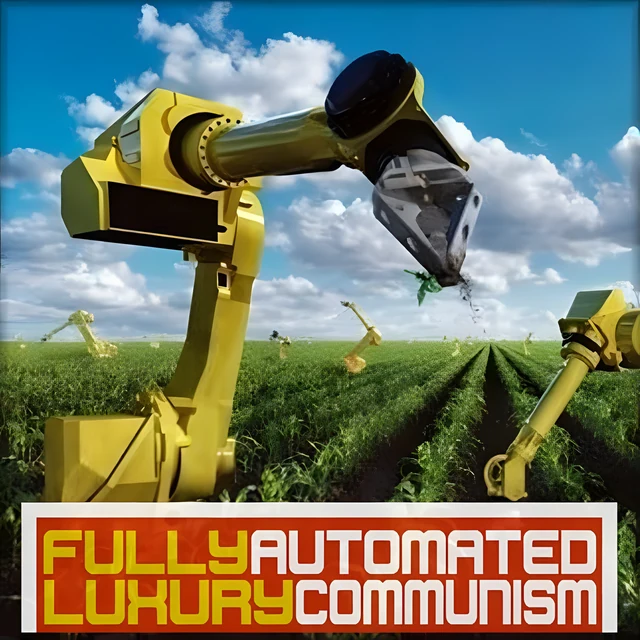
KMO welcomes Professor Nicholas Kiersey to the C-Realm to talk about the guiding principles that could lead technological humanity to a post-scarcity, post-capitalist existence in which nobody has to toil, and everyone has everything they need to live a fulfilling and dignified life. Seem unlikely? Prof. Nick isn't here to argue for the technical feasibility. He's here to clear away the conceptual obstacles to envisioning such an existence.
Both KMO and Prof Nick are science fiction fans, and they can both be found in a weekly discussion of SF on Clubhouse: https://www.joinclubhouse.com/club/sci-fi-politics
Open the formatted reading edition →
Reading edition · Published with KMO’s approval. Covers the full recording: KMO’s introduction (including passages he reads from the Amazon description of Aaron Bastani’s book and from a Forbes article, set as block quotes), the conversation with Professor Nicholas Kiersey recorded on KMO’s Tuesday live stream at the FACT TV studio (Falls Area Community Television), and KMO’s closing remarks. Edited for punctuation, paragraphing, repeated words, fillers, false starts, and obvious transcription errors; long unpunctuated stretches of the machine transcript were repunctuated with an automated punctuation model and then checked by eye. Speaker attribution is based on conversational context; no full audio listen has been done, and a few short back-and-forth turns are marked as uncertain. Opinions and factual claims are the speakers’ own, as of May 2021. KMO mentions owing Vault subscribers an episode, but no specific Vault continuation of this conversation is identified.
“If you speak the truth, have a foot in the stirrup.” — Opening quotation
KMOHello, and welcome to another installment of the C-Realm Podcast. I’m your host, KMO, and this is episode number 572, Fully Automated Luxury Communism. Have I used that title before? I don’t know. I’ve certainly talked about it, but I don’t recall any episode with that exact title. But even if I have used that title before, that episode wasn’t called episode number 572, Fully Automated Luxury Communism. And it certainly wasn’t called episode number 572 Fully Automated Luxury Communism with guest Nicholas Kiersey, otherwise known as Professor Nick. Nicholas J. Kiersey is professor of political science at the University of Texas, Rio Grande Valley. He taught previously at Ohio University and the University of Virginia’s College at Wise. He graduated from Virginia Tech in 2007 with a Ph.D. in Planning, Governance and Globalization. In 2014, he published a co-edited volume with Iver B. Neumann entitled Battlestar Galactica and International Relations.
Other peer-reviewed publications of his address the debate about empire in international relations theory, the status of power as a concept in world-state theory, and Foucault’s understanding of place of economic thought in the [wording unclear; heard “globalization of literature”] discourses of government. He is currently writing a book exploring the cultural-political economy of the Irish financial crisis. And the conversation that you’ll hear after a few minutes, there’s a bit of preparation, a little spade work to do in advance of the actual conversation, but it took place at Falls Area Community Television, which is the TV station which is right across the parking lot from the building in which I live. So it’s very easy and convenient for me to go over there to do new interviews. And I have a regularly scheduled Tuesday night live stream. It’s Tuesday early evening here on the East Coast, 5:30 p.m. That is 4:30 p.m. Central. I’m not sure about Mountain time.
I think it flips, you know, depending on whether we’re in daylight savings time or not. But it’s in the middle of the afternoon for you folks over on the West Coast. And, you know, for folks in Japan or Australia or other places where people listen to the C-Realm podcast, I’m sure it’s very inconveniently timed for you, which is why the best of the content that I produce when those live streams will end up here on the podcast. So we’re going to be talking about technology and the life that it could potentially provide for humans going forward. And the phrase fully automated luxury communism, it gets thrown around a lot by the extremely online left, but it’s also the title of a book. The book is by Aaron Bastani, and I’m looking at the page on Amazon.com for the Kindle version, and here’s the description of this book.
A different kind of politics for a new kind of society, beyond work, scarcity, and capitalism. In the 21st century, new technologies should liberate us from work. Automation, rather than undermining an economy built on full employment, is instead the path to a world of liberty, luxury, and happiness. For everyone. Technological advance will reduce the value of commodities, food, healthcare, and housing towards zero. Improvements in renewable energies will make fossil fuels a thing of the past. Asteroids will be mined for essential minerals. Genetic editing and synthetic biology will prolong life. Virtually eliminate disease and provide meat without animals. New horizons beckon. In fully automated luxury communism, Aaron Bastani conjures a vision of extraordinary hope, showing how we move to energy abundance, feed a world of nine billion, overcome work, transcend the limits of biology, and establish meaningful freedom for everyone. Rather than a final destination, such a society merely heralds the real beginning of history.
KMOAnd now to flesh that out a bit, I’m going to read just the first, I think, three paragraphs of a 2019 — this is September 18th, 2019 — article in Forbes, or at least on the Forbes website, by Daniel Araya, who writes:
Forecasts suggest that we are entering an era of massive automation. According to McKinsey, close to half of all work activities could be automated using existing technologies. But what happens after automation? What happens after artificial intelligence and robotics displace huge swaths of routine labor? According to Aaron Bastani, a London-based researcher, the answer would appear to be fully automated luxury communism. Strange as it may seem, Bastani believes that automation is driving capitalist societies headlong into a post-capitalist utopia. Think Star Trek or Iain M. Banks’ Culture series. The truth is that this is not an entirely new idea. As Peter Diamandis, founder of Singularity University and executive chairman of the XPRIZE Foundation, explains, the exponential acceleration of technology promises a new era in social and economic abundance. What is perhaps more counterintuitive, however, is Bastani’s belief that this technology-driven abundance is now making actual communism possible for the first time in history. As he frames it, we are moving toward an economy of extreme supply in which capitalism has reached its evolutionary conclusion.
KMOAll right, I’m going to stop there. The article goes on. I know that some of you who are holdovers from, you know, the many years in which I gave voice to and a platform to people who were articulating a future of extreme privation, you know, the absolute opposite of post-scarcity, rather prolonged, acute, chronic scarcity. Some of you remain attached to that vision of the future and find, you know, just the introduction here pretty galling. And I warn you, it doesn’t get any better. In fact, in the course of the interview, I’m going to make reference to a series of science fiction novels, which I really, really love. They are the novels of Iain M. Banks, and they are collectively known, there’s 10 of them. They’re collectively known as the Culture series. And the Culture is a vision of a perfected, perfect, post-scarcity, post-work, post-anxiety for most of its citizens, communist utopia.
And stylistically, it’s very different from Star Trek, but it’s like Star Trek in that, you know, in the world of Star Trek, at least if you live in the Federation, particularly on Earth, you don’t have to worry about money. You don’t have to worry about supporting yourself. There’s plenty, you know? And consequently, life on Earth is kind of boring. So stories in the Star Trek universe usually don’t take place on Earth. They take place way out on the fringes, you know, where representatives of the Federation, and they’re boldly going, encounter people who are not nearly as advanced and sophisticated and enlightened as the Federation. That’s where the interesting stories take place, out where the enlightened post-scarcity folk meet the unenlightened, still in the thick of scarcity folk. Okay, so here is my conversation with Professor Nicholas Kiersey.
Program identification: “You’re listening to the C-Realm Podcast. C stands for consciousness.”
KMOHey, everybody. KMO here, and we are live from the FACT TV studios at Falls Area Community Television. And I have a guest on zoom from. Are you actually in Texas?
Nicholas KierseyI am.
KMOOkay, we’ve got Professor Nick Kiersey. He’s in deep Texas.
Nicholas KierseyDeep Texas, so deep it’s practically Mexico.
KMOPractically Mexico. You hear a lot of Spanish, do you?
Nicholas KierseyOh yeah, [wording unclear]. Yeah.
KMOI’ve been dreaming of moving south of the border, watching a lot of videos about living in Mexico or living in Colombia. There’s a podcast I listen to, The Expat Files. Okay, and he’s in Guatemala. He has nothing good to say about Mexico. Okay, but Nick, you are the host of a podcast. It is — tell me about the podcast.
Nicholas KierseySo it started a while back, a few years ago. It may not be the most appropriately named podcast for what I’m trying to do, but sometimes you know names stick around, right? So I’ve been running a blog for many years called Occupy IR Theory. You can find it at occupyirtheory.info. And there — you know, as part of what was initially sort of back in the 2013-2014 period, you know, what was initially kind of an effort to see what, you know, hypothetically I might check, to use the old Occupy slang, what [wording unclear; heard “I might check”] from the streets might say to international relations theory as an academic discipline. So, we did a couple of, me and some friends did some writing in around that time, which got published in sort of open source journals, which were kind of a new thing in IR back then. So, we wrote a little bit under this kind of hashtag of, you know, Occupy IR Theory, and the blog was set up around that.
And it ended up being me that was the one who was kind of maintaining it and sort of paying for this blog. And I was, you know, years later, it was kind of like, well, why am I keeping this up? You know, it was an archive of a certain time, but, you know, it was sitting there doing, it wasn’t really being updated. It wasn’t really being used. So I had had some interest in doing a podcast, and I mean, admittedly, my interests have sort of shifted since then, a little bit more interested in kind of questions of futurism and acceleration and things like that. Neither necessarily for or against, but, you know, definitely interested in talking more about it. And so that seemed to be the logical home for this new project, to use the blog as a kind of a, because it existed and because it already sort of had a following and it was already connected with my name, I decided to host my new podcast there, which is not new anymore. It’s about four years old now. It’s called Fully Automated, and it is a podcast sort of at the intersection of technology studies and international relations, and definitely sort of a podcast that has what I guess you’d call a more Marxist orientation, though not exclusively. We do all kinds of interviews to do with space exploration, debates within the left about liberation and emancipation. You know, also very interested in sort of what you might call the post-identity left, that is, a left that’s kind of seeking to try to maybe get out from underneath the thumb of the post-’68 movement and try to get back to some kind of materialism or materialist orientation.
KMOAll right. I must warn you, you’re mostly going to be speaking to an audience who, they use the word imaginary as an adjective, for example. Okay. So sometimes I might ask you to unpack some of the lingo.
Nicholas KierseyThat’s fine. That’s fine. I’m totally happy to do that. I’ll do my best, at least.
KMONow, you also like science fiction.
Nicholas KierseyI do love science fiction, yes. And that’s, I think, kind of how we’ve become connected lately because I’m working with some friends on a new venture at the minute. It’s on Clubhouse, which is kind of new for me. But this is an effort to kind of explore the politics of science fiction and the science fiction of politics. So that is an event that takes place at a fixed day and time on Clubhouse.
KMOGo ahead and plug.
Nicholas Kiersey12:30 Central time every Wednesday. I’ll share the link for that to KMO, if you want to pop [it] in your description as well.
KMOI absolutely will. Most of the people who hear this will hear it as an audio podcast, but, right, I’ll leave it up on YouTube. Most people don’t know to go to YouTube to look for my stuff, but this is a convenient way to convene.
Nicholas KierseyOkay, very good. So—
KMOThat’s tomorrow. Unfortunately it starts in the middle of a weekly call that I have to attend, so I’ll be coming in late. But I went last week and last week my weekly call was canceled so I could attend the whole thing and I had a great time. We talked about an episode of Star Trek: Deep Space Nine—
Nicholas KierseyYeah, that’s right.
KMO—which to me is a fairly recent episode of Star Trek: Deep Space Nine. But now that I think about it objectively, there is no such thing as a recent episode of Star Trek: Deep Space Nine. It was from 1995.
Nicholas KierseyYeah, that’s right.
KMOIt was an episode. It was a time travel episode. And Benjamin Sisko ends up taking the place of some historical figure who was a key player in a, you might call it a riot. They called it, I think, the Bell Riots is the official name.
Nicholas KierseyThat’s right.
KMOHe ends up basically bringing everyday but sort of marginalized people in front of the camera to put them on, you know, what writers, science fiction writers of 1995 thought the future internet would be. You know, the story takes place in the 2030s.1 And we all, I suggested anyway, and I think a few people agreed with me, that it was absurdly sort of rose-tinted in its view of, you know, what global connectivity would do for our, you know, how we relate to one another.
Nicholas KierseyYeah, it was a very symptomatic episode. I would agree with you on that. I mean another aspect that really kind of jumped out for me, which I admit I wasn’t really ready for, and maybe it just was interesting — I hadn’t watched a Deep Space Nine episode in quite a long time, but I mean, I’d watched them all once upon a time — but revisiting that episode was also very kind of clear how nostalgic it was for the post-industrial lumpenproletariat. You know, the expectation or the anticipation of the show was that, you know, you need these kinds of horizontally organized post-industrial movements. And when I say post-industrial, of course, I just mean like post-industrial era, you know, where automation and various other economic pressures might have dislocated a lot of what we took for granted in the post-war era as the, you know, the American proletariat and the struggle of the working class in America, which, of course, through various political machinations, managed to strike quite a good deal for itself in the decades after World War II, right up until the era of the birth of so-called neoliberalism, where, of course, things have taken a turn for the worst.
But one thing that sort of struck me was how, you know, in the present context where we are all sort of very much being led to sort of have a new curiosity or renewed curiosity in the writings of the Black Panthers, Fred Hampton and people like this, you know, who expected, you know, that racial minorities, especially African-Americans, would be this kind of like vanguard of this new post-industrial movement, right? Where white people were kind of coming late to the lumpenproletarian game. The Black leadership class would already have sort of established a vanguard, a revolutionary vanguard in the urban landscape and it just it was so striking to me watching that episode, almost like right cookie cutter, you know, like you couldn’t have, you couldn’t have scripted it better. You know, the expectation that everything we want — which is what? A Star Trek future, right? Fully automated luxury communism — it can happen, but it can only happen — the sort of essential condition of its possibility in our timeline has to be these sorts of street protests, these street revolts from this particular class. I just found it really remarkable, as a kind of presage of where we are today with our debates, that this Star Trek episode is already doing this in ’95.
KMOYeah, yeah, exactly. So you’ve made multiple references to the lumpenproletariat? I thought the lumpenproles were the ones who were just too thick in the head to be of use to the revolution.
Nicholas KierseyWell, I mean, the lumpenproletariat was taken up by the Black Panthers as a sort of, in a positive sense, right? That they were, they were, they were in a sense going to be the hope for the Marxist future in the way, in the aftermath of the deindustrialization period. Of course, it’s not sort of strictly in keeping with Marx’s description of the lumpenproletariat because Marx was kind of down on them, you know. He said many negative things about the lumpenproletariat and sort of thought of them as like doltish, you know, mercenary types who had no particular commitment to leftist causes, had no sort of essential interests that connect them or bound them to the left. They were guns for hire. But you know, the post-’68 left, I think, has a different take on this. Now I will say that my reading of this is very much shaped by Clyde Barrow’s recent book on the so-called Dangerous Class — that’s the name of the book. But, you know, it is interesting that for Barrow, well, I don’t know if you want to get into this right now, but for Barrow, the idea is that that’s a mistake, right? That the Black Panthers kind of essentially took a wrong turn and put way too much hope in the possibility of a lumpen revolution. And Barrow kind of sutures that narrative to his own critique of the Trump era and the kind of rise of, I don’t think I’m quite putting words in his mouth, but if I am, I apologize here, live on air. But it seems to me he’s kind of connecting, kind of trying to go back to the older Marxist definition of the lumpenproletariat and sort of connect that to the deplorables debate and sort of suggest that the January 6th insurgency that happened earlier on this year in Washington, D.C., is what was kind of an expression of a, of a lumpen, of an actual lumpen revolt, and it wasn’t pretty. So you know, it just kind of, I think, shows up at least that Marxist idea that maybe the lumpen aren’t as predictably reliable for your revolutionary purposes as you might wish and they are certainly kind of guns for hire in that sense, but I don’t know, I mean it’s an interesting debate. I have a lot to say about it and we can talk more about it if you want.
KMOWell, on the topic of being fully automated and having a wonderful post-scarcity society, you say that Star Trek is such a society, you know, it’s, I would call it a post-scarcity society. You suggest that is, it is the embodiment of a fully automated luxury communism, but with Star Trek, it’s always, I mean, it’s, it has such a long history, a long production history and it seems that the Star Trek of each era is very much of its era, you know, and there are some things which have changed dramatically in society now where, if you look at the original Star Trek show, it just seems absurd that people would be so sort of culturally retrograde or, you know, very hyper conservative about certain things. And yet it’s the far future, but, I think, a better embodiment at least of my understanding of fully automated luxury communism would be the Culture from the Iain M. Banks novels. You’re nodding as if you’ve read those novels, so let me pass it over to you and first encourage you to describe the Culture.
Nicholas KierseyI think I’m the wrong person to get into Iain M. Banks. I’ve casually read two of the novels and I don’t have a sort of a grasp on the hard dynamics of those books, unfortunately. I mean, get me on Kim Stanley Robinson any day of the week, and I can probably talk a bit about that. But unfortunately, Iain Banks is not my bailiwick. But I think just to sort of, I’m not sure if you’re kind of coming at a kind of a critique of the idea of Star Trek as a fully automated luxury communism. But I think the beautiful thing about Star Trek is that it kind of leaves closed the question of the politics of fully automated luxury communism. And this is a big criticism that I have in the literature or of the literature, which is that I think the critics of fully automated luxury communism kind of seize upon it as starry-eyed naivete.
You know that it’s putting too much hope and praise in the idea of a technological revolution being the cure to everything that ails us. And you know people like Aaron Benanav who has a book out right now, just had a few months ago. He is very critical of left-wing arguments about fully automated luxury communism from that perspective, you know, and argues kind of from a more traditional leftist perspective that we need to kind of forget the technology and get back to the working class struggle. But now, to what extent Benanav’s characterization is fair or not, I don’t know, because certainly Star Trek doesn’t necessarily help it, because Star Trek doesn’t get into the politics of how we get there, if you know what I mean. You know, what is to be done? But I think the fully automated luxury communism literature, another Aaron Bastani, the British commentator who to my knowledge coined the phrase fully automated luxury communism — you know, he’s very clear on this and it’s a point that’s completely overlooked in, I think, the criticisms of his work, which is that he’s not really kind of just describing the techno future that might come. You know, the idea of a kind of a Marxist revolution of abundance that might just sort of be bestowed upon us, kind of by accidentally or by the way, as a result of the machines developing sort of superior ability to manage and produce themselves. I think what’s clear is that FALC, as we call it in shorthand, fully automated luxury communism, FALC is a political project and I really insist on this point. I think it’s essential if you want to understand why people find it such a compelling concept, because I think the left right now has such a hard time unifying behind anything, right? And I think that’s why you see so much of the problematic behavior you can see among [wording unclear; heard “many left it’s”] online, you know, various sort of debates about cancel culture and things like this which are, you know there’s an important critique to be made there. But, you know, like Adam Curtis and people like that, you know, his documentary HyperNormalisation was very informative a few years ago for many of us. You know, this kind of turn, this cultural turn of the left, can it — I’m not so dismissive of it, but I think when it becomes the sort of singular focus and the trump card of the left it can really send us in a wrong direction. And I think, you know, it’s a symptom of the powerlessness of the left at the moment. So what I think we actually do need to be doing is getting back to slogans, getting back to political organizing. And I think arguments like fully automated luxury communism provide many of these slogans and provide coordinates, provide goals that we can kind of shoot for as a way of moving towards, you know, a more socialist trajectory and I appreciate you know the your audience may not be fully down with me on that, but I mean, that’s the argument. It’s a kind of — what I’m hoping for is that it’s potentially a language, a toolbox, if you will, that allows us to escape from the trap that we’re in on the left right now, where we seem to be doing the opposite of what Dale Carnegie famously kind of wanted for us all, which, you know, to make friends and influence people. I think we can be more friendly and more influential if we have high-quality slogans that show how the struggle combined with the technology can pay off.
KMOSo when I think about Star Trek and I think about the Culture, and let me quickly describe the Culture.
Nicholas KierseyYeah, you talk about the Culture because you made some great points about it in our Clubhouse last week, and I’m sure the listeners would love to hear it.
KMOSo Iain M. Banks, he wrote what I would call a space opera series of books. It’s basically heroic characters having adventures in improbable circumstances. There’s not a consistent cast. The novels can be read out of order. There’s only a couple recurring characters. But the Culture itself is this enormous, probably thousands or millions of planets, but not everybody’s living on planets. It’s a human civilization, but it’s basically run by AI. Everybody has everything they need. Everything is provided for them. There are no laws. There are no rules, everything is sort of consensus driven. But it works. And there are no borders to the Culture either. It sort of fades out as you get further from the center. But, you know, if you live on a planet, or if you live on what’s called a Banks Orbital, which I think players of the game Halo would be familiar with.
It’s these big, like a ring world, but it doesn’t circle a star. It’s sort of out in orbit of a star, and it’s tilted in such a way that there’s a 24-hour day. I don’t think they have the Star Trek replicator technology, but they’re almost to that level. Nobody has to do anything they don’t want to do. There’s no toil. And like Star Trek — like Star Trek, on Earth, Earth is pretty boring. Very few Star Trek stories are set on Earth because Earth is so tranquil, so peaceful, so harmonious. Nobody’s mad at anybody. Nobody is struggling for anything because everybody has everything they want. So to get any interesting stories, you have to jump in a starship and fly off to the far reaches of the Federation and deal with primitive people. You know, with warrior culture Klingons or greedy capitalist Ferengi or, you know, you have to get out away from Earth to have a fun story.
So with the Culture, in the Culture, I mean, if you want a job, you can have a job. You don’t have to, but you can. And some of the most coveted jobs are in the Culture’s version of like the CIA, which is called Special Circumstances. There’s a general group of people called Contact, people being humans and AI, and Contact is dealing with, you know, forces and entities outside the Culture. And then you know the covert operatives, the ones who are going to go out on missions and actually do stuff that’s fun, they’re Special Circumstances, and almost every book involves somebody in Special Circumstances. And so the two fictional worlds are similar in that it’s really super boring, you know, to live there. And to get an interesting story out of it, you have to show some interaction between the Culture and somebody who is warlike or acquisitive or domineering or something.
I think the big difference is Star Trek makes a big deal out of we don’t let AI do our thinking for us. It’s all humans or humans with funny, wrinkly foreheads making all the big decisions. Whereas in the Culture, it’s the exact opposite. Humans are great. Humans are fun. We love our humans to death. Put them in charge of civilization? As if. And there’s just that really unabashed embrace of, yes, AI will do it better than we do. So let me stop on the topic of AI and have you jump in there.
Nicholas KierseyWell, that’s a good one. I have read, I believe, the novel Use of Weapons.
KMOI love that one.
Nicholas KierseyWhich I thought was a cracker. And I do intend to revisit Banks soon. So the AI question is very interesting because of course, so many of us, when we first sort of embrace the concept, to find ourselves curious about it, automatically kind of jump to the science fiction world for our cues, right, and so what we find are, you know that we preoccupy ourselves with debates about, you know, the ethics of how we deal with AI. You know, I think about the TV show Battlestar Galactica here, for example, which even raises kind of the question of, like you know, can you rape a robot? You know, a thinking, feeling robot. And these are all sort of fascinating symptoms I think of our own culture, if you’ll forgive the phrase, because I think they’re so disconnected from what AI actually is and will remain for the next several hundred years.
I don’t really foresee a thinking feeling artificial intelligence in the offing. You know, I think if that were ever to happen, it’ll be a long way away, simply because I don’t think we have any kind of a clue about what our own, what our own intelligence is, or as human beings — not to sort of be nostalgic for humanity or something like that, but I think part of what it means to be human is to be non-linear, right, I mean to accept that human beings are kind of random. You know, we don’t really fall very neatly into categories. We are, we tend to be slippy, messy creatures, and that’s where creativity comes from, right? That’s where the thing that makes us us comes from, and we should celebrate that and you know and appreciate that, I think, as frustrating as it can be sometimes, I mean it is what makes us us.
So, you know, the real question about AI is, therefore, what is AI today and what is AI doing with us today? And how do the science fiction representations of AI kind of disarm us against from seeing the key debates that we should be having today, you know, which is like, what does it mean to live in a society that’s so algorithmic, right? What does it mean to live in a society that is kind of essentially forcing us into sort of a multitude of processes that that remove the randomness from our lives and from who and what we are. Now, of course I’m not, I’m not kind of a fetishist of randomness. You know, that’s not good for us politically to have too much of that. You know, it’s a trade-off there. Whether you’re on the left or you’re on the right, you need to be organized, right, you need to have structure.
But what I will say is that, you know, I think in our, in our lives, AI is, is, you know, certainly something that has downsides and it as much as it can solve, as much as, say, cybernetics and debates about cybernetics are super interesting because they can solve problems to do with how we allocate goods and services, problems to do with how we allocate wealth. I think, equally, we all know that that AI can kind of give us a [wording unclear; heard “full”] sense of the world that we’re living in. You know, I’m trying to think that’s its main job. Cass — oh, what’s his name? It’s not Leon Kass. Cass Sunstein, several years ago, was talking about, you know, the idea of a Daily Me. I’m not a huge fan of him. I find him to be quite a conservative thinker, formerly attached to the Obama White House, I think. But he argued, I thought, very well, you know, that one of the risks of AI sort of commanding our lifeworld is that it sort of diminishes the possibility of us encountering difference, right? You know, and having alternative thoughts as a result of that. Something to watch out for.
KMOSo when thinking about fully automated luxury communism as a desirable state, you know, for the world to be in, let me ask you to describe it specifically with these questions in mind. What technology is required to bring it about? Could we do it with existing technology, particularly energy technology or energy availability? What’s the power source? And you’ve already mentioned that you think that AI, like artificial general intelligence, is hundreds of years in the future. So I take it for granted then that you think that fully automated luxury communism doesn’t rely on artificial intelligence. But correct that as you need to. So go ahead.
Nicholas KierseyI mean, I won’t claim to have thought all of this through, KMO, but I’m very taken with books like The People’s Republic of Walmart by Michal Rozworski and Leigh Phillips. I think it’s a great book. Everyone should read it. The idea there being that, you know, look, we already have the technologies to handle the logistics of complicated social relations in a manner that allocates goods and services efficiently using non-market-based solutions, which is obviously always the canard, right? You know, well, how are you, the market’s the most efficient mechanism we’ve ever discovered for allocating resources. How are you going to sort of artificially get around that? And Rozworski and Phillips argue that, you know, we actually have already in our present time solved this problem. Large corporations like Walmart do this every day, you know, by very, very complicated algorithms and what they are arguing — and I think it’s brilliant — is that, you know, there’s no reason why these can’t be run — these algorithms can’t be run by, you know, by the public, for the public, in a more democratically accountable manner. So, you know, is that fully automated luxury communism? I don’t know. Again, as I said earlier on, fully automated luxury communism isn’t sort of a destination, it’s a slogan, it’s a political project, it’s about a road from here to there. And if we think about it in those terms, I think it’s quite interesting to look at debates about, you know, the Chilean experiments on using cybernetics to organize the economy. It’s quite interesting to look at books like Rozworski and Phillips’ book on Walmart, to see, again, you know, just thoughtful, creative ideas about ways in which we can democratically manage the economy without necessarily regressing into these, what I would consider more unattractive, you know, horizontalist left sort of propositions, you know, which always sort of succumb to these accusations, like Oscar Wilde sort of famously put it, you know, the problem with socialism is it takes up too many evenings.
Of course, that’s because you’re always in a meeting somewhere, you know, trying to figure out, like, trying to vote about some obscure point about what to do with the sewage system in your local town or something like this.
Speaker uncertainBefore you go on, let me interrupt for a second.
Nicholas KierseyPeople find that off-putting. People find that kind of level of being sort of like asked to democratically deliberate and participate in every single thing to do with your economy to be, you know, kind of almost like childish. Like, we have technologies at our disposal so we don’t have to worry about these things. We have the means at our disposal to, you know, democratically decide some basic parameters for how these things should function and then just let them go. You know, let them rip. They don’t need to be looked at every week. They certainly don’t need, you know, mass civilian assemblies to come and discuss them every week, right? So I think, in that respect, the hope, the promise of using cybernetics and using automation for communism, if you will, is that it allows us to kind of get on with the business of being free and not have to get super bogged down in these details, which is, rightly or wrongly, what many of us feel anarchists are asking us to do, right?
So we’re kind of coming at this from an anti-anarchist perspective, you know, obviously not like blanket anarchist, anti-anarchist. I mean, there’s a lot of good stuff in anarchism, but, you know, the stereotype that’s invoked about anarchism is kind of what we’re trying to assuage here, right? That people get so — and not without cause — worried that what they’re being asked to do by the left today is deliberate on everything every minute of every day, and what we’re trying to sort of show is like, no, actually you do get to go ahead and have a life and be free if we’re willing to let cybernetics help us along the way. And, of course, the state, right? The state has a role to play here. Sorry, I feel like I may be alienating your audience a little bit because I’m getting kind of in the weeds, and I apologize for that. I hope this is useful for you.
KMOWell, let me throw that same question back to you for review. What about energy? Does fully automated luxury communism run on coal, or does it run on solar and wind energy, or what’s powering this?
Nicholas KierseyI don’t think we have a black-and-white answer to that question. I personally come from the school of thought that says we will have to rely on nuclear power for a lot of our energy in the future, because I don’t think that, you know, again, I’m totally ripping off Leigh Phillips on this. So, you know, if you want a better version of the narrative I’m about to give you, just go to him. He writes in Jacobin and he can be found, you know, getting hauled over hot coals on Twitter for this position by a lot of people on the left. So, you know, the left isn’t fond of what I’m about to say here. But the reality is I don’t think we will get the kind of energy that we need for everything from renewable sources. You know, there are problems, at least in the present moment, maybe in the next 100, 200 years, we can get better solar energy, better wind-powered energy, better batteries to store that energy.
But in the meantime, you know, we do have to sort of consider that a lot of our industrial applications need consistent deliverable energy levels that are high, you know, and right now in terms of green energy, nuclear seems to be the only way to do that. And I think I would insist that nuclear is a relatively clean technology. I think, you know, you just look at what Germany has done getting out of nuclear altogether since the Fukushima nuclear power disaster, and it’s not pretty. You know, they’ve switched back to coal. It doesn’t, you know, it’s, you know, they can’t, they don’t have enough renewable energy to serve their needs, so they’re bringing coal power plants back online. And I think we’re probably going to need to avoid that in the future. So, that’s the, that’s the energy question. I mean, I think, I think another useful aspect of this, though, is that it’s not just, you know, where do you get the energy, right?
Like, the technology itself will make the delivery of energy safer. You’ll conserve more energy out of the system by having a better grid. There are possibility of more local sources of energy going to be available, so we may not be as dependent as we would imagine on a grid. Battery-powered cars, I think, will be more energy efficient than combustion engine-based cars. There’s a lot of proof or evidence to suggest that that’s the case at this stage. So it’ll be a mixed bag. But again, as I say, the goal here isn’t to have the perfect solution described. We want to get away from sort of the territory where we’re getting called utopians. The goal is to draw people’s attention to the fact that we could be doing so much more with what we have, and that it can make people’s lives better in the here and now.
KMOSo it’s fully automated luxury communism. Speak to the luxury part.
Nicholas KierseyI’m glad you asked me that, actually. That’s a part that I think often gets underexamined. I might be a little bit off base compared to other people who advocate FALC here, but I think one really good scholar on this is James Livingston, who wrote a really good book about 10 years ago called Against Thrift. And in that book, he just really goes to town on the post-’68 left. And when I say post-’68 left, I hope people are kind of following along with what I mean here. This is the kind of like the anti-consumerist identity politics style left that sort of picked up after, you know, it became apparent what the USSR was doing and the atrocities that were being kind of carried out in the name of communism in Central Europe and Eastern Europe and in Asia. So what you have in Livingston’s argument is a recognition, I think, that consumerism itself isn’t necessarily a bad thing.
You know that in the future utopia there will have to be consumerism, you know, if it’s going to be attractive to people. I think that’s the main strategic point, right? If you want to sell it, it’s going to have to have flat-screen televisions. Whereas a lot of the left in the ’70s and ’80s spilled a lot of ink on the argument that you know capitalism was reproducing itself off a kind of a false consciousness created by crafty and clever advertisers who wanted nothing more than to keep people addicted to Coca-Cola and Levi’s and, you know, Snoopy, you know, clothes with Snoopy logos and things like that on them. Which, of course, were big in the ’70s, right? Sorry, I was just remembering some articles I read a long time ago about that. So the idea here is that, you know, representation is key, that we’re living in an era where our politics is fundamentally mediated by how we represent ourselves to ourselves, as opposed to any kind of question about, you know, what do people want? What does it mean to live in a utopian society? You know, are we going to, you know, just kind of cast off all these worldly possessions and go and meditate in a cave like mystics? You know, are we going to become ascetic beings and renounce worldly pleasures? Is the body, is the flesh nothing, right?
So, you know, in its haste to be anti-consumerist, the left, I think, forgot to explore the question of luxury and how and whether and to what extent there should be limits to that. And it strikes me, having read Livingston’s book — he makes a really good argument there that the ultimate limit to consumerism shouldn’t really be, oh my God, you know, false consciousness, too many people like the new Britney Spears album when it’s clearly no good. I mean, that sends you down the road of the Frankfurt School and, you know, sort of arrogantly posturing high culture as a kind of a, you know, a better alternative to low culture, this kind of thing, right?
So what you want instead, I think, is a limit that recognizes the environment, of course, right, like that’s just a very strategic, pragmatic limit to what we can consume. You know we cannot consume more than our planet will allow. But apart from that limit, what’s the problem, right? Like, our, you know, our PlayStation’s not cool? I mean, you can have a great time on them. Gaming is probably going to be part of our utopian future. I would like to think it would be. Probably designer handbags with fancy labels will be part of our utopian future. I mean, they won’t be centered around the profit motive anymore, conceivably. But, you know, if I can venture the point, I would say that, you know, looking good, feeling stylish, even modifying your body if you want. I mean, there’s no, there’s no intrinsic reason why these things cannot be part of the left in the future, [wording unclear; heard “are the left a promise”] of what the future can be.
KMOGot some comments here. Ben A. Rubber [commenter’s name; spelling unverified] says, “So is the agriculture industrial? Can it be regenerative agriculture, which does better at allowing the soil to have water absorption capacity, which affects the climate via hydrology? Thermodynamic dynamics of healthy soil is rad,” says Ben A. Rubber. “There’s a substantial population of people who are nauseous at externalizing our relationship to the environment to an industrial behemoth that affords a culture to attain absurdities like veganism.” There’s a lot packed into that.
Nicholas KierseyThat’s a lot. That’s a lot to unpack. Yeah, how do you get from the behemoth to veganism? Sorry, was there more?
KMONo, that’s it. But I mean, if we want to jump to the end, to veganism, sorry.
Nicholas KierseySorry, please. I interrupted you. I’m sorry.
KMOIf we want to jump to the end to veganism, I think — let me read his exact words again. “There’s a substantial population of people who are nauseous at externalizing our relationship to the environment, to an industrial behemoth that affords a culture to maintain absurdities like veganism.” And I think the point he’s making with veganism is that vegans think that since they are not eating animal products, their diet is harmless when, in fact, if it’s an industrial diet, which is supplied to them by, you know, intensive uses of pesticides and fertilizers and enormous monocultures, fence row to fence row monocultures that, you know, if you drive I-70 from one end of the country to the other, you just endless seas of corn and soybeans. It’s not harmless. You know, that’s not the way these ecosystems are meant to operate. And so the reason we do that is because you can do that with a bare minimum of human labor.
You are outsourcing most of that work to machines. So we have less than 2% of the population engaged in agriculture now. And for people like Ben A. Rubber, I think that’s not a good thing. So is fully automated luxury communism one that is fed by industrial agriculture and all the harms that come with it?
Nicholas KierseyYeah, I think it will have to be unapologetically industrial and I think I would, you know, sort of gingerly push back on the idea that the problem with industrial agriculture is that it’s industrial. I think the problem with industrial agriculture is that it’s capitalist and that, and as a result, it’s not accountable. It’s not accountable to the externalities it creates, it’s not accountable to how it handles the land. It’s not accountable to the people who depend on it for their nutrition and for their calories. There’s a lot to say here. I would start by — broadly, I mean, let me see where I can go here. One of the most powerful moments to me in my sort of intellectual development in recent years was a little clip interviewing Slavoj Žižek in a trash heap or trash dump.
And it was in the movie Examined Life. Who made it? The name’s on the tip of my tongue. It’ll come to me in a minute. But, yeah, it’s in the documentary, the Examined Life. And so we have Žižek, the Slovenian philosopher. Astra Taylor is the name of the person who made the documentary. So Žižek’s walking around this trash dump, you know, talking about how, you know the big problem facing us, those of us who want to do something about our ecological problems right now, is that, you know, the trash dump just encapsulates so much about how we disavow the externalities of our production system. But he warns in this video — and I think it’s a very, very strong argument — that I’ve seen now repeated multiple times in other sources, but this was the first time I really myself encountered this argument, because I think I had always been, up to that point in time, someone who was a certain kind of environmentalist.
Let’s just leave it at that. But Žižek warns us in this, in this video, like not to be fetishistic about nature itself as being an unproblematic realm, right? Despite the way movies like Avatar represent nature, you know, it has not and is not a beautifully harmonious whole wherein everything is perfectly fine, were it not for the interference of humanity as some kind of external parasite that invades nature or exploits nature or treats nature as a standing reserve. Instead, says Žižek, you know, no, there are lots of creatures that are farmers in our natural world, we can see a lot of them at work. Beavers, ants, and human beings are, of course, the same, right? So they are part of nature, and they are farming creatures by definition. The question is, are we willing to step up and acknowledge that’s what we are? What Žižek argues for is a farmer’s mindset, a farmer’s approach to being an ecological activist, if you will, or an ecologically sensitive citizen. And in this argument, he believes that, you know, just like a good farmer understands he has to attend to the land if he expects and believes the land is going to give back to him, so do we also have to tend to our garden, so to speak, right?
We have to develop a farmer’s mindset, and that will actually be the way we keep the ecology of the planet whole, not by treating nature as some kind of sanctified realm, pristine realm, where everything would be fine were it not for humanity. He draws our attention, I think, very thoughtfully to the existence of oil itself and asks us the question, you know, like, where do we think oil comes from? It comes from a massive destructive event, most of it, you know, that wiped out in one blow 90% of the organic material on the planet, you know, the organic life, and deposited it into the soil, and that’s where oil comes from, the oil that we put in our cars, right?2 Right. So our civilization depends on this carnage and death for its existence. But that doesn’t mean that we should, you know, back away from the responsibility of having to look after nature.
But probably better not to call it nature, probably better to call it the ecology and probably better to, again, recognize the limits of the ecology in terms of what we can do with it as farmers. But to understand that, look one way or another way, we are dealing with something that we have and that we cannot but look at as humans, right? Nature is a human narrative. Ecology is a human narrative. Nature itself doesn’t really care, right? It doesn’t have a consciousness, it doesn’t think, it doesn’t have a heart, it doesn’t have a brain, right? So one way or another, it’s an aesthetic creation of the human mind, and its politics are the same, right? Now, to move from that, then — from having sort of knocked nature down a peg or two, that’s not to say we should just do whatever we want with it, of course we have to use our technologies to try to get more out of it with less impact on it, and you may have seen — I’m not sure how much hope we should take from this, but it seems auspicious that, you know, we now have the possibility of growing perfectly good beef in a test tube, right? Genetically, once upon a time it was DNA from the thigh of a cow, and now it is being grown in a vat as a perfectly viable form of meat. In Singapore there’s a restaurant right now where you can get a beef burger, a hamburger made out of vat-grown beef, for fifty dollars, right?3 And that same beef burger would have cost you a hundred and fifty thousand dollars, even ten years ago, or something like that. So the price of this kind of potentially very valuable form of meat production, if we’re interested and concerned to deliver calories and protein nutrients to people around the world, at a price, if that, if the cost of producing this vat-grown beef becomes lower than the cost of growing it from fields, then, you know, obviously what’s going to happen: those farmed herds of cattle will no longer be needed as much. You know, they’re a huge source of methane, which creates global warming, and we have a huge opportunity to remove a lot of emissions from human activity and a lot of the burden on the planet’s atmosphere accordingly. So I would be optimistic about possibilities like that. Through capitalism, unless there’s — that’s what I would worry about, is that these sorts of technologies will be seen as kind of [wording unclear; heard “retaining”] baubles by capitalist elites and their potential for being rolled out as a serious solution to global hunger and as a serious solution to climate change are not going to be realized.
KMOWell, Nick, we are just about out of time, and I’m sorry that we didn’t get to talk about the writing of Kim Stanley Robinson, because I absolutely love the fact that in a science fiction field, particularly on the screen, not so much on the page, but on the screen, science fiction is almost synonymous with a dark future, dystopianism, cyberpunk or crime or totalitarianism. And Kim Stanley Robinson’s novels have the ability to acknowledge all the problems that we face and still show us a potentially hopeful future. I mean one of my favorite books by him, I think is one of his lesser known ones. It’s Pacific Edge.
Nicholas KierseyI haven’t read it.
KMOOh, it’s a utopian California, but it’s also—
Nicholas KierseySounds great.
KMOIt’s also a fiction within the novel itself, but I know you’ve read Aurora.
Nicholas KierseyYes, I have.
KMOI’ve heard you mention it. Did you read Red Moon?
Nicholas KierseyYes.
KMOSo these are two novels that he’s written like back to back, I think, and in both of them a major plot point is the first artificial general intelligence wakes up, right, as a result of having been painstakingly trained and shaped by some other character in the story. That’s clearly on his mind right now. He’s put it into those last two novels.
Nicholas KierseyYeah, I think he might be wrong about that though.
Speaker uncertainYeah, they are — the time frame—
Nicholas KierseyYou know, yeah, I think the time frame might be quite wrong on that, but I really liked the New York one. I think it’s New York 2150 or something. That’s another recent book of his, and then I’ve only just started the new one, Ministry of the Future.4 I think those kind of books that he does about climate change are very, very interesting and the way he navigates the political choices that we make to respond. You know, the complexities of the political choices that we’re facing when climate change is basically inevitable. I think those are his most powerful kinds of works. The question of what it means to live after climate change, what humanity looks like after climate change are great.
KMOWell, Nick, I’m afraid we have to wrap it up here, but I hope, well, I know this won’t be our last conversation because I’m going to show up to that Clubhouse event as often as I can again. That’s Wednesdays at 12:30 Central, right?
Nicholas KierseyYes, and I also want to invite you onto my podcast, which has been on hiatus for a few months now, but we just wrapped up school here and my grades are all in, so I have time now over the summer to get back to doing something that I really love doing, which is interviewing people and editing podcast interviews. I’m sure you love doing it yourself, so it’d be nice to have you on, if you, if you would. I’m publicly challenging you now to agree to come on my show, and there’s people watching this who will have heard you — yes, and you have to keep your promise now.
KMOWell, you didn’t need to bring out the big guns. I much prefer to be the guest on a podcast than the host. It’s much easier, there’s no editing.
Nicholas KierseyVery good. I think you’re right about that, by the way.
KMOAll right, Professor Nick Kiersey, thank you very much.
Nicholas KierseyWhat a pleasure. Thanks.
Program identification: “On the C-Realm podcast, a mind that is stretched by a new experience can never go back to its old dimensions.”
KMOAll right. That was Professor Nick Kiersey, and that was recorded over at the FACT TV studio. I’ve just walked across the parking lot from the TV studio back to my apartment, and now here I am sitting at my usual podcasting position, looking out the window. It’s a beautiful day out. Let’s see. It is currently 75 degrees Fahrenheit, and it is 6:40 p.m. here in southeastern Vermont. The sun is near the horizon, but it’s still above the mountains there, and it’s gorgeous. But I had to close my window because I live near a street, and you’d hear the cars going by if I left the window open. And this is an irony that occurred to me recently. I live, you know, most of the people who live in Vermont live up around Burlington, which is in the north, near the Canadian border, really. The southern part of the state is pretty empty.
I mean, if you fly over it, it’s just trees. That’s just what it is. It’s just trees, you know. So there’s lots of places around here where there’s no car noises, but I have to live amidst constant car noises because I don’t have a car. I live, you know, in a village. I walk everywhere I need to go for the most part. And, you know, to be in a position where I don’t have to have a car, I have to listen to cars all day. Whereas if I had a car and I wanted to, I could live out, you know, away from the village and have lots of peace and quiet and, you know, open my windows and you’d hear nothing but bird sound. But because I don’t drive a car, I have to listen to cars. So, Professor Nick, okay, obviously, people who have been listening to the C-Realm podcast for a long time, you know a lot more about the harms of industrial agriculture than Nick does.
Some of you, perhaps, are farmers yourselves, or you’ve had a farming phase in your life where you’re very dedicated gardeners and you understand that fence post to fence post monocultures tended by machines with lots of chemical fertilizer inputs and pesticides. It doesn’t produce the best quality food. It doesn’t produce the most food possible given, you know, the amount of land. The only thing that it’s best at really is reducing the need for human labor. And so, you know, if we could continue the conversation and I would ask Nick more questions, I would ask him, we have so much corn because we can do everything with corn mechanically, it makes it really, really cheap. So we put corn in everything, even though, you know, cows aren’t really evolved to digest it and neither are we, not in the quantities in which we eat it. But we can produce it cheaply, whereas strawberries, well, a human hand has to pick that strawberry, and human hands are expensive, even ones that are here, you know, without documentation, having crossed the border illegally, to come do work that we need, we need to have done, we need that cheap labor, you know, and most Americans, regardless of how broke they are, don’t want to do that labor.
We need people who are willing to do it, and I’ve seen, you know, various machines which are designed to pick strawberries. They’re not very good at it, they’re not nearly as good, as you know, some short brown guy from south of the border who comes up here to do work that we don’t want to do. So I’m thinking in fully automated luxury communism, there can’t be a class of people who do the work that nobody else wants to do because, you know, it is so poorly compensated and it is so physically demanding. You know, one of the questions I would ask, Nick, if we could continue the conversation is my understanding, you know, the bumper sticker version of communism is from each according to his abilities to each according to his needs. In fully automated luxury communism, your abilities shouldn’t really enter into it, right?
Except we’re not relying extensively on AI. It’s still humans designing systems and tending them, so it seems like there’s still going to be a need to sort people according to their IQ or according to their ability to think abstractly. Some people are better at it than others, and in our current capitalist moment, those people are better compensated than people who aren’t good at it for the most part, or they have the opportunity to be better compensated. And in a communist system, as I understand it, and of course, I’m clearly no expert on this topic, that is something to be eliminated. Those sorts of distinctions.
KMOSo I’m not going to go on a long ramble here. If I feel the need to ramble, I’m going to do it on the Vault. I owe the Vault listeners a podcast episode. They haven’t had one in quite some time. That will be my next priority, to get a podcast out to the C-Realm Vault subscribers. And for those of you who don’t know, and I don’t imagine there are many people listening to this podcast who don’t know, that most of my podcasting effort goes to provide content to the people who subscribe to the C-Realm Vault podcast. And all new subscribers now come in via Patreon, almost all. If you’re particularly generous and persistent, other arrangements can be made. But for the most part, if you want to listen to the C-Realm Vault podcast, you’ll need to find me on Patreon. My Patreon account is patreon.com slash KMO.
And the $7 a month contributors get access to the C-Realm Vault podcast. All right. Before I go, I want to send a big thank you out to Jim D. — Jim, [wording unclear; heard “your ad attacker”]. He does the podcast Attack Ads! And he every year very generously sends more than I’m asking for, considerably more than I’m asking for a year’s subscription to the C-Realm Vault podcast. And he did so again this year. I should have thanked him on the last episode and I forgot. So thanks again to Jim. And if you haven’t checked out his podcast, Attack Ads!, with an exclamation point, you really should. It’s a very informative, creative, funny, and well-produced podcast. All right. I think that’s all the thanks I need to provide at this time, except thanks to you for listening to this episode, for taking an interest in these topics. I will talk to you again pretty soon.
Actually, before I go, I want to say that I’m going to be in Maine this coming weekend, up around Bangor on Saturday. If on the off chance there are any C-Realm listeners in Bangor, Maine, or nearby, and you want to hang out on Saturday, it’s possible. Let me know. My email address, as you probably know, is KMO at C-Realm, R-E-A-L-M dot com. Makes sense, right? This is the C-Realm podcast. I’m KMO. The website is C-Realm dot com. My email address is KMO at C-Realm dot com. It always throws me when somebody who is a longtime listener to the podcast tells me they wanted to get in touch with me, but they couldn’t find my email address. Yeah, you won’t find my email address on the C-Realm website. There is no contact form there and there is no way for somebody who doesn’t listen to the podcast to get in touch with me other than to just leave a comment on an episode. But I’ve said it so many hundreds of times and you’ve heard it so many hundreds of times, KMO at C-Realm.com. All right, now I’m gone. Talk to you soon. Stay well.
1. As spoken. The Deep Space Nine two-part episode “Past Tense” (first aired January 1995) is set in 2024. ↩
2. As Nick relays Žižek’s point. Geologists attribute most petroleum to marine plankton and algae buried and transformed over millions of years, not to a single destructive event. ↩
3. As spoken. In December 2020 Singapore became the first country to allow the sale of cultivated meat: Eat Just’s GOOD Meat cultured chicken, launched at the restaurant 1880 as a trio of small dishes for about S$23. A cultivated beef burger was not on sale there at the time, as far as could be checked. ↩
4. As spoken. Kim Stanley Robinson’s novels are New York 2140 (2017) and The Ministry for the Future (2020). ↩
Keep following the conversation.
More on sf
Public audio available
More on sf
Public audio available
Another public conversation
Public audio available