Also with First
Men Need Not Apply →
Public audio available

2020-09-06
Open the formatted reading edition →
Reading edition · Published with KMO’s approval. Covers the full recording: KMO’s introduction; his reading of a long email from Chad Hill of the blog The Hipcrime Vocab, in two parts, with a reply from Marc C. and KMO’s own responses; a recorded response from First; and KMO’s solo closing (the C-Realm Vault, his live stream, Filipino Cupid) through the sign-off. Letters KMO reads aloud are set as block quotes. Edited for punctuation, paragraphing, repeated words, fillers, false starts and obvious transcription errors. Speaker attribution is based on context; no full audio listen has been done, and spots where the wording could not be settled are marked. Opinions and factual claims are those of the writers and speakers, as of late summer 2020. This episode is not followed by a Vault continuation.
“If you speak the truth, have a foot in the stirrup.” — Opening quotation
KMOHello, and welcome to another installment of the C-Realm Podcast. I am your host, KMO, and this is episode number 654,1 “Game over, man! Game over!”, with guest — well, sort of guest — Chad Hill. Not in voice; he just sent words that I will read to you. But he sent over 5,000 of them, so it’s going to take a while.
All right, to set the stage: I’m imagining that most of you know who Chad Hill is. He is a blogger. He writes a blog called The Hipcrime Vocab, and he’s been a guest on the C-Realm Podcast and the C-Realm Vault Podcast I don’t know how many times. He’s somebody that I make a point of contacting once or twice a year to say, hey, let’s get online and check in, see what’s what.
Chad, as you’ll be able to tell in the email that I will read, is pretty solidly in the blue tribe, whereas I am not. I am decidedly gray tribe. And I actually feel more animosity to the blue tribe right now than I do to the red, even though most of the people that I really get along with and respect and enjoy interacting with are blue-tribers. And it’s particularly true among the uneducated. I have zero interest in hanging out with uneducated red-tribers — particularly uneducated red-tribe men, particularly uneducated red-tribe young men. But even there, there are exceptions, like Colin over at the TV station, with whom I do videos from time to time — or at least I did before the pandemic. And I could again; it’s just that our momentum is broken. I’ll say more about my video production work, or lack thereof, at the end of the podcast.
But for now, let’s just go ahead and get into the first part of Chad’s very long email to me. The first part is all about collapse. And as you well know, that was a focus of mine for a very long time. It even spun off a book, Conversations on Collapse, copies of which remain available, dirt cheap, for anybody who wants them. Send me enough to cover postage and I’ll be happy to send you a copy. If you want to get in touch with me about that, send me an email: kmo@c-realm.com. Of course, there is a hyphen between the C and the R in C-Realm. And there’s the C-Realm Podcast discussion group on MeWe, and some of what you’re going to hear today comes from that discussion group. All right, but first, here is the first part of the email — the bit about collapse — from Chad Hill.
Program identification: “You’re listening to the C-Realm Podcast. C stands for consciousness.”
KMOChad writes:
Hi, KMO. I have some thoughts and some observations about recent events more generally. I know you like to avoid collapse topics of late, but if what we’re seeing around us right now, especially here in the United States, isn’t collapse, then what is it? To be perfectly honest, 2020 is turning out to be far worse than I ever imagined things would get in my lifetime. There was once a time when you had to try and convince people that a collapse was coming. Now all you have to do is gesture broadly.
It’s true that predictions of a dearth of fossil fuels grinding industrial civilization to a sudden halt and plunging it into a pre-industrial world made by hand didn’t pan out, and aren’t likely to. Instead, a global pandemic has been the catalyst that exposed the cracks in American society that have long been papered over. It’s like when a bridge whose maintenance has been deferred for decades finally gives way when that overloaded semi-truck drives over it one morning. That semi-truck is called COVID-19.
In one of our first conversations, as I recall, we talked about collapse versus catastrophe, with collapse being a long, slow process unfolding over long periods of time, and catastrophe being a sudden, unexpected event that sends shockwaves through the system. The effect of those shockwaves, of course, is determined by how resilient and durable the underlying system is. In America, I’d say that the system is long past its sell-by date.
The laundry list should be familiar by now to everyone who’s been paying attention: French Revolution levels of inequality, shrinking life expectancies, deaths of despair, epidemic obesity and other chronic health conditions, food deserts, automobile dependency, suburban sprawl, rising levels of depression and anxiety, drug abuse, bankrupt municipalities, crumbling infrastructure, deferred maintenance, fragile supply chains, corporate consolidation, business monopolies, stock bubbles, de-unionization, an insular, out-of-touch political class, political corruption, legalized bribery disguised as political donations, voter suppression, boarded-up main streets, shuttered factories, empty storefronts, ghost malls, privatization, unaffordable higher education costs, college debt, expensive child care, failing urban schools, education quality based on zip code, skyrocketing housing and health care costs, financialization and asset stripping, outsourcing and automation, people lacking health insurance, hospitals closing in rural areas, underfunded pensions, unsustainable private debt levels, worker disengagement, a bloated and overextended military, endless unwinnable foreign wars, veteran suicides, police brutality, street gangs, homelessness, tent cities on the streets, gun violence, school shootings, people living in their cars, hurricanes, floods and wildfires, mass incarceration, a generation of stagnant working-class wages. The list is so long and extensive that a list of functioning institutions in the United States would be shorter and easier to compile at this point.
This week, just a few miles south of where I write these words, an entire downtown has been engulfed in violence and rioting, with buildings burned down and stores looted. Mass protests over the summary execution of a Black man by police officers brought out armed militias and vigilantes, many from neighboring states, who openly coordinated their activities with the police. Reactionary political forces are currently circling the wagons to defend a 17-year-old rifle-toting Trump supporter who came in from out of state and is accused of shooting three people, killing two of them. “If the police can’t protect us from violence, then anything goes” is their assertion, one embraced by increasing numbers of fearful citizens. At the same time, right-wing paramilitaries clash with protesters in the streets of Portland every night, like something directly out of Weimar Germany.
It’s clear from events over the past few months that there has already been significant radicalization of large segments of the American population outside of urban areas, the full extent of which has been ignored by the media and politicians, and that this radicalization has penetrated not only the formal branches of the military, but also the internal police forces, which are increasingly resembling an occupying army. There are also an increasing number of right-wing militias and paramilitary groups, many of them hotbeds of extremist sentiment and white supremacist ideology. Both they and their ideological opponents see no peaceful means of resolving their differences, and can only recommend that their online followers stockpile ever larger caches of guns and ammunition, in a literal arms race. Just this morning I read the following comment from a user on the financial blog Naked Capitalism. Begin block quote:
Long-time lurker, but feel compelled to comment as things are so bad. America is so screwed. I’ve been following Naked Capitalism since the Great Recession. The trend is ever downward. When people start talking about the need for a new ’60s-style protest movement, I have to laugh. How deluded. The police are handing out bottled water to armed right-wing vigilantes and militias. Almost functional fascism. To watch the world hyperpower disintegrating in real time is staggering. Wake up, people. Help is not coming. Look back on this day in a month, a year, a decade. Guaranteed, it will get worse. People are getting so crazy. Even regular commenters on this site are saying crazy stuff like “kill them all,” referring to Antifa or BLM. WTF. Good luck and take care, everyone.
End block quote. I ask you, how can anyone not see this as a collapse? How can any country function under these conditions? Okay, you might say, but there have been riots in America before, from Watts to Rodney King. It’s just part of the background noise of American life, you could say. But did these riots unfold alongside the highest unemployment rate since the Great Depression and the greatest single-quarter drop in GDP ever recorded? No, they did not.
America’s response to the global coronavirus pandemic has caused the rest of the world to stare agape in horror, as if watching a slow-motion car crash. Not only was the response of the so-called leader of the free world to COVID-19 not among the world’s most competent, it has been the absolute worst among developed nations, put to shame by countries with a fraction of its GDP. Meanwhile, the world has been treated to the spectacle of Americans angrily marching in the streets and flying into outrage over the simple requirement of wearing a mask, along with a president who denied and then downplayed the very existence of the virus, later promoting untested and unproven cures from behind the podium. Unlike in the rest of the world, the virus became a political hot potato in the United States. The United States was unable to effectively contain the virus or implement adequate testing and tracking protocols due to four decades of defunding the state in favor of tax cuts for the wealthy and private businesses. Even the slightest directives to help contain the virus were considered an affront to freedom. Many countries ran circles around the United States’ pandemic response, including America’s past enemies like Germany and Vietnam, both densely populated nations of roughly 83 and 96 million people, respectively.
Another commenter at Naked Capitalism noted, concerning the U.S.’s COVID-19 response — begin block quote: “The huge problem facing the U.S. and U.K., I think, is that they’ve floated for decades on the benefits of having excellent administrative structures, while allowing these structures to decay and rot. When you look at how, say, late-19th-century cities solved the problems of disease through massive water and waste investments, or waged total war when needed, or built huge highway systems over a matter of a few years, and then compare it to the chaos of today, as you say, it can only make you weep. Fixing it would be a massive effort, and to be honest, I don’t see anyone willing to take on that task.” End block quote.
Despite the greatest economic cataclysm of the post-Depression era, America’s politicians went on summer holiday and forestalled any efforts to help individual American workers and small businesses, even while doling out trillions of dollars to well-connected large corporations and the investor class. At the same time, an extra $600 a month2 was deemed far too generous to the unemployed, encouraging laziness and sloth. As a New York magazine headline put it, “GOP Hopes to Revive Economy by Making Life Harder for Unemployed.” One prominent Texas Republican even insisted that the economy must reopen immediately because, quote, “there were more important things than living,” close quote, and that he was more than willing to sacrifice his life for the cause.
America’s outrageously expensive colleges and universities remain shuttered after an abortive attempt at reopening, teetering on the edge of financial ruin — just like its similarly extravagantly wasteful for-profit health care system, which leaves millions without coverage even in the midst of a pandemic. One million new unemployment claims were filed just last week, and an eviction crisis is looming on the horizon, with politicians sitting on their hands, afraid to, quote, “spend too much,” close quote. When asked about the revenue shortfalls of cities and states due to the pandemic, Senate Majority Leader Mitch McConnell callously suggested that they simply declare bankruptcy. Even Marie Antoinette at least offered cake.
Also, as I write this, an area larger than some small European countries is burning in California. The fires are raging out of control because the prison labor that is normally used to fight the fires is too sick with COVID-19. Ponder that for a minute. Simultaneously, on the other end of the country, Hurricane Laura is slamming into Louisiana, unleashing devastation across the region. Before it was downgraded to a tropical storm, the Gulf of Mexico was anticipated to get slammed with two simultaneous hurricanes back to back, something that has literally never happened before. As one meteorologist remarked, quote, “In modern meteorological history, there’s never been anything like this before, where you could have possibly two hurricanes hitting within miles of each other over a 48-hour period,” close quote.
Okay, but we’ve had natural disasters before, right? Sure, but it’s abundantly clear that they’re coming faster and harder than ever now, exactly in line with the most dire predictions of anthropogenic climate change — a problem that, let’s face it, we are not going to deal with in any significant way. That ship has sailed. The worst-case scenarios of climate change are going to happen at this point. Anyone who doesn’t believe that is living in a fantasy world, in my opinion.
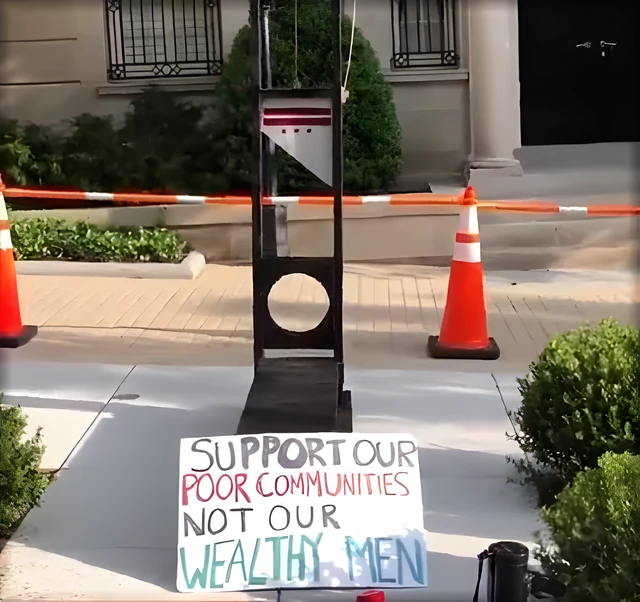
Then we have what has been described as a small-business apocalypse going on right now across the country. Your erstwhile employer, Amazon, is finally close to accomplishing its long-term goal of consolidating all online commerce under its umbrella, with only a few other behemoths providing any sort of token competition. The consolidation of all commercial activity in the hands of just a few giant global conglomerates, a trend long noted by observers, has for the most part been accomplished thanks to COVID-19. Inequality is now surpassing Gilded Age levels. I just heard that protesters are constructing a guillotine outside of one of Jeff Bezos’s many mansions. America’s billionaires saw their fortunes soar by $434 billion during the pandemic. As Mark Blyth likes to remark, quote, “The Hamptons are not a defensible position,” close quote. No wonder they’re so afraid of protesters. How can one look around and not see that the country is falling apart in front of our very eyes?
And then there’s Trump. It’s difficult to discuss the administration objectively due to the extreme polarization of American society, itself a cause and symptom of collapse. But I think it’s fair to say that the political norms that have kept America relatively stable throughout all of the above challenges are being dismantled by the day. When has a sitting president taken every opportunity to openly cast doubt on the validity of an upcoming presidential election? When has a sitting president contemplated suspending the election outright, even as his cronies dismantle the United States Postal Service, an institution that has literally existed since the republic was founded? At this point, no one thinks the transfer of power will go smoothly. The only question is, how bad will it get? Think about that. The world’s oldest democracy can’t even hold functional elections for political office anymore.
And that’s before we get to the many, many blatant examples of voter disenfranchisement. For example, this spring, I myself was unable to vote because the polling stations in my city went from 180 to just four overnight, and attempts to delay the election were deliberately thwarted by the state Republican Party using the court system — the same court system they are now using to overturn mask requirements. Thanks to gerrymandering, the Republican Party has an ironclad grip on power in my state, and is using it to strip authority from the recently elected Democratic governor, all of it with the tacit approval of much of the electorate. As Nathan Robinson noted in The Guardian, quote: “A failed state is one that can no longer claim legitimacy or perform the government’s core function of protecting the people’s basic security. Lately, the Wisconsin Supreme Court seems to be doing its level best to make its state qualify for failed status. Multiple decisions have both undermined the government’s legitimacy and endangered the people.” Close quote.
Perhaps the most shocking aspect of the Trump phenomenon is the extent to which his cult-like followers appear to be living in a totally alternative reality, curated by algorithm, one in which COVID is no big deal, the economy is doing great, the police are never wrong, the news is fake, voting fraud is endemic, climate change is a Chinese hoax, homicidal Black hordes are pouring out of inner cities, Democratic-run cities and states are all economic basket cases, and the U.S. health care system is the best in the world; Democrats want to confiscate all your guns, and the biggest threats to Americans are socialism and cancel culture. And these opinions are as impervious to facts as Captain America’s shield is to bullets. How can representative democracy function when there’s no longer even a shared common basis in reality? Then we have the QAnon supporters, a bizarre and growing conspiracy movement that is truly living in a separate reality.
Energy shortages aside, James Howard Kunstler hit the nail on the head when he noted that, quote, “Sometimes countries just go crazy,” close quote. It seems like an apt description of what’s going on right now. To steal yet another phrase from Kunstler, even if Biden wins the election and by some miracle there is a peaceful transfer of power, the yeast people will still be there, and will inevitably rise again.
So, to recap: we are unable to hold free and fair elections, and heavily armed right-wing paramilitaries openly patrol the streets of American cities and occupy statehouses with tacit approval from the authorities. Large parts of the country are under de facto one-party rule. The police shoot people with impunity. Cities and states across the country are on the verge of bankruptcy, with the federal government held hostage by a radical conservative movement. Millions are unemployed. This is already below failed-state status. Why aren’t more people pointing this out? Why aren’t people shouting it from the rooftops?
The first post I wrote that went viral, back in 2012, was called “What If Collapse Happened and Nobody Noticed?”, referring mainly to the austerity measures in Europe at the time. Now, here in 2020, I can’t help but ask the exact same question again, with even more urgency. How are you people not seeing this? How is any of this okay? Am I taking crazy pills or what? It’s as if the 1918 flu pandemic, the Red Scare, the Great Depression, the long hot summer of 1967, Kent State, the Ludlow Massacre, the disputed 2000 election and Hurricane Katrina all took place within the same 12-month period. At least the massive clouds of locusts are still confined to Africa — for now.
Had I said this to you years ago — say, back during the heady days of your so-called doomer phase — you might think that we would all be living in something out of Cormac McCarthy’s The Road. And yet it all seems so normal. As I noted, a city a mere 25 miles from where I live was engulfed in riots, yet I only found out about it by going onto the BBC News website. I still go to work. I still walk to the store for some wine, albeit while wearing a mask. I still buy tacos from taco trucks. It is a beautiful, warm, sunny day today, with perfect weather. I still have electricity, running water and internet service in my house. Yet just a short stroll from where I live, there is a walking path along a river where a large number of homeless people have set up camp, and every off-ramp now features someone holding up a cardboard sign asking for spare change. Oh, did I forget to mention the coin shortage?
This is it, KMO. This is what collapse really looks like. By just about any metric, aside from maybe screen size and processor speed, the world since 2008 has gotten progressively worse for the average person all over the world. Even the vaunted internet, the subject of so many utopian visions from the late 1990s, has been transformed into either a vehicle for mass surveillance, a vector for the propagation of disinformation and agitprop by hostile state actors, or an echo chamber contributing to the radicalization of malcontents and a way for them to coordinate their activities. And the march of illiberal, nationalist, authoritarian governments is not confined to the United States. It’s a worldwide phenomenon, including places like Brazil, Turkey, Hungary, Poland, the Philippines, Belarus — especially relevant right now — and arguably India, China and Russia. And that’s on top of countries that were never viable democracies in the first place, or are in outright meltdown, like Syria and Iraq.
So when I still hear people wondering, “When will the collapse occur?”, I can’t help but wonder what reality they are living in, or what the heck they are expecting. It’s like someone asking, “When will the ballgame start?” during the sixth inning. I think it comes from an eschatological background inherited from Christianity, where we are patiently waiting for a single defining event which will be some sort of turning point. There has always been a quasi-religious aspect to the collapse and survivalist mentalities which has obscured an accurate appraisal of our situation.
As an aside, in my opinion, the notion that “I will be okay” by disengaging completely from the wider society and somehow living off the grid in a country of 328 million people is a dangerous fantasy, and yet another manifestation of the toxic American concept of rugged individualism, which has gotten us to this point in the first place. It won’t work. Any society, no matter how large or small, is an ongoing collective enterprise. We are not Robinson Crusoes, all living on our own private islands, no matter how many MREs and cases of bottled water we stock up on. The very notion is proof positive that people have pretty much abandoned even trying to constructively reform the system at this point. It’s on autopilot. We are powerless, and we know it. It’s easier just to give up and withdraw. Defeat is better than disappointment. Even the Silicon Valley tech oligarchs are buying doomsteads in New Zealand, because, as Slavoj Žižek once quipped, it’s easier to imagine the end of the world than an end to capitalism.
So you weren’t wrong about collapse, KMO. You were just early, and got some of the details wrong. But that’s true for most of us. But the collapse is here, and it’s happening right now. I don’t think that’s disputable at this point. We’re in for a long, long period of chaos and decline that will probably last for the rest of our lives. After that, it’s impossible to tell what will happen. Perhaps the title of one of Buckminster Fuller’s books sums it up: Utopia or Oblivion.
KMOAll right, we’re going to pause there. And I’m not going to say a whole lot just yet. I will just say that the rest of the email doesn’t deal with collapse specifically. It shifts gears and looks at a different topic.
KMOBut before we get into the second part of Chad’s email, I want to share a response from Marc C. Marc is somebody who has been a guest on the C-Realm Vault Podcast, but his instinct for self-preservation prevents him from appearing here on the main C-Realm Podcast, and I don’t blame him. Marc C. works at a university in Maine, and he is a regular participant in the very-low-traffic group which is the Friends of the C-Realm — actually, it’s not the Friends of the C-Realm; it’s the C-Realm Podcast discussion group on MeWe.com. So I posted Chad’s entire email to that group, and this was Marc C.’s response. Marc C. writes:
You are not crazy. This is the real thing. We are deep into societal and national collapse at this point. I’ve been having this conversation on MeWe, where I exchange opinions with at most two people, and on a few other sites limited to communists, for years. I think it is very likely, à la John Michael Greer’s catabolic collapse scenario, that most people won’t notice the process. They’ll notice the local riots, or shortages of stuff that was recently available, and maybe the more extreme political manifestations of late-stage capitalism. Otherwise, not so much. Anything noticeable can be presented and framed by well-situated elites or their professional minions such that a systemic understanding and analysis is very difficult, or impossible, for most people.
That said, some of these situations have happened before, just not in such close proximity time-wise, or with such a wide range of calamitous happenings, and on an international scale. When I lived in L.A. in the late ’80s and early ’90s, it was just about at the level of a failed state. Racist cops, cops working with gangs, shakedowns by gangs and cops, unsolved murders, riots and burning buildings — we had it all. We also had, albeit minus internet monopolies, very little real news about any of it. When a situation got to the point of burning buildings, the L.A. Times did a story or the six o’clock news covered it; otherwise it might pass entirely unnoticed. I watched a riot in South Central Los Angeles, complete with rioting cops breaking down apartment doors for no obvious reason — why not, right? Thousands were involved, and it got a short segment of about a minute on the nightly news and then a few lines in the back pages of the L.A. Times. All the news was vague on detail: bad people causing trouble, that sort of thing. One May Day in the early ’90s, a contingent of unknown protesters marched through the first floor of the L.A. Times and trashed it without receiving the slightest mention. Police also didn’t bother to stop them. Too much trouble, maybe.
The ’70s were also pretty violent everywhere, or at least that was the impression I had as a child, via the adults around me. We had the Klan and mean-spirited right-wingers on one side, and a hodgepodge of leftist rebels whose main focus seemed to be robbing armored bank trucks. Most of the violence on the left was more myth than substance, but a generalized state of potential violence on all fronts was a constant lived reality. Race, religion, just being in the wrong place — any of that could get you trounced or worse. I was regularly trounced for being something or other, and I’m a relatively average white dude.
Is the current situation worse, or likely to get worse? I don’t know. But as a long-time reader of your blog, I value your opinion. The reason I bring this stuff up at all is that people forget how bad things were in the past. I do. I wouldn’t remember this stuff if I didn’t have written evidence via my own notes and newspaper clippings. It just seems like it couldn’t have happened. But I was there for some of it, and yeah, it really was that bad.
The reverse is also true. I teach college classes, and students last semester called BS on my claim that when I was in high school, you could have a reasonable life on a convenience-store night cashier’s pay — a life including a late-model used car, weekly entertainment, a decent apartment and food. They accepted all sorts of other stuff I said, but that one? No way. He’s making this up just to get a point across.
As bad as Chad’s description is, I’m still not sure that it is worse than the recent past, although I fully believe we are heading down the Hershey Highway at a decent clip. If things are going to get precipitously worse, then we really are in for it. I say this because my perception is that there is no left to counterbalance the worst of the right wing. No communist party or nation out there, however corrupt they might have been; no real organized opposition at all. As recently as the ’90s, there was a small but persistent leftist presence in places where I lived — i.e., Los Angeles and the Central Valley of California, and South Korea — usually communist, but with other hard-left groups in there as well. They were already long in the tooth and often stubbornly backward-looking, but they weren’t to be toyed with. I watched the Progressive Labor Party and a group of anarchists negotiate the release of a prisoner with the South Pasadena Police Department at the end of a demonstration once, and it was an impressive demonstration of power. The PD clearly understood a lot was at stake, and was willing to break the law in favor of release. The person in custody had committed multiple misdemeanors and maybe a felony. These parties also had a lot of surprising connections in education, the military, even among cops.
As weak as these groups were, I do not believe their equivalent exists anywhere in the U.S. today, and I doubt their existence outside of the U.S. as well. My take is that these groups weren’t destroyed by COINTELPRO-type operations, although those persist. They fell apart because people, whatever their political inclinations, could generally go to college, have hobbies and entertainment, and get jobs that weren’t so oppressive they drove you into the arms of open rebellion. At the same time, real rebellion was increasingly addressed with fast and extreme punishment, such that it was easier, and appeared more effective, to channel left sentiments into safer forms of expression. I think that’s the genesis of identity politics, and the sort of feminism that finds Hillary Clinton or Kamala Harris impressive.
I guess my first question is whether the right wing — and really all the politics in the U.S. is right of center — will continue the carrot-and-stick approach now that there is no real left opposition, or whether they will just go for broke. I figure they will continue with carrots and sticks so long as the system is profitable for them. If, as you suggest, we are really, seriously in collapse, though, all bets are off. Why present carrots at all?
Where I am, things are relatively normal. My university is handling the situation as you would expect of a well-run establishment, with testing, retesting, tracing, mandatory rules for just about everything, and lots of really detailed scientific explanations for each of the rules and plans. That said, Maine has always been sort of a semi-third-world backwater, and we remain so, and things are clearly getting worse. Also, everyone is armed to the teeth and tetchy, albeit so far we’ve had very little actual violence, and most gun injuries are accidents. There are a lot of those, though.
Program identification: “You’re listening to the C-Realm Podcast with your host, KMO.”
KMOOkay. Now I will give my own feedback to the first part of Chad’s email. Marc started off by assuring Chad, you’re not crazy. Chad, you sure sound crazed. I don’t think you’re crazy. I don’t think you have any clinically diagnosable condition. But you do seem to be taking a very alarmist approach to examining the current moment — which, you know, a lot of people resonate with. And if you’re a blogger, before you can communicate anything to anybody, you have to get their attention and hold their attention.
So you ask repeatedly: how can anybody see what I’m seeing and not come to the same conclusion that I’m coming to? Now, that’s actually a sort of meta-paraphrase of what you asked. What you asked over and over again is: how can anybody see the things I’m describing and not see it as collapse?
Well, for example, I’m listening to the audiobook of The Storm Before the Calm: America’s Discord, the Coming Crisis of the 2020s, and the Triumph Beyond. In it, the author, George Friedman — who I know is anathema to some of you out there, those of you who have heard of him — is looking at the history of the United States through the lens of two cycles. There’s an 80-year institutional cycle, whereby government institutions tend to encounter crisis and then adapt to that crisis, largely by the government reinventing itself or embracing some new paradigm. That happens about once every 80 years. Then there’s a socioeconomic cycle that happens about every 50 years, and this is not driven by the actions of institutions, but by the economy and the evolution of belief systems and identities — national identities, cultural identities, racial identities. And throughout the nearly 300 years3 of this country being a country and having a government, these two cycles overlap, of course, but they have never started and stopped at the same time.
According to George Friedman, the 80-year institutional cycle is coming to an end right around now, maybe a couple of years from now, and the 50-year socioeconomic cycle is coming to an end in the early 2030s. And he discusses in the book pretty much everything that Chad addressed in his email, and he says that all of this stuff is going to get worse throughout the 2020s. But then, toward the end of the 2020s, there’s going to be a new institutional paradigm, whereby the rule-governed technocracy and the infrastructure of government — which touches everybody’s lives, but which is so impersonal and so inflexible — will be replaced with a system where the people who implement government power and who represent the government hierarchy at every level will be invested with the ability to exercise common sense. And this is going to usher in a period of stability and prosperity — which, of course, will encounter troubles 50 and 80 years down the line, probably sooner than that.
But the short answer is: if you see collapse as some sort of finality, some sort of end state, I think it’s ridiculous to think that the United States has collapsed — that this is the end state, that we’re going to be like this forever. No, this is a period of crisis. If you follow folks like George Friedman, it is a repeating, cyclical crisis that will come around again, though we ourselves will be dead before it does. But starting in the 2030s, George Friedman, who acknowledges everything in Chad’s email, thinks that we are going to enter a new cycle, whereby we will enjoy an extended period of calm and prosperity. So that is one way to look at the exact same evidence and come to a different conclusion: to abandon a linear sort of apocalyptic finality and adopt a more cyclical view of how nations and civilizations progress, age, develop and, dare I say, evolve over time.
KMOAll right. Now, I mentioned that Chad’s email was pretty long, and not all of it had to do with the big-picture state of collapse here in the United States. Rather than try to summarize the second part, here’s the conclusion of the email that I received from Chad Hill. Chad continues:
Switching gears to your conversation with First about gender relations: one topic that didn’t come up was the radicalization of many of these disaffected young men to extreme right-wing politics. One would think that if any demographic group would benefit from reforming the current pseudo-meritocratic, winner-take-all economic order, it would be them. On the face of it, these young men should be a natural constituency for ideas like reducing extreme income inequality, taxing away enormous multigenerational fortunes, labor unionization, requiring employers to provide decent wages and benefits, subsidized higher education and training for everyone, and establishing things like MMT’s jobs guarantee.
But they’re not doing that. Instead, this demographic appears to be lurching more and more to the extreme right. They are channeling their lack of advancement into these intense hatreds for feminists and political correctness, rather than looking at the underlying economic conditions affecting their lives. Indeed, when one thinks of a stereotypical incel or NEET — that’s N-E-E-T, not in employment, education or training — one thinks not of the mythical Bernie bro, but rather of a troll on 4chan shitposting memes in order to own the libs or trigger the snowflakes. What’s going on here?
It seems that most socially awkward young men — the white ones, at least — have been gaslit into supporting a philosophy that is expressly designed to concentrate wealth even more at the top and leave them with even fewer opportunities and a bleaker future than what they have now. They seem driven by some inexorable force to support the economic libertarianism that has destroyed their future. Why is this? Why are they fighting so virulently to defend an economic system that has basically destroyed their lives? Why are they fighting against higher taxes on the wealthy, and for stripping away the remains of the welfare state? It’s just so bizarre. It’s as if the Jews were the Nazis’ most fervent supporters. I’m glad that you were willing to take on this charged topic. The lack of discussion surrounding it, and the denial that it’s even happening, are only going to further the radicalization process. I’d be curious to hear First’s reaction to this trend.
To give a partial answer to my own question, I think one reason is simply that, unlike the left, the right has actively courted this demographic. There is a quote by Steve Bannon to the effect that gamers were his ideal candidates for radicalization. It does appear that there is an active online recruitment effort targeted to computer gamers, many of whom are the young men who have difficulty finding girlfriends or establishing careers. As Vox put it in a 2019 article, quote, “A rot has quietly spread among video gamers: a reactionary political culture from which outright white supremacist groups have been recruiting America’s men and boys,” close quote. This, of course, does not mean that anyone who enjoys computer games is a budding fascist, if that needs to be said.
The popularity of Jordan Peterson provides another example. It’s obvious that Jordan Peterson’s message is deliberately tailored primarily to struggling young men and boys, although admittedly it is not confined to this demographic. Peterson’s philosophy centers on reclaiming traditional masculine values, and peddles an idiosyncratic metaphysics as the antidote to the chaos unleashed by a creeping cultural Marxism emanating mainly from college campuses, where gays, transsexuals, feminists and assorted radical leftists reign supreme. Economically, Peterson promotes a form of libertarianism to his fans — or classical English liberalism, as it has been rebranded — while defending the status quo and deliberately conflating social democratic movements and Soviet-style communism.
At the same time, hysterical attempts to depict Peterson as a misogynist or even a fascist reflect a deep hostility among some of the more extreme parts of the left to even speaking to this demographic. There is a small but vocal part of the left today that depicts anything remotely related to white males as evil, and depicts them as the fountainhead of everything that is wrong with society. This is obviously counterproductive. It’s clear that such rhetoric is driving many men into the arms of the reactionary right, but some parts of the left don’t seem to care. In fact, they even seem to welcome it. Now, I think the number of leftists who think this way is very small, and has been deliberately exaggerated as a rhetorical weapon, but it surely does exist.
Another reason might be that these young men have been conditioned to see the welfare state as the root cause of their lack of success with the opposite sex. One frequently hears grumbling from certain quarters online about how women can supposedly have as many children as they want without men, because “the state is their daddy.” This assumes that stripping back the current social democratic welfare state, such as it still exists, will somehow rewind the clock back to a patriarchal system where women are once again dependent upon males for economic survival. Yet, as you pointed out, the majority of college graduates are now women, and they are seen as more desirable employees by today’s corporate culture, for better or worse. These reactionaries are cutting off their nose to spite their face. Women aren’t going to go back to being economically subservient without some sort of repressive government straight out of The Handmaid’s Tale, which I certainly don’t want. Blessed be the fruit.
Another factor is that the mainstream left in America is increasingly pitching itself to the winners of this system, the so-called professional-managerial class. As Hillary Clinton mused, she won among the, quote, “economically dynamic,” close quote, regions of the country — the places that were, in her words, quote, “optimistic, diverse, dynamic, and moving forward,” close quote. Thomas Piketty calls this the Brahmin left, an apt description. If you don’t happen to live in one of those optimistic, diverse and dynamic areas, and have no chance of ever living in them due to the unaffordable housing and education costs which have effectively constructed an invisible moat around them, why then would you feel any sort of affinity for the left’s current platform and policy goals? At least you’re not walking on eggshells when you tell a coarse joke among your right-wing buddies.
The vision of uniting the working classes of all demographics and geographic locations into a coherent pro-worker movement that effects real change is forever sabotaged by this cultural condescension. You’ve mentioned it many times before. It’s frustrating to those of us who want this vision to succeed. It’s the vision that was promoted by Bernie Sanders and articulated by shows like Rising, which I believe you are a fan of, as am I. There is no one who is even attempting to speak to the life experiences of those whom Chris Arnade poignantly referred to as, quote, “the people in the back row,” also known as the unnecessariat. And so, without even the hope of a better future, increasing radicalization is unfortunately the probable trajectory for such people. We see it already. It shouldn’t have to be this way, but that’s the way it is. Hillary Clinton may not have called all Trump supporters deplorables, but the enthusiasm with which they embraced that label to refer to themselves is one of the most telling things from that election, I think.
At this moment, I feel so helpless when I see so many young men embracing the toxic politics of the extreme reactionary right, who see those of us fighting for better economic conditions for all of us as the mortal enemies — in some cases, enemies to be slaughtered. And indeed, many factions of the left relish seeing them as enemies as well, when they should be natural allies. As you noted previously, the right tends to seek out allies, while the left looks for heretics. I don’t, of course, and neither do you, but I don’t know how we stop this. I guess discussions like this are a start.
What brought this vividly to mind is the case of Kyle Rittenhouse, the 17-year-old vigilante who shot and killed several people during the riots in Kenosha this past week. From the reports, he seems to have been obsessed with guns, police, the Blue Lives Matter movement, and was an enthusiastic Trump supporter, even attending his rallies. He seems typical of a lot of these young men. He lived in one of the anonymous, down-at-heel areas in the northern Illinois flatland, and was raised by a single mother who appears to have given him the gun and driven him to the protests.4 So a lack of a father figure — and yes, he probably didn’t have a girlfriend either.
From my observations, it seems like some form of guard labor is the only option for downwardly mobile whites looking for a decent life nowadays. What does that say about our current economic conditions? It’s especially popular among rural whites, who tend to be rabid gun enthusiasts. This isn’t given enough attention. I work with a number of non-college-educated blue-collar folks, and all of their male sons are in the military, while all of their wives and daughters are nurses or work somewhere in the health care industry. They are mostly Trump supporters, although not enthusiastically. When I was young, you might see a security guard only at a bank, if there. Now they are everywhere. Obviously, the more unequal a society is, the more guard labor you need to protect the property of the winners from the burgeoning mass of losers. In this scenario, being a cop means you’re not a loser. I wonder if this tweet has a hint of truth. So here’s the tweet:
“These ideas — fascism, authoritarianism — are also aligned with some aspects of the psychology of power and how people react when they perceive themselves to lack power. People often compensate by latching on to ideologies which help them retain a sense of power or explain their feelings of lost power or control.” End tweet.
Chad continues: I’m going to go ahead and guess that having the power trip of a gun and a badge beats wearing an orange smock and cleaning up aisle seven, which is probably the only other option for a boy like Kyle — just like it’s more exciting and lucrative for inner-city Black youth to sell drugs than to flip burgers and man the deep fryer. But what does it say that these are the best options on the table for so many young men in our country today? What it says to me is that much of America is quietly becoming an open-air prison with two classes of people: guards and laborers. That’s a damning indictment of America under late-stage capitalism, of course, but it won’t show up in the traditional economic metrics. After all, Dachau had zero percent unemployment and reasonably high productivity. Work makes us free.
The profiles of his victims are interesting as well. Their profiles are a bit different. They’re a tad older, in their 20s and 30s, but still quite young, and both of them apparently did have girlfriends. One had a daughter, and another a stepdaughter. But interestingly, neither appears to have been married. However, none of the reports I’ve read about them so far mentioned them in connection with any sort of job or profession. The only career mentioned for either of them was skateboarder. Also troubling, but in a different way. So radicalization might be caused by the same underlying economic conditions, but manifest itself in profoundly different ways.
So that’s the reality in America today for young men. The skateboarding enthusiast becomes a Black Lives Matter protester, while the gun enthusiast becomes a cop firing tear gas at the Black Lives Matter protester. In the past, small-town guys like Anthony and Kyle might have worked alongside one another for the same company, sent their kids to the same middle school, attended the same church and played on the same softball team. Now, instead, they’re rootless and confused young men, sitting on opposite sides of America’s increasingly divided society — tragic victims of a country increasingly unraveling at the seams and inevitably spiraling towards civil war. How do we stop this? I wish I knew the answer.
So anyway, a lot of thoughts, but no real solutions. In other news, I just recorded a podcast with Christopher Ryan of the Tangentially Speaking podcast. I don’t know how articulate I was; I was battling a major case of impostor syndrome the whole time. His podcast topics have quite a lot of affinity with yours, from people living off the grid to psychedelics. I’m going to do my best to suggest you as a guest. Because I’ve been working partially at home thanks to the virus, I now have a pretty good teleconferencing setup, if you’re interested in recording another podcast. Regards, Chad Hill.
Program identification (partly unclear): “You’re listening to the [wording unclear; heard “podcast. Your mind,”] one week at a time.”
KMOThere’s the second part of the email — the conclusion of Chad’s email. And this is where I think, Chad, if you are looking to paint a worst-case scenario, your obvious blue-tribe allegiances prevent you from spelling out all that’s really going wrong in our society right now. Because you take the image of the alt-right, girlfriend-less, angry young man who’s been seduced by the Steve Bannons of the world into supporting extreme far-right politics. Where do you get that impression?
So, in response to Chad’s email, I wrote back to him, and — I’m not going to read the whole email — among other things, I wrote:
I just had my 19-year-old son here for a month. A blue-checkmarked Twitter user would probably call him an extreme right-winger, and that would be absurd. Yes, he disdains some of the more ridiculous ideological demands from the blue-checkmark set, but he’s not into guns or Blue Lives Matter or anything like that. He followed Jordan Peterson for a while, but I think he’s moved on from there.
You wrote, quote: “Indeed, when one thinks of a stereotypical incel or NEET, one thinks not of the mythical Bernie bro, but rather a troll on 4chan shitposting memes in order to own the libs or trigger the snowflakes. What’s going on here?”
KMOTo which I responded:
Your characterization of 4chan indicates to me that you don’t spend much time on that site. It reminds me of when SJ leftists compile clips of Joe Rogan to demonstrate how problematic and deplorable he is. I don’t listen to Joe Rogan regularly, but I tune in for certain guests, and I’m familiar enough with his modus to recognize bad-faith attempts at character assassination when I see them. Joe Rogan is habitually humble, recognizes the limitations of his own knowledge and perspective, and defaults to a fair-minded neutrality, or at least agnosticism, most of the time. He even brings people onto the show that he doesn’t agree with and lets them talk without interruption.
If you go to 4chan looking for confirmation of your pre-existing belief that it’s a hotbed of proto-fascism, you’ll find what you’re looking for. But that’s like listening to 100 hours of The Joe Rogan Experience to find three minutes of out-of-context statements that portray him as a racist, sexist, transphobe, blah, blah, blah. Personally, my problems with 4chan are aesthetic and generational. The formatting of the site is profoundly ugly, and the lack of ongoing identities for the posters renders any sort of reputational appraisal of an offering obsolete. To me, that’s a bug. To my son, it’s a feature. Generational differences. But for most participants, posting to 4chan isn’t about owning the libs. They know that the libs aren’t reading 4chan, except to dredge for evidence of Nazi sympathies. There is a community project in progress there that can’t be articulated by people who only go in looking for evidence of guilt. Anyway, lots to talk about.
KMOTo which Chad responded: “You’re right. Guilty as charged. I don’t know much about 4chan beyond the stereotype.”
So you invoke a stereotype. You invoke an image of the worst of the young, alt-right, disaffected youth, and accept that that stereotype accurately describes a broad swath of single young men who are disenchanted, disenfranchised, discouraged, dispirited by the whole dating scene right now. But then you describe the worst of the left — the left that not only doesn’t care if young men are driven into the arms of the alt-right, or the extreme right wing, as you describe it, but who actively embrace that; who understand how damaging it is to demonize young white men and go ahead and do it anyway. And then you say that that’s a tiny, tiny fraction of the left — a tiny little sliver of the blue tribe.
Yeah, it might be a tiny sliver, but that tiny sliver has a lot of leverage, because they’re in the HR departments at the big tech companies. They’re the blue-checkmark people on Twitter. I mean, basically, that is the ideology of official Twitter — of the company, of the platform, and of the users that it chooses to promote and champion. And I won’t go into all the conspiracy theories, or conspiracy facts — I’m not well versed in it — but there is a huge body of literature and discussion and debate over the supposed ideological neutrality of platforms like Twitter and Facebook. You don’t have to be some crazy right-wing conspiracy theorist to see a thumb on the scale there.
So from my perspective, you accurately articulate the harmful tactics of the blue tribe, but then you say, oh, this is just a tiny, insignificant little subgroup. They are tiny, I’ll grant you that, but they’re not insignificant. They wield power, and they use it destructively — to the destruction and despoilment of this culture, this society, this civilization, this nation. And from my perspective, to pick on the red tribe at this point is to completely lose the plot. It is the blue-checkmark Twitter set which the rank-and-file blue tribe need to reject and ostracize as the fanatics that they are.
So, I talked to First of [name unclear; heard “Incelmatics”]. He had made a documentary about the black pill, which is basically informed nihilism, is how I would describe it: people who take an honest, informed look at evolutionary psychology — the differing reproductive strategies of women and men, and the psychology that those reproductive strategies give rise to — and then at how a corporate workplace which prefers female workers, and a dating sphere which is shaped by apps which definitely tilt the tables in favor of women, affect young men trying to establish themselves as adults, with careers and mates and families and the suite of responsibilities and opportunities that give rise to what we used to think of as an adult in the 20th century. And you just appeal to the blue-tribe stereotype of: oh, they’re all deplorable, ugly, racist Nazi sympathizers who have been swept up by the alt-right. Well, I forwarded your email to First, and here’s how he responded.
FirstHey, KMO, this is First, and this is my response to Chad Hill’s excellent letter to you about collapse and some of the things he touched on about gender relations. I’ve been following Chad Hill and his writing on The Hipcrime Vocab since about 2015 or 2016 — so about the same time I found the C-Realm and started following that — and he has some of the most excellent writing I’ve ever encountered on the internet, especially his critique of the modern system, and specifically the neoliberal order in the West.
So he talks in his first paragraph about gender relations — that many disaffected young men are kind of attracted to extreme right-wing politics. I’ve seen exactly the opposite. This is just mind-boggling to me, because just yesterday we were basically having a conversation in one of the largest Discord servers of the incel community, and we were talking about Marxist views on labor. I mean, you will not find a more class-conscious group of people than incels and the black pill. They’re very class-conscious. They’re very conscious of their belonging in the social scene. The black pill is not only gender relations; it’s economic. And I don’t understand where this comes from. I guess on the surface level you get these ideas that they are on the right wing, but I’ve seen nothing but the opposite. It’s mostly centrists. They’re a bunch of centrists, and a lot are left-leaning now, especially when it comes to labor and stuff like that.
So when it comes to why black-pillers or incels detest the far left, it goes back to the 2012 Occupy Wall Street movement.5 What happened is Occupy Wall Street was getting big, and it was all about the working class reacting to the 2008 bailouts of big business and Wall Street itself during the recession. And it seems that this movement got co-opted or infiltrated by this woke type of — race, you know, all these things to split the movement up. There are many disaffected men that left that movement — and one young woman too — because all of a sudden there were all these barriers: it was about who’s most oppressed. And it just seemed like the perfect wrench to throw at the movement for organized labor in America. That’s the best way you misguide it.
And part of this is what we call in the black pill the woke capitalist superstructure. It’s about these companies that say: hey, we support Black Lives Matter — but you can get evicted, you can lose your job. We’re not going to address the job crisis. We’re not going to address that real wages are going down, that the quality of life is going down for workers. They’re never going to address that. But hey, we support Black Lives Matter; we support the SJWs. And that’s kind of the problem. Everyone I’ve seen seems to be very class-conscious — more class-conscious than some of the leftist organizations on Discord or wherever. That’s why we’re discussing Marxist theories on labor and [wording unclear; heard “three books”]. We discuss that way more.
And Chad goes into Jordan Peterson. Jordan Peterson and things like PragerU are the most detested things in the black-pill community. We detest the traditionalists. We detest the tradcons, as we call them, because they are so out of touch with reality. They are speaking from a perspective of the boomer era, from the 1950s to the 1970s — the golden era of increasing wages, when a young man could just get a high school diploma and have a better quality of life than a college-educated worker now. It was easy for the boomers. So Jordan Peterson does not represent this movement at all. In fact, these are the most detested figures in the community. Again, we detest the tradcons because they are just out of sync with the reality of 2020, and they don’t address a lot of the labor reality. Again, I’ve talked to over a thousand incels at this point through various mediums, and we’re a very class-conscious group. We understand what’s going on here.
FirstHere’s a simple, basic, one-paragraph explanation as to what’s happening. There are not going to be the pro-family policies that we had in the past. KMO, you talked about Rising — how one of the commentators on the show said that the best policy you could have for America right now is to encourage 30-year-olds to get married. The thing is, the elites at the top have increasing automation. For the first time — that’s why the Fourth Industrial Revolution is so different — an extreme amount of labor is being shifted around to cheaper countries through globalism, through the sharing economy, which takes jobs and cuts them into pieces, and through full-on automation, which Andrew Yang talks about. This is what we’re experiencing.
So if the elites have a system that can replace labor, why would they need families to form? Why would they need a man and a woman to get together? That’s why this incel crisis will never get addressed by the top: because they don’t need it. They need more people to not have kids, because what happens when they do is those kids have the potential to become disenfranchised labor. Even during Obama’s recovery, we still did not create enough jobs just for the number of people turning 18 each year and entering the labor force, even with the abysmal birth rate we had. So this issue won’t get solved, because with oncoming automation, labor is just not worth anything now. Labor’s share of the economy has been tanking since the ’70s. Productivity has decoupled from labor. The stock market has completely separated itself from the reality of the economic situation on the ground.
So again, this is the main issue, and this is why the gender crisis will never be addressed: because this is beneficial to the elites. You do not want a bunch of excess labor that’s going to go out and riot and protest. The Hamptons aren’t a defensible position, as Chad points out in the email. And when these riots happen, the people at the top don’t want those to get big. That’s why they introduced all this cultural and SJW stuff to Occupy Wall Street: because Occupy Wall Street focused on the top 1%, and they needed to subvert that. So, hey, now we’ve got white people going against Black people. That’s perfect. It’s division. And we’re seeing the same division in the gender dynamic.
And the whole reason why this won’t get addressed, and why this will get pushed, is because it makes sense for the woke capitalist superstructure that we have. If you have atomized individuals, they’re going to cope with their atomization by spending more money into the economy — by becoming better consumers. The women and the men that are split apart have to get their own apartment; they have to get their own furniture. It’s just like going from the extended family to the nuclear family: it’s an economic boom. It’s part of the system — to split everything up into individual consumers. It’s not going to be families, because families produce excess laborers that aren’t needed anymore and that are a danger. A labor glut causes a lot of radical [wording unclear; heard “causations”] that the elites don’t want at all.
But here’s the problem. The incel, black-pill sphere is centrist. It doesn’t really see a solution, left or right, because both the left and the right don’t want to address the sexual reality. Here’s the thing: now 51% of American men 20 to 29 are single. That’s Pew Research that came out very recently.6 For the first time ever, we’ve seen this many single males. So the situation is getting worse. More incels are created every day. There’s an excess of 10 million young baby boys being born every year.
And here’s the difference — I will send this to KMO as well — the share of U.S. adults who are single varies by demographic group. Among men 18 to 29, 51% single; among women 18 to 29, 32% single. When you get to 30 to 49, 27% for men, 19% for women. So women are doing much better, and this is not addressed. We know this. We haven’t heard this from any side. Our frustrations haven’t been addressed.
And even if you do make it up in the economic sphere — you do climb that hard ladder that’s constantly being cut away — you find that there is no result. So when incels see that even if you economically succeed — even if we have MMT for jobs, or some type of more egalitarian policies to re-franchise labor — it’s not going to help them with the most important, critical thing they’re missing, which is a steady relationship, they have no motivation to get behind the left or the right. They want their issues addressed, and they’re not being addressed.
I mean, men are far more likely than women to be on the dating market: 61% of single men say they are currently looking for a relationship or dates, compared to 38% of single women. You have a biological difference. Women, when they were sampled on OkCupid, which is a huge sample size — it’s very statistically valid — said that 80% of men are not attractive. So even if we do have an egalitarian society, most men will continue to lose out.
That’s why it necessitated the female being disenfranchised in order for things to work like they did for the boomers and sort of Gen Xers. The female had to get together with the regular guy to climb the socioeconomic ladder. There weren’t a lot of jobs for women; there weren’t a lot of education opportunities for women. A woman basically had to attach herself to regular Joe — working Joe, working at the factory — to be able to join the middle or upper classes. And when you don’t have that system of incentive, most women drop out. They want nothing to do with most men. And this is clear. I have two documentaries showing this, and to deny this is just insanity.
FirstAnd I know Chad Hill has had issues in the past because of childhood poverty, and he couldn’t date and stuff like that, and he’s a Gen Xer himself. I won’t say “okay, boomer” to what he says, but it’s “okay, Gen Xer,” because even though I love his writings, Chad Hill is completely out of touch with the modern reality — calling incels and black-pillers far right when they’re actually more left than anything. They’re more class-conscious than a lot of groups. It’s just hilarious to me. Jordan Peterson is detested. PragerU is detested. All these right-wing talking heads are detested. So it’s not a crazy right-wing group at all. And we’re just looking for these things to be addressed.
Because that’s going to be the most important thing on the hierarchy of needs. You cannot start to mobilize incels to really discuss a future for labor when they’re so demoralized by basically not having a steady relationship. From the work of Dr. [name unclear; heard “Gil Martin”]: it rots the male brain. It rots any brain. You can’t dump the excess cortisol that you keep getting without a steady relationship — as a man, without an oxytocin jump once you’re in a steady relationship. I’ve encountered this; many have reported this; and this is true. That’s research that I will send KMO.
And this is the problem. We need to address the inequalities in gender, or this whole thing’s going to collapse. Because to fix our current society, we’re going to need a mobilization like we had back when we had the New Deal. We need a new deal. But if you have demoralized men, how are you going to get anywhere? And they’re going to continue to be demoralized unless we address the realities between the genders. We’re addressing the realities between races, the realities between classes, all this — but gender? Nah, we don’t talk about it. And if we do talk about it, it’s denied. Statistics are outright denied. More men than ever are now single. More men than ever have no relationship potential and are completely socially isolated from most women. And there are barely any women stepping up and talking about this at all.
And it’s going to cause infinite frustration. Until this is really discussed — why can’t we have an honest conversation about gender dynamics in this country, the real ones, backed up by real statistics and data? — until we have that, get ready for more Kyle Rittenhouses. Because they are going to get radicalized, either by the left or the right. If these men had steady relationships — I know there are some outliers — but 51% of American men are single, and people wonder why we have such social instability. It’s not a good system to have, especially when it rots the male brain to become more like the warrior gene. That’s what excess cortisol does without the dump of oxytocin. That’s what the research shows. So that’s why men are going to get more violent. Men are going to get more frustrated. Men are going to get more extreme. The future is a lot of Kyle Rittenhouses. And not addressing this is going to be the downfall of any civilization, because you will not mobilize half of a gender to address any of the issues that we have with the collapse. So that’s the problem.
KMOThere’s First’s perspective. Chad, you invoked the stereotype of the angry young man disenfranchised from the dating market and also pushed to the fringes ideologically — by bad behavior on the left, and also by an invitation from the right. You took that stereotype as real. But here’s some feedback from First, whose information is not based on stereotypes. It is based on hundreds of conversations that he has had with other young men in this position. And they are a very class-conscious bunch, according to First — the absolute opposite of the stereotype that you invoked.
What will you do with the stereotype now? Will you reappraise it? Or will you ignore this evidence, which runs contrary to it, and just continue to accept the blue-tribe presentation of the deplorables — the young men, many of them in the economically depressed parts of the country, the middle of the country, flyover country — and say, yeah, it’s kind of a shame that these people could be our allies, but not make any real efforts to bring them in and actually engage with them and find out what their interests are?
Now that you have been given some information that this really is a very class-conscious bunch of people, what will you do with that information? How will you change the message that you articulate on your blog to incorporate this more nuanced understanding of the category of people that you dealt with through a very convenient stereotype — convenient for the blue tribe? You said that not everybody who enjoys video games is a proto-fascist, and that that probably shouldn’t need to be said. And yet you said it right around the same place where you were quoting Vox — and that is the official line at Vox: that gamers are deplorable. Gamers — young men who compensate for their lack of social achievement through video games, through simulated experiences of reproductive success, you might say: defeating enemies, gaining the rewards for your bravery. Now that you’ve heard from First on this, the next time you encounter somebody peddling that same blue-tribe dismissal of young men — that they’re all deplorable, that they are all proto-fascist, that they hate women — are you going to push back against that? I hope that you will.
KMOAll right, I’m going to leave it here for now. This is an episode of the C-Realm Podcast. On the next free episode, I hope to have Chad here for a one-on-one conversation.
But for the long-suffering C-Realm Vault subscribers: I am taking a little break from the audiobook production, but my reading of [wording unclear; heard “Donald J. Putin on American exceptionalism, it’s not you, it’s just America being America”] will continue not on the next episode but the episode after next of the C-Realm Vault Podcast. On the next C-Realm Vault Podcast, I have a conversation with Jim, [name unclear; heard “your ad attacker”] of the Attack Ads podcast. He lives in Seattle, which has seen some action recently, and we talk in general terms about the big picture of what’s happening right now. So that will be on the next episode of the C-Realm Vault Podcast.
All right. And also, I’m doing a two-hour live stream every weekday now, Monday through Friday, from 9 to 11 a.m. Eastern, in which I’m just drawing. You will see what’s on my Cintiq, basically — you’ll see the drawing emerge as I make it. And if you want to ask me questions in the chat, I will be happy to answer them by voice. So you’ll hear me speaking; I will see your typed messages. This stream is through picarto.tv — P-I-C-A-R-T-O dot TV — and my channel there is KMOart: KMO in all caps, “art” in lowercase. I would love to see some familiar names in the chat, and have people ask me questions so that I can keep jabbering the whole two hours as I’m drawing. Think of it as a live stream. It’s something which I think is important for people in my line of work — digital content creators — to do these days, and I am late to the live-stream game. So please help me catch up by following me there, participating, giving me something to talk about. And you can also make suggestions on things for me to draw.
All right. And finally, my YouTube production has fallen off a cliff as of late. Partially it’s because I had my kids here — first my youngest son, then my older son — for about two months total over the course of the summer. But also, the past couple of weeks I have been really caught up in chatting with Filipinas via Filipino Cupid and WhatsApp. So I joined the dating site Filipino Cupid, and I had the exact opposite experience of what First described for men on American dating sites. I was the sought-after property. I was inundated with attention. And I couldn’t help it: I had to behave the way that First and the incels describe women as behaving on dating sites here in the States. There was too much interest for me to respond to everybody individually. So most of the women who wrote to me got nothing in return — silence, crickets — because I couldn’t pursue them all. I pursued conversations with, I don’t know, 30 people. I spent many hours every day communicating with different people.
I sometimes fell into a sort of interviewer role, where I was not really exploring a relationship with them; I was sort of drawing their story out of them — which I realized isn’t why they were on the site, and which is not really fair. Because, as First and the incels say, in the American context women are getting what they want right there, at that level, from the attention via the app, whereas the men are seeking something more. Well, on Filipino Cupid it’s the reverse, at least for me. I was getting validation. I was getting a reward just from the online conversation, and for me it didn’t need to go any further than that to be valuable. Whereas a lot of the women that I was talking to wanted to move immediately. They wanted a change in their situation right now, and I couldn’t offer it.
So even though my paid month isn’t up yet, I have hidden my membership profile, so nobody else sees it. And really — I won’t say anything about her, because she’s very shy — my communication is basically down to one person, who I talk to on voice calls and video calls a couple of times a day, every day. So again, I’m getting a lot out of it just on the online level. And while I would very much like to move it into the real world with this particular person, that’s not going to happen anytime soon. So there’s a long story there, and here on the free podcast I’ve said as much as I’m going to. Although C-Realm Vault subscribers, and people who support me at just the $1 level on Patreon, get videos where I tell a bit more about what’s going on on the whole Filipino Cupid front. And I will be making a free video on that topic in the coming weeks.
So to see that, tune into my YouTube channel. It’s [wording unclear; heard “out of my head”]. And if you can’t find it on YouTube — I hate to say this, but it’s still the case — if you want to find me, type in “human suck,” and maybe throw in KMO as well, and you’ll find one of my early videos, which will get you to the channel where you can find the more recent stuff. Of which, I say, there isn’t a whole lot, because I’ve had a delightful distraction keeping me from directing my full attention to creative productivity here in recent weeks. But as you can probably tell from my tone of voice, I don’t regret it.
KMOAll right, everybody. I am turning my attention to editing now. But then, after that, I will be turning my attention to combing through that conversation with Jim of the Attack Ads podcast, and I’m going to pull out a few snippets to throw into the next free episode. Because I know most people here are not going to subscribe to the Vault and hear the subscriber-only content, and there’s some really good stuff in this conversation with Jim. So I’ll pull out some of the highlights and give it to you on the next episode of the C-Realm Podcast. I can’t promise it’ll be out in a week’s time.
All right, that is all. I’ve been saying for years, my formulaic close is “stay well.” But here in 2020 — wow. Let me say it with full intention and consciousness, and I really mean it, and I hope that you can follow this advice. C-Realm subscribers, C-Realm Podcast listeners, friends of the C-Realm, friends of mine, people I know and care about: please stay well. Take care of yourselves. I will talk to you again soon.
1. As spoken. This is episode 564; the number is transposed. ↩
2. As written and read. The federal pandemic unemployment supplement in 2020 was $600 per week. ↩
3. As spoken. The United States had existed for about 244 years in 2020. ↩
4. As written, from early reports. Later reporting and the 2021 trial record indicated that the rifle was bought for Rittenhouse by a friend, and that his mother did not drive him to Kenosha that night. He shot three people, killing two, as Chad says earlier. ↩
5. As spoken. Occupy Wall Street began in September 2011. ↩
6. As spoken. The Pew Research Center figures First goes on to cite (51% of men 18–29 single) are for ages 18 to 29. ↩
Keep following the conversation.
Also with First
Public audio available
Also with Chad Hill
Public audio available
Also with First
Public audio available