Also with Eric Boyd
Principles of Precaution →
Public audio available

2020-05-23
KMO talks with Eric Boyd about China's performance during the the Covid-19 crisis as well as the long-term prospects for a CCP-controlled China in the near and intermediate-term future. Grist for the conversation mill came from Peter Zeihan's series of newsletter series, A Failure of Global Leadership.
Open the formatted reading edition →
Reading edition · Published with KMO’s approval. Public. Covers the full recording: KMO's introduction; the audio of KMO's YouTube video summarizing Peter Zeihan's three-part newsletter "A Failure of Global Leadership"; Eric Boyd's emailed response, read on air by KMO; the first third of KMO's conversation with Eric; and KMO's closing through the sign-off. The remaining two-thirds of the conversation are in episode 366 of the C-Realm Vault podcast. Edited for punctuation, paragraphing, repeated words, fillers, false starts and obvious transcription errors. Speaker attribution is based on conversational context; no full audio listen has been done, and spots where the wording or speaker could not be settled are marked. Opinions and claims about China, the coronavirus, debt and politics are the speakers' own, or Peter Zeihan's as KMO summarizes him, as of May 2020; they are not checked here.
KMOIf you speak the truth, have a foot in the stirrup.
Hello, and welcome to another installment of the C-Realm Podcast. I am your host, KMO, and this is episode number 558, "Sino-Sustainability," with guest Eric Boyd, prepared for release onto the World Wide Web on Saturday, May 23rd, 2020.
In this episode of the podcast, we're going to be talking about China, of course, and the coronavirus and the Chinese Communist Party, and the geopolitical pressures that weigh upon it and its rule.
As you probably know, I have been, I won't say captivated, but certainly engaged and entertained and stimulated by the writing of Peter Zeihan. When I first got turned on to Peter Zeihan's writing — his last name is spelled Z-E-I-H-A-N — I didn't know how to pronounce it. So what stuck in my head was one pronunciation, and I've been saying it that way in videos and podcasts for over a year now, but it's really another. So you'll hear me pronounce it correctly and then revert to mispronouncing it, and you'll hear Eric mispronounce it. [wording unclear; the transcript does not distinguish the two pronunciations]1
He has written three books, which I have enjoyed, but he is a prolific newsletter publisher. A couple weeks back, maybe more now, he sent out a three-part newsletter talking about China. So I created a YouTube video summarizing the major points from this sequence of newsletters. And I was, I won't say scrupulous, but I made a point of not interjecting my own interpretations and opinions into this. This is straight-up book-report reporting.
So what I'm going to do, just to set things up, is play the audio from that video. As I recall, there were some slides in it that I make reference to, but you can certainly follow along without it. For those of you who have seen the video and don't care to take a second pass through it, skip ahead about 25 minutes. After the audio from that video, I will play something that Eric Boyd wrote in response to the video. And then I'll have Eric on the line, and we will continue the conversation from there.
So here is the audio from a video that I posted a week or so ago.
Program identification: "You're listening to the C-Realm Podcast. C stands for consciousness."
KMO (video)Hey, everybody. KMO here with a bit of an experiment. In this video, you will hear none of my own opinion. At least to the best of my ability, I'm going to keep my own opinions out of this.
Over the past week or so, Peter Zeihan has sent out a three-part newsletter essay — we'll say — called "A Failure of Global Leadership." So I'm going to summarize all three parts for you and selectively read from it, but mostly just summarize.
Peter Zeihan's larger narrative is that the United States has provided what he calls an order — or the Order, capital O — in the post-World War II years, where the United States provides high-seas security. Basically, anybody can trade with anybody. You can import your raw materials and export your finished goods from wherever you can and to wherever you want to, provided there's somebody there who wants to buy your stuff. And he argues that this order has not necessarily been breaking down, exactly, but the U.S. has been gradually, politely pulling away, hinting to other countries that they really should beef up their own defense because the U.S. isn't going to do it for them forever — basically inching toward the U.S. just being another country rather than the global superpower, or the hegemon.
The election of Donald Trump and his subsequent behavior at pissing off all of our allies has accelerated this process. But the important part is that the process has been underway since the fall of the Berlin Wall. Well, now we have coronavirus, and coronavirus is accelerating the disintegration of the post-World War II, Cold War, Bretton Woods, American-led order.
KMO (video)So, just taking a little skip around the world here in part one, which he calls "A Look Around the World": Peter Zeihan reports that the spendier nations of the European Union — nations like France, Italy and Portugal — want the rich economies of the EU, namely Germany, to share the wealth. Germany ain't going for it. Angela Merkel is competent, he says, but tired, and she doesn't have the mojo to overpower the savings-obsessed German cultural zeitgeist to bail out those European Union nations which habitually live beyond their means.
He has very little to say about Boris Johnson other than the fact that he is fresh out of a COVID ward himself and is in no physical shape to do his job.
The Japanese, fearful of having the 2020 Olympics canceled out from under them, squandered their legitimacy by downplaying the potential impact of the coronavirus outbreak.
Canada's Justin Trudeau has discovered that Canada can't really go its own way independent of the United States, but adapting to the chaotic Trump administration is beyond Trudeau's meager political skills.
Over in Russia, Vladimir Putin's solution to criticism is to murder health professionals who issue public statements that run counter to Putin's happy-bullshit official line about everything being under control. A favorite means of assassination for the Russian security services is to have dissidents and people saying the wrong things in public commit suicide by leaping off of high buildings. Zeihan says that the Russian education system collapsed in the 1990s and never fully recovered, so they don't really have a surplus of medical professionals to fall back on, and murdering the senior officials is probably not a good plan in the long run.
Prime Minister Modi of India is busy disenfranchising a single segment of the population who live within India's borders, and is too busy managing the backlash against that to be at all proactive on COVID-19.
In Turkey, Erdoğan is too caught up in transforming Turkey into a neo-fascist juggernaut, gearing up to do ethnic-based battle with the Arabs and Europeans, to do anything about COVID-19.
Bolsonaro in Brazil is actively suppressing efforts to respond to the virus.
Just south of the U.S., AMLO, or Andrés Manuel López Obrador, has declined to bail out big businesses — which, you know, some lefties in my audience might like, but Peter Zeihan thinks is a bad move.
Moon Jae-in in South Korea and Tsai Ing-wen in Taiwan have done a great job, but that is just part of their national culture, because their intelligence services have to keep a laser-like focus on China as a matter of survival. They have to know what China is thinking and preparing to do at any time.
In New Zealand, a country we typically don't hear a whole lot about, the prime minister, Jacinda Ardern, has done a great job. He doesn't say how, but New Zealand's extremely isolated geography provides a head start that few other countries can replicate when it comes to containing the virus. But South Korea and Taiwan and New Zealand are all really too small, too peripheral, to provide global leadership in this moment.
And of the leaders listed in the newsletter to that point, the only one that Peter Zeihan thinks has performed well and has the potential to provide some measure of global leadership is Angela Merkel. But really, given the past 70 years, it's up to the United States to succeed or fail at providing global leadership in this moment of global crisis.
On that topic, Donald Trump has eviscerated NATO, the World Health Organization and the World Trade Organization. While nominally international organizations, they were funded and effectively managed by the U.S. If the U.S. withdraws its support and participation from these organizations, there's not much left to them. And Trump has killed these organizations, effectively, but failed to create new structures to take up their duties domestically.
All right. And now I'm going to read Peter Zeihan's own words. He writes:
Nor is it purely an international question. Domestically, Trump is a standout in that the longer he's in the White House, the less competent he appears to be at using the tools of domestic power. I'm not talking here about Trump's politics, policies or even personality, but about his gobsmacking lack of managerial skills. Nearly three and a half years into his term, there are still hundreds of positions throughout the federal bureaucracy which remain unfilled, a disturbing number of which deal with issues of health. Headless bureaucracies are broadly useless except to carry out the last orders that they were given.
It is with more than a touch of irony that I must note that despite all sound and fury to the contrary, Trump's pathological unwillingness to engage with the federal bureaucracies has actually entrenched Obama's regulatory dysfunction rather than excised it. Nor has much of what Trump has done trimmed those bureaucracies down to size. After all, reducing staff and mandates and budgetary outlays takes active leadership, and Trump is one singularly disinterested and disengaged leader. Since Trump hasn't disbanded the agencies or programs, America has been landed with all the expenses of a sprawling bureaucracy, but few of the benefits.
Add in daily COVID briefings in which Trump seems pathologically committed to showcasing his furiously deliberate lack of knowledge, and Trump's level of [wording unclear; heard "disrespect"] at home and abroad are at the lowest of his presidency and trending very firmly down. Imagine how weak he will look in a few months — or weeks — when the United States experiences its second coronavirus wave.
Absent from this list of not necessarily failed, but certainly not successful, leaders is, of course, China's Chairman Xi Jinping. Understanding just how disastrously Xi has mismanaged the coronavirus crisis, and just how much permanent, irrevocable damage his leadership is causing China, requires an entirely independent newsletter. Stay tuned for part two.
KMO (video)All right. And where I read from the end of the last newsletter, I'm going to read from the beginning of part two: "A Failure of Leadership, Part Two: How to Lose Friends and Mobilize People Against You." Peter Zeihan writes:
The propaganda out of China of late has been notable. Beijing has accused the French of using their nursing homes as death camps, has blamed Italy for being the source of the coronavirus at the very peak of Italian deaths, has charged the U.S. Army with bringing the virus to China in the first place, has thrown a fact sheet of truly disbelievable disinformation at the fact-oriented Germans, and turned the country's ambassadorial corps into cut-rate tabloid distributors — all while leaning on anyone and everyone, from the United Nations to the World Health Organization to the European Union to regional legislative bodies, to alternatively suppress and delete any information or analysis that does anything but laud China, as well as push them to take public stances that slobberingly praise China.
In doing so, the Chinese have seemingly deliberately wrecked their relations with the Americans, French, Italians, Germans, Czechs, South Africans, Kazakhs and Nigerians, just to name a few. The Swedes had all but ended their diplomatic relationship with China, having come to the public conclusion that the Chinese government was a pack of genocidal, power-mad, information-suppressing, exploitative ultranationalists before COVID.
All right. And as much as I would enjoy reading the rest of this aloud to you, back to summation.
From there, Peter Zeihan argues that China strong-armed the World Health Organization and others into neglecting their duties, that China blames dark-skinned foreigners for spreading the virus domestically, and has basically laid the blame for the pandemic on racial and ethnic minorities. That, says Peter Zeihan, was China's response in April. Back then — way back in April of 2020 — the propaganda was professionally conducted from the top. Now it has grown more diffuse, with all kinds of amateurs lending their creativity to the mix. This spasm of indiscriminate blame-shifting has cost China three decades' worth of effort to build up soft power. Quote:
The Trump administration just lost their Olympic gold in gravitas destruction to the Xi administration, and not by a small margin.
Close quote. It's become clear that the CCP, or Communist Chinese Party, is too arrogant and paranoid to provide global leadership.
KMO (video)So back in April, when the Chinese propaganda was top-down and more professional, Xi Jinping invoked the imagery of a 2015 action movie called Wolf Warrior and said that what they were practicing back in April was wolf warrior diplomacy. I'm not going to include any video — here's a couple of stills — but you can find trailers for Wolf Warrior here on YouTube. And it's pretty funny. This is basically China's Rambo: the hyper-nationalist action adventure where the ethnically pure Chinese hero demonstrates his virtue by killing foreigners en masse. To put it in American terms, I would say it's Rambo diplomacy, but Peter Zeihan suggested Starship Troopers diplomacy.
But again, that was back in April. Now, in May, the official line from Xi Jinping is that what guides the Chinese response to COVID-19 in the present is the Yihetuan movement mindset. And I'm sure I mispronounced that. For Americans and Canadians and Brits, you're probably more familiar with this movement and mindset as the Boxer Rebellion. This was an anti-imperialist, ultra-nationalist movement in China that was in response to abuses conducted in China by foreign powers. It erupted into open rebellion in 1899 through 1901. And it was called the Boxer Rebellion because a lot of the participants in the rebellion were practitioners of Chinese martial arts, and back then Westerners didn't know how to say wushu or kung fu.
Xi Jinping has manufactured an international anti-Chinese backlash to galvanize a Chinese nationalist response at home. Basically, Xi Jinping has behaved ridiculously to piss off the whole world so that Chinese people, from a sense of group solidarity, will band together and adopt an ultra-nationalistic, anti-foreigner stance. In short, he wants to stoke Chinese anger at the rest of the world. Why would he want to do that? Well, that's part three.
KMO (video)Okay, part three: "The Beginning of the End of China." The Chinese are intentionally torching their diplomatic relationships with the wider world. The question is why?
Okay, so this third part is longer than the other two. With the other two, I gave a pretty thorough synopsis of the content. This one, I'm going to be more selective, largely because a lot of it is stuff that I have covered before. Specifically, I did a video last year called China Is Boned, which includes a lot of the information and the points that Peter Zeihan makes in this third part of "A Failure of Leadership." So my summary here in this third part is going to be even more abstract and high-level than it was in the first two parts.
Here, Peter Zeihan argues that China has seen continuous economic growth since Deng Xiaoping's economic reforms of 1979. And now, for the first time since 1979, the economic growth and increased prosperity for the Chinese people, which had been growing continuously for decades, has stalled out. And it was definitely coronavirus which kicked off the current Chinese recession. But, says Peter Zeihan, there were indicators to say that it was due. For example, when a people are experiencing a sustained increase in their quality of life, they tend to look to buy cars. And Peter Zeihan notes that car sales fell off nearly two years ago, before the coronavirus appeared.
KMO (video)Also, money and financing is just very different in China than it is here in the United States and in the rest of the capitalist, industrialized West. China treats money as a political good, whereas in most of the rest of the world it is an economic good. So that means in places like the United States, banks want to see that you have some collateral and a decent business plan before they will make a business loan to you. Whereas in China, particularly among state-owned enterprises and private enterprises that are large enough to be considered pillars of the economy, they have access to infinite credit — just bottomless loans for Chinese state-owned enterprises and for the big private enterprises.
The aim here is just to create lots and lots of employment, because China doesn't really provide much else in the way of services — which is kind of surprising when you consider that they call themselves a communist country. But providing limitless credit, just bottomless loans, to their enterprises creates a lot of employment and a lot of growth. Quote:
Provide anyone with a bottomless supply of zero or even sub-zero percent loans, and of course they'll be able to employ scads of people and produce tsunamis of products and wash away any and all competition.
Close quote. Peter Zeihan writes that conservative estimates of corporate debt in China put it at 150% of GDP, and that does not include any sort of public-sector debt. That is just corporate debt. Since the year 2000, China's economy has quadrupled, but its debt has grown by 24 times.
Since 1979, the deal between the CCP and the Chinese people has been: we get total dictatorial control over everything, and in return you get a continuous improvement in quality of life. And the Chinese Communist Party has been able to hold up their end of the bargain since 1979 — until now. What will the people do when the CCP can no longer deliver? Well, the longer unsound entities are kept alive by artificial supports, the worse the inevitable correction. And in China, that correction is long overdue — like, decades overdue.
KMO (video)And then Peter Zeihan lists some other challenges that China faces. China has very poor soils, and as a result they have to use a lot more agricultural inputs. What am I talking about? I'm talking about fertilizer, pesticide, herbicide. And they use, on average, five times the global norm.
I would suggest going and watching my China Is Boned video, or reading one of Peter Zeihan's books, to read about their troubles when it comes to shipping. They are an export-led economy, which means they need access over water to other countries, and they are dependent on foreign imported oil, which mostly comes from Saudi Arabia. And because of the island chain that rings the entire Chinese coast — most of the countries stationed on those islands are not friendly to China — China just has an ongoing challenge in sustaining itself as an energy-import-dependent and export-led economy.
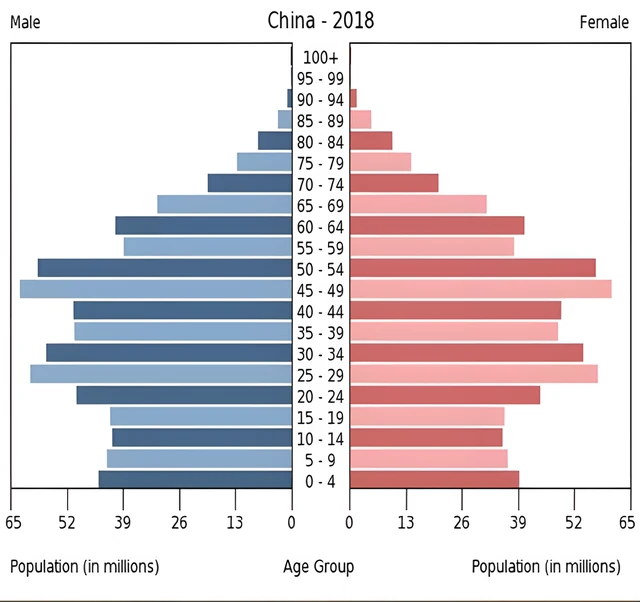
And finally, their four decades of the one-child policy have screwed up their demographics, making an economy based on domestic consumption impossible, because old people don't consume enough goods and services to sustain a consumer-led economy. So if they're going to be a consumer economy, their consumers have to be overseas, and to supply those overseas consumers, they need to be able to ship their goods over long distances on the water safely.
KMO (video)So Peter Zeihan's argument is that Xi Jinping and the Chinese Communist Party have deliberately pissed off the rest of the world over coronavirus in order to get the Chinese people to feel a renewed sense of nationalism and outward-directed anger, because the Chinese Communist Party knows that it can no longer provide the increasing standard of living and the economic growth that the Chinese people have become accustomed to, and which is the CCP's side of the bargain. They have to provide that in exchange for the total dictatorial control that they demand. Well, the CCP knows they're not going to be able to hold up their end of the bargain, and they are preparing for the next stage. They're looking to have a pissed-off domestic Chinese population focus their anger at the rest of the world and not at the Chinese Communist Party.
And Peter Zeihan concludes the newsletter as follows. Quote:
It isn't so much that the Americans have always had the ability to destroy China in a day — although they have — but instead that it is only the Americans that could create the economic and strategic environment that has enabled China to survive as long as it has. Whether or not the proximate cause for the Chinese collapse is homegrown or imported from Washington is largely irrelevant to the uncaring winds of history. The point is that Xi believes the day is almost here.
Global consumption patterns have turned. China's trade relations have turned. America's politics have turned. And now, with the American-Chinese breach galloping into full view, Xi feels he has little choice but to prepare for the day everyone in the top ranks of the CCP always knew was coming: the day that China's entire economic structure and strategic position crumbles.
A full political lockdown is the only possible survival mechanism. So the solution is as dramatic as it is impactful. Spawn so much international outcry that China experiences a nationalist reaction against everyone who is angry at China, convince the Chinese population that nationalism is a suitable substitute for economic growth and security, and then use that nationalism to combat the inevitable domestic political firestorm when China doesn't simply tank, but implodes.
Close quote. All right, I'm going to leave it there. But let me just remind you: none of my own analysis or opinion, as far as I can tell, is on display in this video. This is me just straight summarizing and, in some cases, excerpting from Peter Zeihan's newsletters. So if you think I'm misrepresenting Peter Zeihan, do leave a comment. If you disagree with anything that I said in this video — again, this isn't my stuff. I am not attached to it. I won't consider attacks on it to be attacks on me. If you disagree with some of it and you need to say something, well, go ahead, but I'm probably not going to engage with you in the comments. All right. And with that, I bid you good day.
KMOAnd in response to the content of that video, Eric Boyd responded via email with the following:
I agree fundamentally that China is in for a big reset and that the CCP, as we've known it, won't survive. But I don't really buy his economic arguments for this. I think it's mostly a political problem, created by the same insecurity and weakness that Zeihan observes.
For many years, Xi Jinping has been essentially hollowing out the political world in China, clearing the decks to consolidate his own personal power. And that's been working, in the sense that, obviously, Xi is more personally powerful than ever. But it's self-sabotage for the country as a whole, same as it would be in any other country if leaders eliminate all their competition, suppress criticism, stifle the functioning of government agencies, etc. The U.S. is, in fact, experiencing some of that itself under Trump and the Republicans, though not as severely since, obviously, power in the USA isn't so concentrated.
Anyway, debt problems are real, but they alone wouldn't drive China — or, frankly, any other country — into crisis, especially in the current world, where the price of capital is ludicrously cheap. You can actually see the truth of that in action in places as various as Japan, Greece or even Canada. We all have a lot of debt, and it distorts our ability to act in some ways, but it doesn't challenge the legitimacy of our government by itself, nor does it compel us to reform our government or way of life. Debt just applies a pressure, and the governance needs to respond somehow in order to adapt.
And while China's political resilience isn't zero, it's not far from it. The social contract Zeihan mentions — control for increasing living standards — is very much true. And because of Xi's recent moves to more control rather than less, as had been happening for decades under previous leadership, that contract is straining. The correct move for China would be to release political controls and institute governance which is more open to and resilient to change, people's demands, etc. The Chinese people are in fact famous for their ability to just adapt, make do, improvise, innovate, etc. — but only when they are free to do so.
I think that it's Xi and his inner circle of oligarchy who are making poor choices: provoking fights (see Hong Kong), clamping down on civil rights (see Xinjiang — there are lots of other references here, of course, but that one is so egregious it can stand in for all others), retreating on economic reforms, and many others. The problem with control as a strategy is that it only works well if you know exactly what you're doing. The reason dictatorship isn't great in larger countries is precisely that it doesn't scale. A small group of people can't do a good job of controlling everything, and it's pretty clear now that the CCP makes at least as many mistakes as it does correct moves.
My geopolitical feeling is that China will yield leadership back into more hands rather than face an actual collapse, of the sort that Zeihan hints at with his talk of agricultural collapse, or even of the Cultural Revolution kind of madness that sometimes plagues China. This may take many more years to properly play out, though. It would be very surprising to me if there was much political change in China this year.
I think China, as with the USA and many countries, is going to experience a surge of nationalism in response to COVID-19, and that the world in general will become more mercantilist, i.e., more narrowly focused on number one. Part of this is just a response to Trump and America being more mercantilist, and another part is COVID-19 itself — wow, we sure do need our medical supplies. But another big part of it is the realization that without one dominant global superpower, everyone does need to pay a bit more attention to their own resources.
And make no mistake, the USA has lost its global superpower status — partly by abdication; Trump literally just walked away from it — but mostly because the USA just isn't as globally dominant economically or culturally as it was. The rise of China, India and even the EU, not to mention many, many smaller countries (Korea), have all made the world a more equal place than it used to be. It was the USA's game to lose, for sure, but it was how well others played that got us where we are today, and Trump's walking away from it was a symptom, not the cause.
The main geopolitical question over the next two decades is how world governance is remade in a new, multipolar world. And frankly, Xi Jinping has basically ensured that China isn't going to get the big say that everyone thought they would have five years ago. China is big, but its leadership is so much weaker than it used to be, and people don't respect them anymore. The recent self-sabotage on that front, which Zeihan mentions, is just some final nails in the coffin that they've been building for years.
It's been, frankly, horrifying to watch the lack of global leadership during this COVID-19 crisis. There really are things that need to be coordinated internationally, like travel, vaccines and certain supplies, like personal protective equipment. In a world from 20 years ago, that global leader would have been the President of the United States of America. It's easy to imagine Bill Clinton, for instance, convening a discussion among the G20 about how to make sure that these issues are globally coordinated as we all work towards opening up and moving forward. But even just thinking about that makes it clear why this is a different world. The G20? The president of the USA as having global soft power? That isn't our world anymore. And even if somebody like Clinton was president, it's not clear that the world could respond in the way it would have then.
All that said, it'd sure be helpful if the president of the USA wasn't actively counterproductive. Doing nothing would frequently be better than what is being done, and that is a thing that China's leadership shares currently as well. Sure seems like it most of the time. China and the world would be better off without whatever Xi and the CCP is doing.
As a bit player, there isn't much that Canada can do to help guide the global storm. We're going to come out of COVID-19 not hurt too badly. Our New York is Quebec, but it's not nearly so bad as New York was [wording unclear]. Canada overall has done better than most of the so-called first world, which in general has done poorly. But we're shackled to the USA in terms of geopolitics, as Trudeau, for all his charm, just isn't up to playing a major geopolitical role. I agree with Zeihan there as well. There are currently no world leaders who command the kind of soft power that could actually get a global consensus going, or even materially strengthen global governance.
Maybe our future looks like the EU does, with endless bureaucratic bickering which somehow results in actual policies that are not terrible, but rarely rise to good. Or maybe our future is more like the colonial era, with a lot of competition and ruthlessness. That world clearly has runaway global climate change. Or maybe, against the odds, the crisis will somehow result in the rise of some new global governance structures which are capable of handling things like COVID-19 and the climate crisis.
I do think that COVID-19 will come to be seen historically as the end of one era and the beginning of the next, in a way that, for example, 9/11 or even the fall of the Berlin Wall totally wasn't. But what the new era will be like, that remains a gigantic unknown right now. There isn't any place in the world that anyone can go to hunker down in this new era of change. Sure, you can escape from COVID-19 in, for example, New Zealand, but whatever this new scheme is, New Zealand, like all places, is going to have to adapt to it. I just hope that the new era isn't World War III. It's unthinkable, but they said that about World War I, too.
Program identification: "You're listening to the C-Realm Podcast, with your host, KMO."
KMOWell, that brings us up to the current moment, where I've got Eric here on Zoom. Eric, let me just invite you to summarize the pieces of what's come to this point that really engage with your interests.
EricYeah, I mean, that's a big question, because there's sort of a sprawling discussion of both the impact of coronavirus and the sort of U.S. geopolitics, and the rise of China, and then the rise of Xi Jinping. So there's a lot of moving pieces in this conversation. But I guess the most important piece for me is how much China has changed in sort of five years with the rise of Xi Jinping. Five years ago, I think it was reasonable to expect that China would play a major positive role on the global stage. And now, just because of all the moves that China has made recently, nobody trusts them anymore. And they're sort of screwing up domestically in many ways as well, so they're a little more fractured on the inside, too. And so it just doesn't seem plausible anymore that China is going to play a major positive role on the global stage. In fact, lots of people are very worried now that they're going to play a negative role. So I think that's probably the most important piece of it — other than the fact that the pandemic obviously is a global change the likes of which we haven't had in my lifetime, certainly, and I think basically since World War II.
KMOSo Peter Zeihan's contention is that China knows that the writing is on the wall — that the Communist Party is not going to be able to uphold their end of the bargain of "we get total control, you get a continuously rising standard of living." They know that they won't be able to deliver the continuously rising standard of living and economic growth. So a lot of their international bad behavior of late has been aimed at really pissing off the rest of the world, and in return getting the Chinese people to direct their anger outward rather than at the CCP.
EricYeah, yeah. I mean, I don't think he's entirely wrong, but —
KMOIn the broken-clock sense, not entirely wrong? [speaker uncertain]
EricWell, no, he's more right than a broken clock. But I guess I would say you don't have to ascribe to malice that which can easily be ascribed to incompetence, right? There's probably some element of that kind of stuff going on, but I feel like the larger element of what's going on is that Xi has been trying to consolidate his own power inside the CCP and shore up other things. And similar to Trump, he is much more focused on his own power and vanity than he is on what's good for China or what's good for the world. And the result of that is tiny little things which piss him off for personal reasons end up getting lashed out, and then there's blowback, right? And this is the negative spiral: once you start getting blowback, then you react even more selfishly, and you get more blowback.
Obviously Americans are familiar with this from the way that Trump behaves, too. He'll dig himself into big holes on a regular basis and then do really insane things. And I don't think that Trump is necessarily malicious either. I think he's, like I said, just kind of focused on himself and on number one, and not really thinking about the long-term geopolitical implications of any particular action. So it's not about evil. It's about ignorance.
KMOSo, Donald Trump — I don't hate him the way a lot of Democrats do. And I certainly don't go in for all the lunacy that Democrats have endorsed for the past three years, and all of the Russia conspiracy obsession and whatnot. But I don't like to listen to Donald Trump talk; that is certain. And I really wish he would shut up on the topic of the pandemic, and particularly anything touching on epidemiology or medicine or science. I mean, he just has absolutely nothing positive to contribute on that score. He has verbal diarrhea. He can't help but get up in front of the camera and just shoot from the hip and say the most horrendous, impossible, disgusting —
EricThings that lead people into bad actions. Yes, I agree. [speaker uncertain]
KMOYeah. It's seemingly stuff that just pops into his head.
EricYep. Yeah, I agree. It has no basis in reality.
KMOIs Xi Jinping similarly unable to control his own mouth?
EricNo, I don't feel like that is really there.
KMOI think you don't rise to the top job in the Chinese Communist Party in the same way that you get to be the president of the United States. [speaker uncertain]
EricYeah, exactly. Somehow Donald Trump was essentially able to win a popularity contest, which boggles the mind. I've taken to calling him the reality-television president, right? Basically, we voted everybody else off the island, and so that was what was left.
And I agree that, of course, the Chinese political system is totally different, and in some sense is more concerned with your ability to actually govern. The way you rise in the Chinese Communist Party is you do well as mayors or local governors; you hit your numbers. And a lot of that hitting-numbers stuff in China is severely gamed, so it's not necessarily a true test of your abilities. But it certainly is a test of your ability to manipulate people and manipulate numbers to your favor, or at least to your apparent favor. And obviously Xi is sort of a master of that kind of thing, and that's how he's gotten so much power.
I don't feel like Xi necessarily goes off the handle and rants. But I have actually read quite a large number of the Chinese state media official propaganda organs that are filled with long — like, three-hour-long — Xi Jinping speeches. And that kind of dialogue that comes out of China is very stilted. It's very ideology-heavy. It's almost impenetrably self-referential. They will take things that he said in previous speeches and then give them a Chinese phrase that refers back to that whole thing, and so there's sort of nested levels of propaganda. And in the end, it also presents a very communist, socialistic, utopian vision of the future of China.
And this is part of the promise that — what's his name — Zeihan mentioned, right? They've been promising this sort of 50-year vision of the future of China being a communist utopia. And progress is being made towards that vision, but, like, wow, it's an impossible vision, kind of thing, you know?
So I guess my overall feeling is that, between a combination of personal power aggrandizement — seeking it out at all expense, including the expense of jailing and imprisoning all kinds of people who oppose you — and this obedience to Chinese Communist propaganda stuff, there's not a lot of space left for actual attachment to reality, in the same way that there doesn't seem to be a lot of space left in Trump for actual attachment to reality, right? So I don't think it's necessarily that he flies off the handle. It's that he's just disconnected from reality. And so a lot of the things that end up being said are being said regardless of whether they're true. They're being said because he thinks it'll increase his political power, because he thinks it's part of maintaining the propaganda line that has to be maintained.
KMOHave you seen Wolf Warrior or Wolf Warrior 2?
EricI actually have not. It's definitely on my list, though. In fact, I was listening to a podcast just yesterday that was talking about the sort of Academy Awards equivalent in China, which I'd never heard of before, but apparently they're called the horse statue and the turkey statue, or something like that.2 But anyway, apparently, like a lot of things in China recently, there's been a political shakeout of the freedom of those organizations to grant their equivalent of the Academy Awards to whatever movie they want.
It used to be there was one that was sort of based in Hong Kong and Taiwan that was relatively free, and they would give awards to all kinds of art films and things of actual value. And then the other one of the two was controlled by the Chinese Communist Party, the CCP, and it would give awards to the propaganda films. But as of two years ago, the Chinese Communist Party locked down on the one that was free, and it was no longer able to give awards the way that it wanted to. And basically they were promoting the — oh yeah, the rooster one, which is the CCP one — they were putting that as the only legitimate prize. And in order to appease some of the art people, now the legitimate one [wording unclear; possibly "the official one"] actually gives some of the smaller prizes to some of the actual legitimate art films, but all the big prizes still go to the Communist Party propaganda films, like the Wolf Warrior.
So it's just yet another sign. Like I said, this happened like two years ago. It's yet another sign that what we're seeing out of China as part of this coronavirus is part of a longer-term, like, five-year trend, where a lot more power is being used in order to stifle culture in China than used to be true. And I think, like I said, that is Xi Jinping-led. It's propaganda-led, and it's inconsistent with what was happening in China for the 30 years before that, where things were getting freer. So there was sort of a direction change five years ago, and we're seeing the fruits of that coming home to roost now.
KMOIn the email that I read from you, you started off by saying that you agreed with Zeihan's conclusions — that at least the CCP's version of China probably doesn't have a long shelf life — but you disagreed with his reasons. What did you mean there?
EricWell, I think that the path that the CCP is on right now — of tightening control and consolidating power in Xi's hands and eliminating its competition, and cracking down on things like the Academy Awards, and even all their actions in Hong Kong and, of course, Xinjiang — all of these things are not sustainable and lead to bad places. And so I think inevitably there has to be a correction. A lot of this stuff has to be undone, because, A, obviously it's going to lead to economic problems. When you don't promote local regional administrators and heads of companies in ways that accord with reality, shit just gets worse, right? It's hard to maintain 8% economic growth, or even 2%, really. So there needs to be some kind of reckoning.
But I don't feel like it's going to be a catastrophic reckoning. I think what's going to happen is internal pressure inside the Communist Party is going to force Xi to relax some of his quest for total power — that the Communist Party is going to go back to the way it was sort of 10 years ago, where there was a much more dynamic allocation of power among more individuals. There was a little bit of competition. I mean, the leader of the party actually used to regularly change, which was obviously valuable for the same reason it's valuable in America, right? You can course-correct by getting a new person in charge for a while. And maybe they overcorrect or whatever, but if you bank to the left for a while and then you bank to the right for a while, overall you're maintaining a central course, which is a good idea. So that's kind of what I expect to see happen in China: a reversion to that kind of thing.
The only question is whether they will have a soft transition in their power — whether they'll be able to roll with getting back to being more open politically and culturally — or whether they'll have to go through some kind of nasty phase where their control maximizes, and then the populist protests [wording unclear], and they go through some kind of horrible thing like the Cultural Revolution — which wasn't itself political,3 but was a massive uprising that disrupted so many people's lives. And in the end, I don't expect to see China go through a thing that kills tens of millions of people or whatever, but I totally think it's possible that they'll go through a thing that has some level of violence, and it wouldn't be good. I hope that the other people in the CCP will be able to convince Xi Jinping that they don't have to go through a period of violence; it can just be a soft transition of power or whatever. But we'll see.
KMOA lot of what I remember from Peter Zeihan's newsletter was that the Chinese have been really just spendthrift, in that they give limitless, bottomless financing to state-owned enterprises and to private enterprises which have grown large enough to be considered pillars of the economy. In the time that their GDP has quadrupled, their debt load has increased by something like 23 times.
I'm caught up in the UBI conversation here in the United States, and the first knee-jerk response is "we can't afford it." But if China can afford to spend limitless amounts of money to prop up their larger companies for the express aim of creating full employment — making sure everybody has a job — it strikes me you could just give everybody money.
EricI mean, we're essentially doing it here in Canada. They call it the Canada Emergency Response Benefit, CERB. Basically, we're giving $2,000 a month to anyone whose income dropped by more than 30 [wording unclear; unit not heard], and so it's essentially like a giant UBI experiment here. And I agree that the States could be doing it as well. It's, in fact, kind of surprising to me that you aren't. I think they just actually extended the CERB by another couple of months. Originally, the idea was it was only going to cover March, April and May, but I think they just extended it to cover July and August here as well.
And I think there is going to come a reckoning in Canada. Our federal government was actually in pretty good shape debt-wise after many years of relatively balanced budgets — basically, the GDP was growing faster than the debt. But even so, we can't afford to be paying some big chunk of the country some big chunk of their normal salary. The government can't prop up the whole fucking country, you know? So there will come a reckoning here for sure, and I think there will come a reckoning in China, too.
EricBut I mean, the totally weird thing about our macroeconomic situation is money has never been cheaper. The interest rates on large amounts of capital are below inflation. Money is not just free; it's like you get paid to take money these days. And in that kind of situation, it is totally possible to maintain just astronomical levels of debt, right? Obviously, if you're getting paid to keep money, you can have as much as you want, because you're making money on it. So it's very distorting — extremely distorting. It does really weird things.
And I think that the danger is, if we ever get back to a world where money actually costs significant amounts — interest rates rise significantly — there's going to be a lot of companies and governments and countries and businesses, individuals and so on, who are underwater. They can no longer make their debt payments, right? And I just have no idea what that moment in time would be like. It's going to be completely fucked.
And in fact, the U.S. has been playing this game for quite a number of years. They've realized that lots of businesses and so on are already in that place. So, for instance, during the last boom, there were lots of people saying that the Fed should be raising interest rates, so that when we do have a crisis like this, we have some place to take interest rates, right? Once they're up, then we can lower them. And the U.S. never did that. And I think one of the big reasons they didn't do it is they were a little afraid that if they raised interest rates much, a lot of places that have astronomical levels of debt would be in huge amounts of trouble. And so interest rates never went up, and that crisis was kicked down the road a little, right?
So I feel like, macroeconomically, it's a very similar situation in China as it is in the States. Lots of companies, lots of governments have astronomical levels of debt, and if that bill ever comes due, weird shit happens. So, yeah, I agree it's a problem, but it's not a problem that's exclusive to China — not nearly. Everybody is playing that. I mean, Europe is filled with that kind of stuff, Japan and so on.
KMOBut is anybody racking up as much debt as fast as China?
EricOh, yeah — I don't know that; you would have to go look. I don't know. Part of it is it's so difficult. Even here in Canada, I spent a bunch of time digging, trying to find out, well, what is the total level of debt, right? Sure, the federal government's doing okay, but if we add provincial debt to that, and then municipal debt to that, and then corporate debt to that, and then personal debt to that, how do all of these pieces add up, right? And when I did finally get to the bottom of all of that digging, the number was kind of scarily high. If you take it on a per capita basis, Canada's total debt per person is like 250% of GDP. It's a lot. And I have not done a similar level of digging for any other country, so I don't know whether China is 150% or 1,050% or anything.
KMOPeter Zeihan — I think it was 150% of GDP just in corporate debt. That was no public debt at all.
EricYeah.
KMOWow.
EricYeah. But on the other hand, a lot of companies carry a lot of debt these days because it's considered cheaper than equity. And it frankly is: if you're doing the accounting, carrying debt is a lot cheaper than carrying equity. And this is how you increase the returns to your shareholders, right? If there's less equity and more debt, then there's fewer shareholders, and so when you have more profits, it goes up quicker. So again, corporate debt is one of those things that's been distorted by the fact that debt is so cheap, and it's hard to know what will happen in the case where interest rates go up.
Because a lot of corporations actually have a lot of flexibility in how they split their debt and equity. If you're a large corporation and your debt is drowning you, you can just go issue a bunch of equity and then pay off the debt — literally sell a whole pile of shares on the market. And the downside, from the corporate perspective, is, sure, it makes your share price go down, right? But it's not an existential issue for you.
And in fact, Boeing is a really good example of this, actually. The government was talking with Boeing about doing a bailout, and the government's terms were basically, "Oh, hey, we want to have a share of your equity, so that later, when your stock price returns back to normal, we'll get a big benefit." And Boeing was like, "No, I'm just going to go get $50 billion of debt on the open markets, because that's cheaper."4 And that choice is driven by the fact that it is cheaper, right? But if it ever stops being cheaper — if interest rates ever go back up — now Boeing is really drowning in debt. So it's hard to know whether that choice is a good choice in the long term. Certainly in the short term, shareholders loved it, and the government doesn't have to bail them out. It's a win-win, right?
KMOAnother issue for China could be that the United States decides to start manufacturing things for itself again. And once that ramps up, it's going to create a lot of employment. It's going to create prosperity for working-class people here in the United States. And once that process starts, it will be difficult to interrupt it; it would be a very unpopular move to interrupt it. Whereas until the coronavirus started, it was a fait accompli that everything gets made in China, and American workers really are scrambling to find something to do other than make stuff.
If that transition really comes through — if we really do start, starting with medical devices and personal protective equipment, things like that; if we start manufacturing that here in the United States — it would be a hard sell, I think, after the pandemic has been dealt with, to say, "Okay, let's let the Chinese go back to making all that stuff for us, because it costs a penny less, or 25 cents less, or whatever." That could be a problem for China.
I mean, ultimately this all comes under the heading of: China is an economy that is dependent on imported energy, and it also depends on foreign markets to absorb its manufactured goods, because its population, after 40 years of the one-child policy, is rather gray at the temples. And middle-aged and older people don't consume like young people do. So there's not much possibility, just for demographic reasons, that China is going to reorient its economy to have internal demand drive its consumption. What do you think of that argument?
EricWell, yeah, I think there Zeihan is just factually wrong. The history of the last sort of 10 years of China has been the rise of a massive domestic economy. There are something like 450 million middle-class Chinese citizens who consume enormous amounts of stuff. All you have to do is walk around the streets of Beijing or Shanghai to see that. The level of fashion on display, the level of status automobiles on display, the level of ridiculous hipster restaurants and places that people can hang out on display — it's frankly stunning for anyone who has been to China before that, right? Because I agree, 20 years ago there was essentially little domestic economy of that sort, and you could tell just by the way that people looked and the sort of services that were available. But that is not the China of today. The China of today has a massive domestic economy.
I would say, in general, China is still a little bit more export-centric than most countries in the first world, but it's not overwhelmingly dominant the way that it used to be. So I think it's very misleading to say that the Chinese economy is going to be more disrupted by a fall in exports than other countries that do a lot of exporting — for instance, Germany, or Japan.
So I think this rise of mercantilism is going to happen, where there's going to be, as you say, a lot more stuff that's made domestically — not just in the United States, but in lots and lots of countries all over the world — for reasons having to do with their perception of national security concerns regarding PPE and lots of other things. I think that there is going to be an impact of that on the Chinese economy. But frankly, there'll be an impact of that on the American economy, there'll be an impact of that on the British economy, there'll be an impact of that on the German economy, and so on. We're all going to be dealing with that.
In classic econ talk, a shutdown in world trade makes everybody poorer. When you decide that you are going to pay more locally because you value local, your actual net wealth goes down. And so that's going to be felt, I think, in the United States and felt in China. And like I said, I don't feel like it'll be differential in terms of the outcomes of the economies.
KMOWould it be fair to call you a Sinophile?
EricI think if you had said that five years ago, I could have agreed, sort of without reservation. Now, like I said, because of all of the horrendous decisions that the CCP and Xi Jinping have been making, I don't feel like it's quite safe to say. There are lots of things going on in China that I wish were not going on, and they've been making very negative decisions that impact not just my perception of them, but the actual quality of life in China, especially for foreigners, but even for locals. And so, yeah, I definitely am sort of a China watcher, but I don't think I would call myself a China-phile anymore.
Program identification: "On the C-Realm Podcast: a mind that is stretched by a new experience can never go back to its old dimensions."
KMOThat was the first third of my conversation with Eric Boyd. Of course, the remaining two-thirds will be in the C-Realm Vault podcast. That will be episode number 366 of the C-Realm Vault, which I hope to get posted tomorrow.
All right, we're at the end. Time for the usual calls to action. Mostly: hey, if there's anything in here that you want to comment on, hit me up — KMO at C-Realm.com — or you can find me on YouTube. Or, better yet — it's kind of hard to find my YouTube channel unless you have a link, but you can find many links to my YouTube channel on my Patreon page. I haven't been entirely consistent with it, but it's on my to-do list: every time I post a publicly available YouTube video, I also post it to Patreon. And it's real easy to find me on Patreon. It's just patreon.com/KMO — that's just the letters K-M-O.
And if you wanted to subscribe to the C-Realm Vault podcast, you would start right there at Patreon. Actually, you could go to C-Realm.com, but it's going to redirect you to Patreon, so, you know, cut out the middleman. Although I can't really say cut out C-Realm.com; I've put a lot of time and effort into that site. I know it looks way out of date right now, and I plan to get that fixed. But when you think about the C-Realm, you don't think so much about a website. You think about a podcast, right? You think about a voice that you hear in your ears as you do stuff. That would be my voice, and I'm very glad that you listened to it.
All right. I have already recorded the next episode of both the C-Realm Podcast and the C-Realm Vault, so stay tuned. There is more to come. All right. I will talk to you soon, and until you next hear my voice, please stay well.
1. KMO spells the name on air (Z-E-I-H-A-N) and explains that he had been mispronouncing it. The machine transcript renders both the mispronunciation and the correct pronunciation the same way ("Zion"), and various other spellings elsewhere, so neither pronunciation can be recovered from the text. This edition spells the name Zeihan throughout, as KMO spells it. ↩
2. As spoken. The awards Eric is reaching for are presumably the Golden Horse Awards, held in Taiwan, and mainland China's Golden Rooster Awards; he names "the rooster one" a moment later. Mainland China barred its films and film workers from the 2019 Golden Horse Awards. ↩
3. As spoken. The Cultural Revolution (1966–1976) was a political campaign launched by Mao Zedong. ↩
4. As spoken. Boeing declined federal aid tied to government equity and in late April 2020 raised about $25 billion in a bond sale. ↩
Keep following the conversation.
Also with Eric Boyd
Public audio available
Also with Eric Boyd
Public audio available
Also with Eric Boyd
Public audio available