Also with Jim
Getting Clear →
Public audio available

2020-04-18
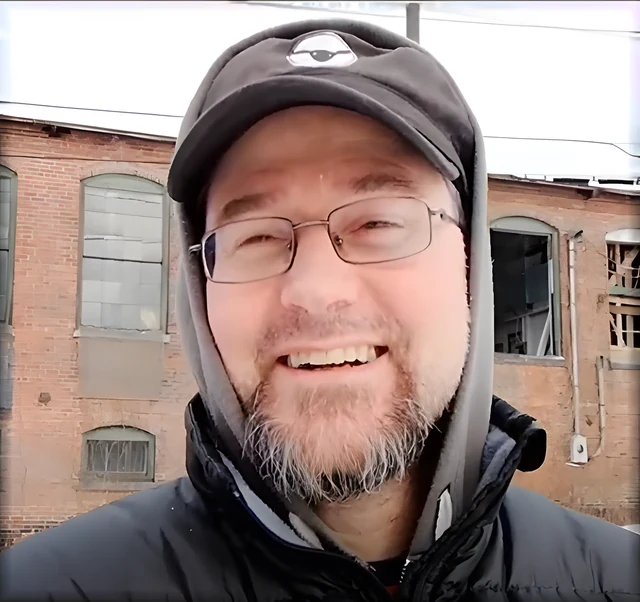
Buckminster Fuller talked about how technology can accomplish more and more with less material and energy. Eventually, it will become so effective that it can do anything with nothing. Jim, your ad attacker, has a problem with the name the Fuller gave to this process. In this podcast, he explains why.
Open the formatted reading edition →
Reading edition · Published with KMO’s approval. Public. Covers the full recording: KMO's introduction (Buckminster Fuller on ephemeralization; Kevin Carson on catabolic collapse vs. transformation; Vermont paper-mill decline); the conversation with Jim, "your ad attacker" (essential work in Seattle under COVID-19; Andrew McAfee's More From Less; ephemeralization vs. etherealization; empty buses and destinationless riders; Puerto Rico transit and cars; New Optimist claims about pollution and extinctions; farmland, the Green Revolution and California agriculture; Joel Salatin and Polyface Farm; fracking, pipelines and Democratic Party politics); the mid-episode pointer to C-Realm Vault episode 362; and KMO's closing (Dope Fiend Network reunion and Queer Ninja; destinationless writers; a 5G / Starlink email; selecting a worldview; GEBB; COVID test; plans on hold; Rising). Edited for punctuation, paragraphing, repeated words, fillers, false starts and obvious transcription errors. Speaker attribution is based on conversational context; no full audio listen has been done, and spots where the wording or speaker could not be settled are marked. Opinions and claims about COVID-19, energy, agriculture and politics are the speakers' own as of April 2020; they are not checked here.
KMOIf you speak the truth, have a foot in the stirrup.
Hello, and welcome to another installment of the C-Realm Podcast. I'm your host, KMO, and this is episode number 556, "Etherialization," with guest Jim, your ad attacker. Prepared for release onto the World Wide Web on Saturday, April 18th, 2020. In this episode of the podcast, I'm going to talk with Jim of the Attack Ads podcast about the concept of ephemeralization.
And rather than ramble at you and take too long — or longer than necessary, anyway — to get the information out, I'm going to share a few paragraphs from a website called c60.com. That's the letter C and then the number six and then [wording unclear; heard "xty.com"].1 And I'm reading from a page called "Buckminster Fuller, the Outstanding Thinker."
Geodesic domes are inexpensive, efficient and well-researched, aesthetically pleasing, and have a multi-generational support base. And so the question has to be asked: where are the domes? If Fuller's Dymaxion car was as much of a marvel as it was said to be, why aren't we all driving one? The future that Fuller predicted seems invisible, but take another look and you'll see we've arrived — and right on schedule.
Richard Buckminster Fuller was born on July 12, 1895. He was born at a time when what was changing the world the most was also what was invisible: radio waves, X-rays. Increasingly, more was being done with less. Fuller came to call this process of doing more with less ephemeralization. Ephemeralization was a central theory to Fuller's work. When Fuller was a boy, many tons of copper wire were required to lay a trans-oceanic telephone cable. When he was a man, the amount of communication formerly requiring tons of copper could occur using only a few ounces of copper wire found in a geostationary satellite. The way every generation of computers is smaller than the prior yet does more also fits Fuller's models. Computers have gone from occupying the floor of a building, to the corner of an office, to part of a desktop, to a laptop, to a smartphone, to a smart watch, and the trajectory of smaller yet smarter has not yet stopped.
KMOSo I'll stop there. That gives you a good idea of what is meant by ephemeralization.
Now, back in 2013, Kevin Carson published an article on the Center for a Stateless Society website in which he said that the catabolic collapse predicted by people like John Michael Greer is indistinguishable — based on just looking around at the landscape — from ephemeralization. If the old infrastructure that has been replaced by something newer hasn't been torn down, hasn't been removed, if you just leave it there to decay, it looks like civilization — the physical manifestation of industrial civilization — is in decline, when in fact it's just in transformation. And what you're seeing is something which should have been removed but hasn't been.
Well, I live in a little town — a little village, actually — in rural Vermont, and it used to be a very prosperous place because of some old paper mills, which used to provide a lot of employment around here and also created a lot of local fortunes, which resulted in some very nice Victorian houses being built here in the village. Well, that source of employment and prosperity has been shut down. And here, nothing has really come along to replace it. So here, what looks like decay really is decay. And it really does seem to be a degeneration — a decline from former prosperity. But that's not the case everywhere.
So this topic came up recently, either in my conversation with Brent Bednarik or on a C-Realm Vault podcast. But I got an email from Jim, your ad attacker, talking about the problem he has with the word ephemeralization. So here is a conversation that I've recorded just recently with Jim, your ad attacker, on that very subject.
Program identification: "You're listening to the C-Realm Podcast. C stands for consciousness."
KMOI am joined by Jim, your ad attacker, who also drives a bus in Seattle and is an essential employee.
JimI feel so essential.
KMOI am definitely not an essential anything.
JimIt is ironic in a way where the coronavirus outbreak, the COVID-19, has affected you to the point where you can only socialize over an internet connection in your own home. And with me, since I'm essential, I still go to work. So really nothing has changed for either of us.
KMOUnfortunately, I was in the process of making a change from this lifestyle when COVID said, don't be in a rush.
JimYeah, a big one too.
KMOFrom Vermont to elsewhere where it's warm and humid.
JimYep.
KMONow, unfortunately, one of the things that drives me nuts about Vermont is definitely also a fixture of Puerto Rico, and that is young men expressing their masculinity through their automobiles and the amount of noise that they can coax from the engines.
JimWell, you have to admit they're not allowed any other venue.
KMOYeah, that's true.
JimI'm kind of the opposite. In fact, many of my motorhead friends started to take a different look about what they could do with their cars when they saw that I didn't care. To say I drive an electric — you know, I can't rev it up. It can just go.
KMOThat's right. Just revving up.
JimWe're moving place and [wording unclear; heard "threatened to go pantomime going"]. No, no: we go or we stop. Make your decision. None of this variable transmission with the disconnect.
KMOWell, as I was sitting here waiting for you to navigate the Zoom subtleties or complexities or whatever, I was reading an article. Actually, it's a book review. And I was reading on the Forbes.com site a review of More From Less by Andrew McAfee. So I've read a few paragraphs summarizing the themes of the book. But as I understand it, you've read the book.
JimI've read the book. Yes. So I should give a little preface here. I listen to a various number of podcasts, and one of them is the Long Now Foundation. I don't know if you're familiar with that one.
KMOStewart Brand.
JimStewart Brand. That's right. Yeah, kind of the opposite of the peak crowd. They're very techno-yay. Andrew McAfee gave a little speech there, and a part of me, still with a toe dipped into the peak crowd, said, "No! Wait a minute! No! That can't be right! No, the world's going to hell. It's important to me that it's going to hell."
Well, I'm not — again, I'm not quite there anymore, but I still have some basic tenets that are like, hmm, hang on, I need to read this book. So I essentially checked it out from the library and did a hate-read. I went through it and looked for things that I would hate. And actually, I was like, okay, there are a few things.
KMOAll right, you're quoting Michael Shellenberger.
JimI don't like that. He's a big nuclear power rah-rah-rah, sis-boom-bah. But he did have a lot of other points. What did you read in your little review?
KMOOh, what did I read — that McAfee is a member of a group called the new optimists — you know, reference to the new atheists there — and the new optimists include Bill Gates, Steven Pinker, Hans Rosling and others. I don't know Hans Rosling.
JimI don't either. No.
KMOYeah. But there's a lot of people who say, hey, look, there's a lot fewer poor people in the world than there used to be, even though there's a heck of a lot more people in general.
JimRight. Right. And with Steven Pinker, he pointed out that it was a much more dangerous world in the old days than it is today. People don't die nearly as much from killing each other. We don't suffer disease nearly as much. So, yeah, we have to concede those points.
JimThe thing I got from it was what we were emailing — the discussion between ephemeralization and etherealization. And he's big on the ephemeralization. And to his credit, he actually gives real-world examples of ephemeralization. And very briefly, I'll just say I object to ephemeralization as the term. And if you'll let me rant just a little bit.
KMOWell, let me just structure your rant.
JimOkay.
KMOStart off by explaining what ephemeralization is supposed to be, and then tell us why it's a stupid word.
JimGood call, yeah. Yeah. Ephemeralization is the idea that as we have gotten better at manufacture, at science, we are finding ways of doing what we need to do with less capital inputs, with less fuel inputs, with less physical inputs. So his great example that I took to heart was the aluminum beverage can that was introduced in, I believe, 1985 by the Coors Company. And when it first came out, the aluminum beverage can weighed about 85 grams. Now this was lighter than the steel or whatever they used for the beer cans before, but it was still significantly heavy, especially when you compare it to the six-and-a-half-gram can that most of us use today. And he did have a little aside that some people have gotten it down to four grams.
KMOSo let me just have you pause right there. And I'm going to read from the Forbes article, which has the same example, but with different dates. "When aluminum cans were introduced in 1959, they weighed 85 grams. This fell to 21 grams by 1972, and by 2011 it was down to 13 grams." And now we're, you know, a decade past that almost, so they don't say what the current weight is, but it starts off with that same number, 85 grams — but that's in 1959.
JimOkay. Okay. Like I said, I hate-read it, and I have maybe half a page of notes. I didn't take any number notes. So all my notes — disclaimer — from my brain, which is in its mid to late 50s. And I guess that's not really an excuse, since I heard James Lovelock interviewed the other day, and he's 100.
KMOWow.
JimAnd he sounds sharp. Like, wow, if I can be as sharp as James Lovelock in my 60s, I'll be happy.
KMOYes, although he's sharp, but still not only a doomer, but like — the worst combination for me — the doomer-nihilist-misanthropist.
JimOh, wow. I didn't get that from his talk. But I just got, wow, he's a hundred. You don't have to listen to content. Like, you just listen to what you want: hey, this is an attractive person; hey, this is a very old person. You just move from there.
So yeah, ephemeral is supposedly the reduction of using stuff to make stuff, and all that is great. That's wonderful — with the one sole exception of the fact that ephemera means short-lived. Literally the mayfly, as I pointed out in my email: that is the Ephemeroptera, from the genus of Ephemeroptera, meaning short-lived flyer. Okay, well, if you want to make cans that are short-lived, call them ephemeral. But these cans are holding the same beverage for the same amount of time as the 85-gram 1959 can, so it's something else that's going on here. I would choose ethereal, which is to lighten, I believe. Let's see what my little computer dictionary has to say about that: "Extremely delicate and light in a way that seems too perfect for this world." So that's just me. Like you said, you have a problem with raising and begging the question. I fully understand that one. So yeah, ephemeralization — I'll have to just accept it.
KMONow, I can think of a way of looking at the change in technology and the fact that we're getting better performance out of less material and energy where ephemeralization makes sense. And that is, you know, the new technologies replace and render obsolete the old technologies, which means that technologies have short lifespans, because the thing that is new and shiny and more efficient and replaces the old thing isn't the final thing. It too will be replaced. And as we do this faster and faster, the lifespan of these technologies gets shorter and shorter.
JimYep, I can totally accept that. I can also accept — it just came to mind just now — the biodegradability issue. If you want a bag that's going to go to a landfill and dissolve into nothing, you want it to be ephemeral. You don't want the chemicals in that thing to stain the ground and turn into weird bugs that'll take over and become our bug overlords later in the centuries. So okay, those two exceptions would be perfectly fine.
Of course, I'm one of these people that hangs on to old things until they just beg to be put out of their misery. So for me, just charging a phone can be difficult, because they have — and I hate this too — the universal serial bus is no longer universal. There's USB 1, there's USB 2, there's USB 3. It's like it's universal within those categories, but it's not necessarily —
KMOIt's what? There's also the USB-C. That's the one — that's the newest one.
JimOh, the Apple USB-C or the Android?
KMOWell, if it's Apple, it's definitely not universal.
JimYes. Now the Androids are not the same as the old Androids. Anyhoo, yeah. If I graduated to the new and exciting stuff all the time, I'd be all in favor of Ephemeroptera and having my old things fly out the window, the short-lived flyers that they should be. But no, I use an MP3 player from 15 years ago, and I still like it.
KMOWhat's the storage capacity?
JimThe storage capacity is twice that of the battery capacity, and the battery capacity has not changed yet. So I don't see a point in adding storage capacity if I have to recharge it anyway. It's the way I think. I'm sorry.
KMOWhereas I remember reading an article when I was working at Comcast, when I was living in Maryland — Comcast; the office where I worked was in Delaware — and I listened to a lot of podcasts driving back and forth, and I did it on an MP3 player. And I remember reading an article at the time saying that pretty soon your MP3 player is going to dissolve into your phone, and nobody could accept that at the time because that would run down your phone battery too fast.
JimRight, and who would want to go around constantly asking people if they have a charger? Nobody wants that, and yet —
KMOAnd yet I don't own an MP3 player. I just have a phone.
JimI understand. Now, can you download, or are you reduced to — no, I shouldn't say reduced. Do you stream?
KMOI stream stuff pretty much all day.
JimOkay. So the download issue isn't really one for you.
KMOSince I'm at home all day, data is not an issue, because my phone is connected to the internet via Wi-Fi.
JimRight. No, no, the reason I bring it up is if you're out of cell service and you're not getting any data and you don't have anything downloaded onto the physical device, you don't get any entertainment.
KMOYou might entertain other people with your string of curses.
JimOh, I do that anyway.
KMOHey, before we continue on in this topic, let's just get a little Omega Man or I Am Legend-sort of imagery. What's it like? What are the streets of Seattle like right now?
JimYeah — Vincent Price is out there in The Last Man on Earth.
And if you want to complete the trilogy: let me tell you, we have always complained about the schedules that we were forced to drive — you know, we're supposed to be at a point not earlier than this. But we never got there earlier than that because we were constantly stuck in traffic and picking people up. We are now dragging our feet and holding up traffic. It is empty. The people who get on today — I carried a grand total of seven.
KMOWow.
JimAnd that's the story. I have to say, there are people who do need to go to their essential jobs. They drop them off at the mall, and they head straight to the mall, and they sit there and probably cook food for takeout. That's still allowed. There are people that are going to the grocery stores. I like those people to be at work.
But transit and many of the places where people gather have turned into places for the homeless, because they closed the libraries, they closed the coffee shops, they closed a lot of the shelters because they didn't have good COVID protection. Well, they didn't offer an alternative. So many of us drivers are talking about what our union president called the destinationless riders — just kind of getting on. The euphemism, yes. And they get on and ask where you're headed. And sadly, if — are you going — it's like, well, usually I tell people if they need to get somewhere, but you don't seem concerned about that, then I gotta tell you.
What the other day, when one of these riders said, "Driver, I have to warn you about something," everybody stopped, including myself. And luckily she had her meds stalled — I say luckily — and she would be at risk of a grand mal seizure. Luckily, because nobody's going to catch that. And I said, as soon as I heard that, I said, no problem. Nope, no problem. I'll hold your head if need be. No, no worries about that. You're not sick, except with that, which is horrible. And then I had to, you know, encourage her to calm down by commiserating, by telling her I've been homeless, and it's going to get better.
Now, I don't know that it's going to get better, but I know that if she hears that it's going to get better, she might calm down and she's less likely, therefore, to have a grand mal seizure, because that is triggered by stress. And I feel terrible that I said that. Essentially, I don't know that it's going to get better for her at all. I'm seeing this evolve into the biggest problem that everyone's overlooking: is the homeless.
KMOYeah.
JimI don't mean to bring down the audience, by the way. I know you're all stuck at home — unless you're essential.
Yeah, that is the one element that we really need to grapple with, because that's going to be a major transmission vector.
KMOYeah, I'm not even prepared to grapple with that.
JimNo, and I don't blame you. I really don't.
Abandoned streets. The abandoned streets are nice. The abandoned buses are nice. The schedules I can work with — they're nice. Being able to take an actual rest period at a rest break is nice now that I have enough time. But let me tell you, it's like watching paint dry. It is so dull. We often dreamed of a day like this, and now it's here. I'd be happy to go back a little bit.
And my wife's also an essential worker. She's at work right now taking care of babies. Now, if you thought driving transit would be a good transmission vector, try taking all the babies that need somebody to look at them, put them in a big pile and have them suck in each other's toes and play with each other, then hand them back to the nurse who takes them home, cuddles them, gets whatever, and then goes back to the hospital the next day. We don't know why that is still essential other than to allow people to go to work. But unless you put your baby in a plastic bubble, I don't see how that's flattening the curve much at all.
KMOThat's wild. I live right next to a daycare and it's closed.
JimOh, it is greatly reduced. I mean, I think they usually have 100 kids and they're down to 20. So most people who are not essential are watching their kids at home as they work from home if they have that option. But there are lots of people who are wearing scrubs [who] bring their kids in.
KMODid you hear the story of when my friend Rob and I were in San Juan, Puerto Rico, and we tried to take a bus?
JimYeah, I remember you mentioning the bus, and you're like, where does the bus come — oh, there's no schedule or something like that.
KMOWell, we were in Old San Juan, which is the touristy area, and we wanted to get back to where we were staying. And it's real easy to just catch an Uber. It's like seven bucks a ride much anywhere we wanted to go. And we were walking around Old San Juan, and my friend Rob, who speaks fluent Spanish — but, you know, proper Spanish, which is different from Caribbean Spanish —
JimYes, it is.
KMO— walk up to all of these different people and ask them in his fluent Spanish, do you know where we can catch a bus? And it happened again and again: he would ask them in Spanish; they would answer in English: you should call an Uber. Or what, you don't have Uber? Or there's an app on your phone; it's Uber. But we had seen buses, and I had read about them. I knew that they existed. But what we didn't realize was that they have hours of operation but no particular schedule.
JimThat's actually pretty common in some places. I think when my uncle grew up in — remember Port Angeles?
KMOOh yeah — in the Pacific Northwest.
JimYeah, he grew up there. He visited one of my other uncles back in the '60s in Tacoma. And he had walked from downtown Tacoma to my uncle's place. I said, why did you do that? Why didn't you take a bus? He says, well, it wasn't full. In Port Angeles in the '50s, the buses leave when it's full. So if they have something like that over in San Juan where, you know, you've got to wait for it to be full or else we're not even going to fire up the engine — yeah, people just go, well, it's not going to get full then.
KMOMost of the buses I saw were empty.
JimWell, okay. Then it's still on a schedule, and it may be a class issue. I mean, this area — really a lot of people from a lot of different classes ride the bus, but in a lot of areas it's seen as a sign of poverty. So anybody with a cell phone is like, oh, just call Uber. That's what you do.
KMOWho knows? Well, what I also — what really struck me being there was the infrastructure was pretty ragtag. But everybody was driving a nice-looking car. And I've done some research on it, you know, since then. First I asked people in the Puerto Rico subreddit and they all complained about the bad roads and how the roads, you know, wear the cars out so quickly and everybody needs a new car all the time. But also there was a lot of — people buy more car than they can really afford, and their cars get repossessed. And then after the hurricane in 2017 there was a moratorium on car repossessions, which led to a sort of a bonanza of new-car buying. And since, like, I guess 2008, Puerto Rico has been losing population. You know, Puerto Ricans are American citizens; they can move to anywhere they want in the U.S. And more and more of them, particularly young and ambitious ones, are moving to Florida or Texas or New Jersey — but, you know, leaving the less ambitious and the old and the timid. And there's a phenomenon that I read about of people just driving to the airport in San Juan, parking their car, which is not paid off, but making no arrangements with the bank or with, you know, the financier — just going to the airport, parking the car, getting on a plane and never coming back, and the parking lot just filling up with all these cars and nobody claiming them.
JimWell, the least they could do is leave the keys in there so somebody else could take it.
Wow. I didn't know about that.
A friend of mine spent some time in Puerto Rico back about probably 30 years ago. The thing that got her was that people looked at you funny if you pulled over for an emergency vehicle. So if you're driving along and there's an ambulance behind, no one will let it by, she said, and they will look at you like, why did you do that? Why did you pull over? Come on, we're moving.
KMOThere's an ambulance. So I never saw that. I noticed that the drivers, particularly in the city of San Juan, were very courteous.
JimOh, that's nice.
KMOYeah, it was a little bizarre.
JimI mean, from what I know about the language — like Caribbean Spanish — I study a tiny bit of Spanish, and I think the accent that jives best with my gringo sensibilities had to be from Guadalajara. You know, I could almost understand what they were saying back in high school. But you listen to Fidel Castro go on — what, that's not a language? No, I object.
KMOYou know the comedian Fluffy?
JimI don't know.
KMOOh, he's a Mexican-American comedian. He's a pretty round dude. He's very funny. But he talks about Puerto Ricans being, one, the privileged Latino group because, you know, they're American citizens. They can flaunt their heritage and they're in no danger. But also he says they speak Spanish like there's a time limit.
JimYes, exactly. Yes.
Anything in Caribbean, they just cut. Like Rob was saying, they just drop this part, drop this part, and throw them in the waste bin and send them over to Mexico. They'll use them over there.
KMOSo to get us back into the swing of our original topic, let me just read. Oh, I just noticed that this Forbes book review that I'm reading is written by a guy named Calum Chace, whom I've interviewed a couple times.2 And he is an arch techno-optimist.
JimOh, okay.
KMOYeah.
JimI did notice that all the names were dropped with a few exceptions. We're not only arch techno-optimists, but people — what I call people from what I call the distortion factories. So like the Breakthrough Institute was started by Michael Shellenberger. And if you look into it, it's really guys that get out there and talk about nice words about nuclear energy and mock those that fear nuclear energy in any way. And that's what really set my alarm bells. So I'm not surprised that people are gathering around his message. But in Mr. McAfee's defense, it's not a completely dismissible argument. So I would recommend you read it.
KMOWell, let me give you three paragraphs here. This is under a section called "Reducing Harms."
As well as using fewer natural resources, the developed world is generating less pollution. In the U.S., the Clean Air Act was substantially amended and strengthened in 1970, 1977, and 1990. The Clean Water Act was passed in 1972, the Safe Drinking Water Act in 1974, and the Toxic Substances Control Act in 1976. Other developed countries have their equivalents. The results are impressive. McAfee quotes another member of the New Optimists, Matt Ridley: "A car today emits less pollution traveling at full speed than a parked car did from leaks in 1970." McAfee also denies that we are driving thousands of species extinct: "Documented extinctions are relatively rare, with about 530 recorded within the past 500 years and appear to have slowed down in recent decades." This is not to say that our impact on other species is altogether benign: "The biggest threat to animal species isn't absolute extinction, but instead huge declines in population size due to overhunting and habitat loss." But even here, the trend is encouraging: "Parks and other protected areas made up only 4% of global land area in 1985, but by 2015 this figure had quadrupled to 15.4%. At the end of 2017, 5.3% of Earth's oceans were similarly protected."
KMONow, I wanted to read that part because among environmentalist doomers, there is an unquestionable truth, which is that at least 200 species go extinct every day — which is, you know, completely antithetical to what's being delivered here by Andrew McAfee. And really, there's no proving one way or the other. I mean, there's no way to do that sort of ongoing, comprehensive survey of species. So we can say, like, we don't know for sure that the Tasmanian tiger is actually extinct in the wild, although it seems like it probably is.
JimRight.
KMOBut you know, with a lot of these species we've never even categorized them or cataloged them. A lot of species are undiscovered. I mean, it's just — it's sort of what you accept as a fact is dependent largely on your point of view. And if your point of view is humans suck and we're destroying the planet and everything is going to hell, then you don't really ask for any documentation. If somebody says humans are killing 200 species a day, you're like, yeah, of course they are. It's just 200? Sure, sure it's not a thousand. And you know, of course it works the other way as well. We both are very familiar with the uncritical techno-optimist boosters who say that pretty soon discomfort will be cured and sadness will be cured and wasted human potential will be a thing of the past. And yeah, those are probably stickier issues than the techno-optimists are really assessing them to be.
JimYeah, absolutely.
When it comes to the species extinction, I remember one study where they went to the Amazon and they covered an enormous tree with plastic and they gassed it — well, they had to do it, because then they went through and they counted all the things that crawled out to die, and they found in one tree a species or three or five that didn't exist in the tree next to it. So when you talk about species spread and species diversity, the 200 every day — I mean, that's based on how many — let's see, you cut three trees down, okay, well theoretically that's 15 species right there. So they're really pushing let's stop the logging in the Amazon. And given what's happening now with the fires, you know, that might be a way to go. Hard to tell the president of Brazil that, but that's another story.
KMOKind of hard to tell the president of Brazil anything, I think.
JimNo, he might have you killed, you know.
So exactly right. You've got no information on both sides, so you might as well play up the gaps. Play up what we don't know, play up what we do know, and make it fit, whatever.
JimAnd again, it really hurts me to say that McAfee's book is not complete nonsense. Because it's easier to think that way. One of the examples he gave in his book, and he kept repeating it several times, was that the amount of farmland used in the United States has decreased by the size of the state of Washington collectively. So cultivated farmlands 100 years ago — maybe it was 80 years ago; again, I didn't take notes on that section — has reduced to essentially where I live to the state borders. And he's saying this is an improvement because of the way we farm and our equipment and everything's great compared to what it used to be.
Yes, I will grant him two points, but only two points. One of them: Norman Borlaug, the Green Revolution, greatly increased the yield per acre. And the other one was to switch from animal to tractor. Before, when you had an animal, you had to have silage and pasture for your animals. Well, that's considered part of the pasture; that's considered part of your acreage. When you reduce the necessary acreage by three quarters for each farm and increase its yield, yes, you're going to reduce the active amount of cultivated farmland. But he never addressed those two technological revolutions, because, okay, the Green Revolution is continuing. We are still increasing yields in many crops. But we're not going to tractor out with a different thing. There's not going to be a new tractor that takes over. That one-time gain from the loss of animal traction is a one-time gain. And that's stuck in my craw just a little bit. It's like, okay, I'll give you that, but it's limited. It's not exponential. You're not going to have the state of California cumulatively reduced in farm production anytime soon because of those factors — a limiting factor.
Program identification: "You're listening to the C-Realm Podcast with your host, KMO."
KMOBack in, I think it was 2013, I did a cross-country, you know, couch-surfing tour, and I drove through the agricultural portions of California. And it is — it is a truly surreal experience to drive and just see, like, I don't know, fig trees — or maybe not fig; what do they have there, dates? — or, you know, a particular type of fruit-bearing tree just in neat rows, not from fence post to fence post but from horizon to horizon.
JimYes.
KMOIt is a very strange experience. But, you know, it creates a lot of food and it makes food inexpensive. Unfortunately — I mean, for the farmers — it's a very dicey proposition. You know, most farms in the United States are, one, they're worked by somebody who is pushing retirement and their kids have no interest whatsoever in taking up the mantle. And also, you know, the farming-family lifestyle doesn't work without off-farm income, usually from the wife working at the doctor's office or whatever. And the farmer has to take out huge loans every year, and really the farmer is always on the knife's edge. And yet the system as a whole is going gangbusters, and the agricultural companies that sell the farmer the seed are doing great.
JimThe seed and the pesticide and the fertilizer — they have the farmer just by the short hairs when it comes to supply, absolutely.
And there's a complexity in farming you don't see when you're driving through that area. One of the things people complain about in that agricultural region is the fact that a lot of farmers have their water rights. So if they wanted to plant something that's really thirsty, like pistachios — it takes 10 years to get a pistachio tree to produce fruit — well, in that time, why bother installing drip irrigation? We'll just flood-irrigate, because water's free, and they have the rights to it. I mean, there is no recognition of a common aquifer in that valley. That's why Fresno is screwed. They have to bring in trucks of water for the people that live there. Meanwhile, these guys are drilling deeper and deeper wells to get at the last remaining water and putting more and more energy into the pumps to bring that water to the surface. And they're still flood-irrigating. And like you said, they're so deep in debt that a restructure is almost out of the question. And many of them, of course, don't want to hear about alternatives that even if you explained a few to them, they wouldn't listen.
KMORight.
JimDo you remember the signs as you went through that area?
KMONot particularly.
JimThere's an area — it was near Sacramento, I think it was north of Sacramento — one year there's big signs saying how farmers contribute to the economy and farmers provide food and farmers have done this and this. And you start talking to people who live in the area — it's very conservative — and these people are really just trying to thwart any future regulation on their industry so they can continue doing what they do, because they know they can't really change easily.
JimThere's a wonderful documentary, and I don't have the name of it right now, but I'll send you a link to it later. This guy decided to go out there and farm, but he wanted to do it holistically. So it took seven years of back-breaking work, and he turned his 200 acres into an actual productive farm, but without pesticides. It's a different way of farming that you don't see being touted by the techno-utopians, because the one thing you have to do is increase labor inputs. You can't mechanize many of the things that they're doing on these farms.
Joel Salatin is a good example of that. I mean, he does pull a tractor around, but he doesn't plow, he doesn't fertilize per se — he doesn't have to — but he has to have a whole bunch of volunteers to come out and learn how he practices his pasture culture or whatever. What do they call that?
KMOWell, he does rotational grazing.
JimYes.
KMOBut probably several other techniques as well.
JimRight.
No, and he has — you can watch videos for hours on end about the innovations he's tried and things he's abandoned. I've read a couple of his books about some of the things. And if he didn't have the volunteers coming to the Polyface Farm to work that land, I don't know that he'd be profitable. But of course he doesn't get any subsidies at all.
KMOAnd I think one of his books is called Everything I Want to Do Is Illegal?
JimI think so. Or "everything I do is illegal."
KMOIt's a saying of his.
The regulations are all designed for, you know, large industry. Like, sometimes they slaughter cattle on site, and FDA regulations require that the slaughter facility have a separate bathroom that is only for the use of the FDA inspector.
JimYep.
KMOBut, you know, his slaughter facility is a concrete slab in a field.
JimYeah, that was one of his older books. I read one of his newer ones — I think it was Folks, This Ain't Right — and he was talking about —
KMOFolks, This Ain't Normal, I think.
JimYes, folks — he had actually graduated from the slab to an actual butcher shop, but he was still trying to convince the FDA that this was kosher, and he managed to get that approved. And then he was going to sell his organic pasture-raised beef to a big distributor like Costco, and he said once he mentioned he wouldn't be pulling in with a semi, which is at a different height in the trailer than the pickup truck, they're like, oh, I don't know if we can load that. So it's like, great. So I think he did sell to Chipotle, which does non-GMO, non-hormone, non-whatever beef. But, yeah, the stories of his fights to just get regular food into the stores without becoming part of the agribusiness conglomerate are entertaining, to say the least.
KMOYou know, a lot of — I've adopted a lot of positions that would have not just been inconsistent with my peak-oil doomer self, but really just shockingly antithetical. Like, you know, I used to be against fracking, but the advantages of having plentiful petroleum from domestic sources are huge. I mean, it really allows us to disentangle particularly from Saudi Arabia. And just the moral compromises of not treating Saudi Arabia like the villainous butchers that they are is really damaging to the soul. And I used to be against, you know, pipeline construction, but, you know, pipelines are the safest way to transport fossil fuels.
JimYes.
KMOSo now I'm pro-fracking, pro-pipelines. And my 2009 self is just rolling in his grave, you know. And my 2009 self is long since passed, but he doesn't have a physical grave.
JimI'm glad to hear that.
KMOOne thing that remains that I really value from the peak-oil mindset is the understanding that efficiency comes at the cost of resilience. And what a lot of people mean when they talk about pursuing efficiency is removing expensive human labor from production processes —
JimExactly.
KMO— which makes your product cheaper, but if nobody has a job to buy your product, well, there's a problem.
JimExactly.
KMOAnd that is a problem which particularly the Democratic Party is furiously trying not to acknowledge.
JimYeah, the shouting they don't do is deafening.
KMOYes.
JimI don't — I can't — oh boy, we're going to get into politics here just a little bit. I'll try not to go too far afield. The Democratic Party has really become the social-advocate group of the same party that's across the aisle from them. They advocate the same positions when it comes to money. Nobody is questioning, how much money can I accept from a person? Oh, well, that better be huge, because if it's small, I'd have to make more calls. Why aren't we questioning, should you take any money at all?
KMORight.
JimLittle questions like that.
Yes.
I agree.
KMOPublicly funded elections? That's communism.
JimI don't even want funded elections. I don't want elections to be able to buy any advertising.
KMOWell, yeah, that would be a big help as well. I mean, that's where most money goes is into TV advertising, and TV political ads are just an insult to everybody's intelligence.
JimExactly.
KMOThat's the primary source of information, it seems, for a lot of voters.
JimYes.
I sympathize with your position on fracking. I really do. I remember arguing years and years ago about how pipelines were safer than rail, which is what they were doing with a lot of the petroleum coming across the mountains. [wording unclear; a turn about driving boats / an old teacher]3 I see an old teacher of mine, and they say, yeah, how you doing, we're catching up. I hadn't seen him since ninth grade. And he said, what are you doing? I said, well, I'm driving boats and I'm getting into electric vehicles. And he gets this blank look on his face and he wanders off without saying a word. He had married a woman who had a son, and his son went out to play in the crick up in Bellingham, and it all exploded in flame from a leaky gasoline pipe. Three kids were killed, and his son — two weeks ago, two weeks from that day — was one of them. It's like, oh, I mentioned electric cars and triggered his tragedy, and I felt terrible after I learned of that two days later. I didn't have a chance to talk to him later in the cruise. There's downsides to pipelines. There's downsides to rail. The question maybe we should be asking is, why are we exporting it?
KMOYeah. Well, one reason — there are a lot of reasons why we're exporting. Particularly when it comes to oil: what we get from fracking — I mean, we get a lot of it, but it's not complete. We need some heavier crude to mix with it to distill down to make all the products that we need. But also we have allies in the Pacific, particularly Japan and South Korea, who have essentially zero domestic sources of hydrocarbon energy, and we want them to do well. So we send them a lot of oil, a lot of refined products, a lot of liquefied natural gas, because, well, you know, they're our first line of defense against China and North Korea.
JimWell, North Korea especially, yeah, that does make sense. But we had a ban on exports up until a couple of decades ago. We kept Japan and South Korea supplied, maybe not through sales, maybe through a different mechanism. So that's another gray area that I'm incomplete in my information. So I really don't have much of an opinion about it. But it is, you're right, a conundrum.
As far as the refining, I remember everybody complaining after 9/11 about how expensive gasoline was. And there are plenty of tankers out at anchor. It's like, well, yeah, but when you refine the crude from Alaska, you have this much that goes into gasoline, this much into diesel, and this much to jet fuel. Well, after 9/11, there was a bit of a shortage on consumption — like now — so they had to shut everything down. Well, now there's a reduction in every product out of the distillery. You've got diesel, gas and jet fuel reduced, no problem. But when you had only one area of the economy and everyone's switching over to transport in other areas, they had to jack the price of that or they'd be running out of product.
KMOYeah, that was a talking point of Dmitry Orlov's — was that as just a normal human being, American, your job is to drive a car and burn gasoline, because if you didn't, we'd have a whole bunch of gasoline that we don't need and have no use for. But we still need to refine the same amount of crude oil to get the bunker fuel and the jet fuel that we absolutely need.
JimSure. And that totally makes sense. It kind of ignores the fact that you can burn the gasoline in other ways. But we have the infrastructure in loud cars that can signal masculinity in young men. So we have to fuel them. You don't want to have these guys not get laid.
KMOWell, actually, they'd probably get laid better if they got an electric.
Program identification: "You're listening to the C-Realm Podcast. Your mind, one week at a time."
KMOThe conversation with Jim, your ad attacker, continues in C-Realm Vault podcast, episode number 362, which for new subscribers is only available through my Patreon page. I think that if you go to Patreon and you just search for KMO, those three letters, KMO, you will find my Patreon creator account.
The bumper that you heard there, that was recorded, I'm not sure what year — probably 2007 — by Black Beauty, and then remixed by Cody Blacklight of Blacklight in the Attic. And I was on a call with the Dope Fiend and Lorenzo Hagerty of the Psychedelic Salon podcast and various contributors and friends from the early days of the Dope Fiend Network, including Black Beauty and Sancho and Cody, the two talents behind Blacklight in the Attic — a historical treasure, something that is no longer in production. And I'm not even sure that the full archive is still available online. In fact, I'm pretty sure it's not, because Cody mentioned that, you know, that was a decade or more ago and he's moved on. And there's probably some things in those early podcasts that he made when he was younger and less encumbered by adult responsibility that he doesn't necessarily want circulating around. But it was really great to be on a call with all of those good folks today.
And we were there to commemorate the passing of another early podcaster, somebody who touched a lot of people — Queer Ninja, the host of The Sounds of Worldwide Weed. He passed a couple of months ago, and I found out there had been speculation and rumors circulating that he had died of an overdose, either a relapse overdose or possibly a suicidal one. And the Dope Fiend read out a letter from somebody who knew Queer Ninja in real life and was one of his very best friends in the world, who explained that none of those dark scenarios are true. He had an underlying long-standing heart condition, and he had surgery coming up, and it seems as though he died in his sleep without even waking up — which really, I mean, he left too early, but that is the most gentle exit available to any of us, I think. And fitting for such a gentle soul.
But it was wild to think that, you know, the C-Realm Podcast started in October of 2006. That is the year that I first learned of the existence of podcasts. And two of the earliest podcasts that really inspired me to get started were the Psychedelic Salon and the Dopecast. So it was really great to reconnect with that group of people today.
KMOSo I took some notes as I listened or re-listened to the conversation with Jim, your ad attacker, and some of the things that really stick with me are destinationless riders. You know, we all have a final destination, but we don't know what it is. So while we might have some ideas about where we think we're going or where we'd like to go, ultimately we are, to one degree or another, destinationless writers.
I mentioned conspiracies around 5G. And there's a variety of conspiracies, you know, as there are on just about any topic. You have your paranoid conspiracies, your dark conspiracies. And then there are also sort of New Age–infused or, you know, spiritually enlightened conspiracies. And what I'm going to share with you, I think, partakes of that latter category. This is something that a friend of mine who lives in Santa Fe, New Mexico, sent to me via email. This was June 11th of 2019, and he says he got this on My Next Door Neighborhood's social media app. I'm not going to read it all, just the beginning to give you a bit of the flavor of it.
For those concerned about 5G, many believe this is a planetary emergency. Safety tests have not been done and they are going ahead. It is an emergency, not just because of the direct radiation from the satellites, but because of the location of the satellites in the ionosphere. The ionosphere is an integral part of the global electrical circuit that animates all living things. Even a few hundred satellites using the enormous amount of bandwidth that is available in the millimeter-wave spectrum is expected to pollute the global electrical circuit, and therefore our bodies, with what building biologists call dirty electricity.
On the evening of May 23, 2019, Elon Musk's company SpaceX launched its first 60 Starlink satellites into low Earth orbit around the Earth. The satellites were launched from the Kennedy Space Center in Florida on a Falcon 9 rocket. Musk announced his intention to carry out six more launches this year, each carrying 60 satellites. And when the first 420 satellites are in orbit, they will be turned on and begin providing global 5G service to SpaceX's first customers. This could happen by the end of 2019.
KMOSo I will stop there, and I'm not going to go through this with a fine-tooth comb. Just, you know, this is obviously pseudoscientific gibberish. For example, who are the building biologists who say that there is any such thing as dirty electricity? And the SpaceX Starlink network of satellites which bring high-speed service, high-speed internet connection to places that are currently underserved — this is 5G-equivalent in terms of the speed of the data connection, but it is not 5G technology. So, you know, these sorts of concerns appeal to a particular mindset. And as I say, this is more of a New Age-y sort of approach to the 5G conspiracy. There are, you know, shape-shifting reptilian-overlord-flavored 5G conspiracy theories. Whatever valence of conspiracy theory appeals to a particular subset of the conspiracy community, there will be a variety of 5G conspiracy theory that appeals to that particular mindset.
KMOWhich leads me into the topic of how do you select your worldview? And who do you take as an acceptable source of intellectual authority or factual authority? As you probably know, I have over a course of years gone from being a catastrophist and a doomer who was looking for the information, the facts, the evidence that supported my preferred conclusion that industrial civilization is not long for this world. Now, you know, in having publicly rejected that mentality, I am entirely open to the possibility and even likelihood that I have gone too far in the other direction — that I have become incurious about, insensitive to, uninterested in the potential observations and data which would confirm or support or lend credence to a catastrophist viewpoint.
And this change of attitude seems to have culminated just in time for the arrival of this pandemic. But I realize a lot of people are pretty freaked out about this. And whether or not I am correct about how serious the pandemic will be, how many people will die, what lasting impact it will have on civilization, whether or not any valuable lessons will be learned and implemented by the various countries affected by the pandemic and the international relationships, the global community — will we learn anything? Will we do better next time? I'm inclined to think, yeah, probably. But if you're looking for evidence of screw-ups and incompetence, well, there's a wealth — a wealth of information to play with.
KMOAll right, well, as I say, the conversation with Jim will conclude in the next episode of the C-Realm Vault podcast. You can get there from C-Realm.com or from my Patreon page.
And in parting, let me just remind you that I am still writing and drawing a weekly comic strip. It is called GEBB. That is G-E-B-B, Golf Echo Bravo Bravo. And the website is geb.io. You can find it on Facebook, even though I myself have no access to Facebook. I think about the best place to read it, if you haven't started yet — I mean, if you are completely unfamiliar with it and you're going to start from the beginning — I think it looks best on Instagram. And I think on Instagram, it is Geb_IO. Although at this point, if you're interested, I'm sure Google can find it for you. Or DuckDuckGo or, you know, however you like to search the web.
All right. Well, I got tested for the beer bug just recently, actually a week ago today. And I got the news the day before yesterday that it is negative. But I still have a cough, which is a bummer. You know, before the pandemic basically sent us all into lockdown, I was planning to move to San Juan, Puerto Rico. And my mother didn't really want me to go. And this morning she called and she asked me what my plans were. And everything is on hold. Right now, I don't have any plans. I have intentions, but they are tentatively held, and there is no timetable. I just have to wait and see how the big picture is going to shake out before I make my individual little plans within that larger context.
And so it's a strange situation to be poised in. Like, I don't know how long this moment is going to last. There is talk of, you know, promptings from the federal executive that the lockdown's just about over, we're just about to go back to work. But there are regional coalitions of governors forming to keep their own counsel on how they're going to respond to the outbreak and how they're going to coordinate their efforts to contain it and what evidence they're going to take as adequate for moving to a lessened state of vigilance and isolation.
I have strong opinions about the financial relief package and who is benefiting and who is largely left out in the cold. But in that respect, my opinion is in no way unique, and you can get a very engaging and enjoyable articulation of it pretty much every day of the week on the The Hill Rising TV show, which isn't on TV. It is a daily political show, which has high production values and even higher quality content, and yet it is essentially a podcast — a video podcast on YouTube. But I definitely agree with the populist sentiments articulated daily by Krystal Ball and Saagar Enjeti, and if you don't know what I'm talking about, I highly recommend that you seek it out.
And if you have any topics you would like for me to address either here on the podcast or in a daily YouTube video, hit me up. I am always looking for inspiration. All right, I am out of here. Stay well, stay separate, and find your comforts and pleasures where you can.
1. As spoken in the machine transcript ("xty.com"). KMO is pointing listeners at a site whose URL he spells aloud as the letter C, the digit six, and a trailing fragment the ASR did not settle; the reading edition does not invent the domain. ↩
2. Spelling corrected to Calum Chace (heard "Callum Chase"). KMO says he has interviewed him a couple of times. ↩
3. Turn boundary and a few connecting words uncertain around Jim's story of meeting an old teacher on a cruise / boat trip ([00:43:35]–[00:44:22]). The tragedy (leaky gasoline pipe near Bellingham; three children killed) is kept as spoken; the bridge into that story from the pipelines-vs-rail point is marked rather than invented. ↩
Keep following the conversation.
Also with Jim
Public audio available
Also with Jim
Members or episode access required
Another public conversation
Public audio available